Just the hard numbers · Times, temperatures and charts · No foreplay
After Dark BBQTechnique · Chicken
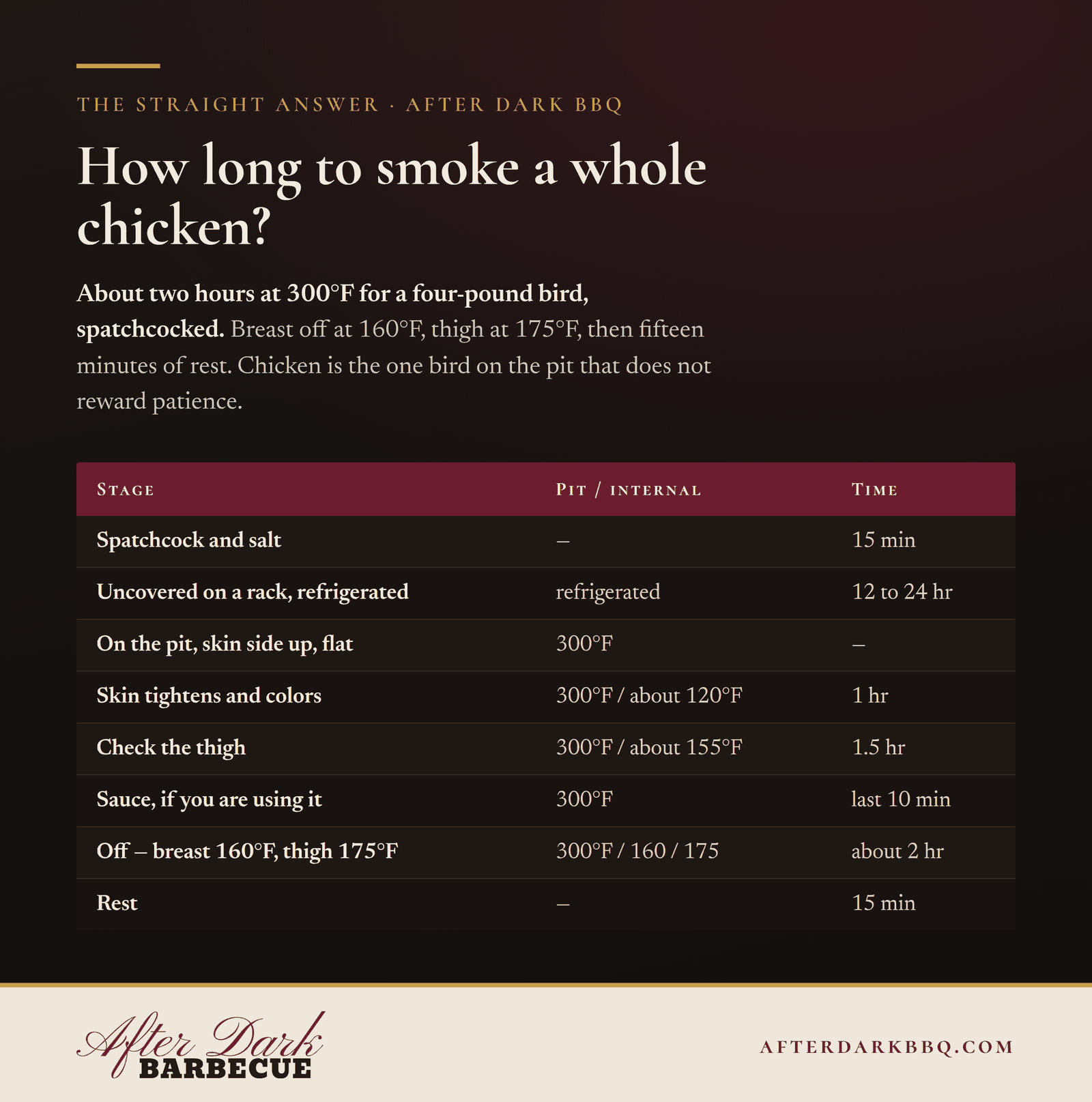
How long to smoke a whole chicken: a four-pound spatchcocked bird takes about two hours at 300°F, with the breast coming off at 160°F and the thigh at 175°F. Left whole and upright at 275°F the same bird runs closer to three hours and finishes unevenly, which is the whole argument for spatchcocking it.
How long to smoke a whole chicken?
About two hours at 300°F for a four-pound bird, spatchcocked. Breast off at 160°F, thigh at 175°F, then fifteen minutes of rest. Chicken is the one bird on the pit that does not reward patience. Run it too low and you get an hour of extra smoke and skin you could chew like a wetsuit.
Lay her out flat, give her real heat, and do not keep her waiting.
| Stage | Pit / internal | Time |
|---|---|---|
| Spatchcock and salt | — | 15 min |
| Uncovered on a rack, refrigerated | refrigerated | 12 to 24 hr |
| On the pit, skin side up, flat | 300°F | — |
| Skin tightens and colors | 300°F / about 120°F | 1 hr |
| Check the thigh | 300°F / about 155°F | 1.5 hr |
| Sauce, if you are using it | 300°F | last 10 min |
| Off — breast 160°F, thigh 175°F | 300°F / 160 / 175 | about 2 hr |
| Rest | — | 15 min |
What temp do you smoke a whole chicken at?
300°F. Higher than most things on this site, and deliberately. Chicken skin needs heat to render and tighten, and there is no collagen in a chicken worth waiting around for the way there is in a pork butt. The only thing low and slow buys you here is more smoke, and chicken takes on smoke fast enough that you do not need the extra hour.
Drop to 275 and you are in for closer to three hours and skin that never firms up. Push her to 350 and the skin is better still, but the smoke runs thin. 300 is the sweet spot, and it is not a close call.
Spatchcock, or leave it whole?
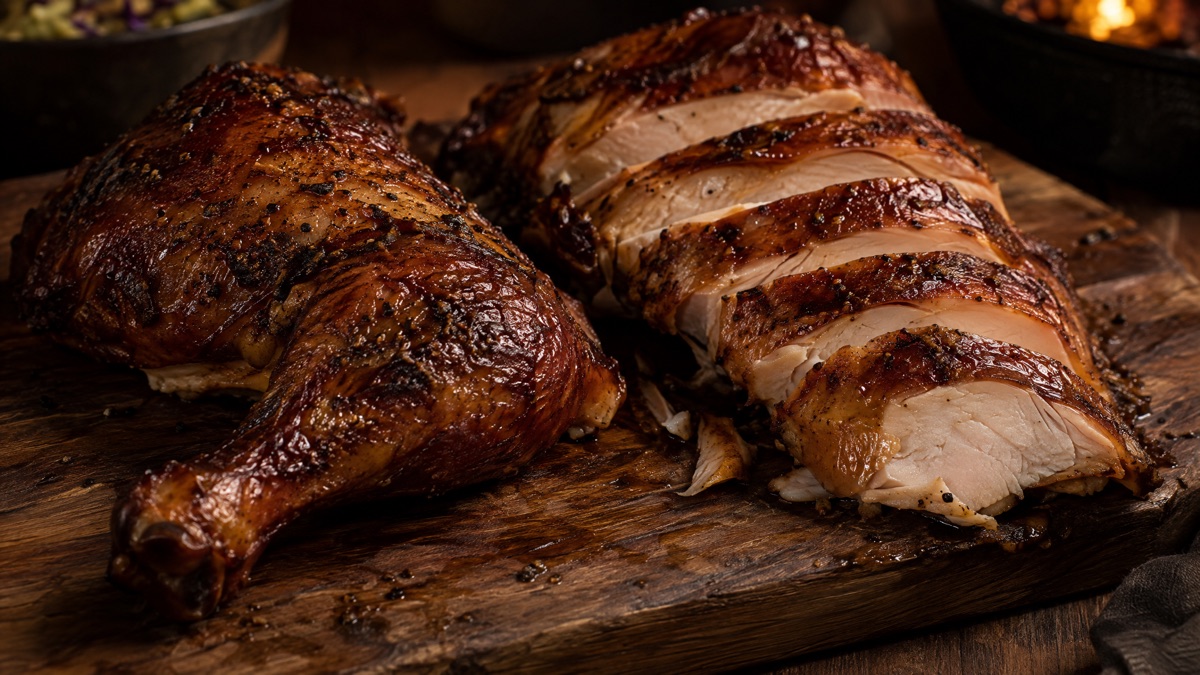
Spatchcock it. Cut the backbone out with shears, press the bird flat, and it cooks in one plane instead of three. A whole upright chicken puts the thighs on the outside and the breast up in the coolest air, so the breast is done and drying while the thighs are still short. Flat, everything sits in the same heat and finishes within about fifteen degrees of each other.
It also gets you there close to an hour sooner. The only reason to keep a bird whole is so she looks like a Sunday roast when she lands on the table, and you can carve her out of sight either way.
Why the Breast Comes Off at 160 and the Thigh Holds Out for 175
The United States Department of Agriculture puts the safe minimum internal temperature for poultry at 165°F. A breast pulled at 160 and rested carries on climbing — five degrees or so as the heat evens out — and passes 165 on the counter. That is the mechanism, and it only works if you actually rest it. If you are not going to rest it, take it to 165 on the pit.
The thigh plays harder to get. It is dark meat with connective tissue running all through it, and at 165 it is safe but still a little firm. Take the thighs all the way to 175 and they finally go tender, and the fat keeps them from drying out on the way there.
How do you get the skin crisp?
Salt it and leave it uncovered in the refrigerator overnight. Twelve hours is enough, twenty-four is better. The air pulls moisture out of the skin, and dry skin crisps while wet skin steams. Nothing you do on the pit will make up for skipping this.
Leave her uncovered all night. The refrigerator does the seducing for you.
If the skin is still limp at the two hour mark, open the vents and give her 350°F for ten hard minutes. That is a rescue, not a plan. The full confession is in Letters to Dutch.
How long to smoke a whole chicken per pound?
Roughly thirty minutes a pound at 300°F, spatchcocked, which puts a four pound bird at two hours and a five pound bird at about two and a half. Treat that as a planning figure and not a timer — birds vary, pits vary, and the thermometer is the only thing that actually knows. Start checking the thigh at the ninety minute mark.
How many people does a whole chicken feed?
A four pound bird feeds four adults at a normal plate and three if chicken is the only thing going. A pound of whole chicken as purchased comes back as about 0.44 pounds of cooked meat once the bones and the fat are out of it, so figure about eight tenths of a pound of raw bird per adult. The meat calculator works it out for a crowd from the USDA yields.
Do you brine a chicken before smoking it?
Dry brine it. Salt the bird all over, about half a teaspoon of kosher salt per pound, and that overnight rest in the refrigerator does the brining and the skin-drying in the same twelve hours. A wet brine does the opposite of what you want here: it puts water into skin you are about to try to crisp.
Wet brining earns its keep on a turkey, which is lean enough to need the protection and big enough that the skin has hours of heat to firm back up. A four pound chicken at 300 degrees does not get those long hours. If you have already wet-brined one, pat it bone dry and give it an hour uncovered in front of a fan before it goes on.
What wood goes with chicken?
Something mild. Chicken takes smoke faster than any other bird on the pit and it is easy to overshoot. Fruit woods, apple and cherry, are the safe answer, and cherry does the extra job of pulling the skin toward a deep mahogany. Pecan sits a step heavier and still works.
Hickory and mesquite are a lot to take for a small bird. If that is all you have, go easy, and pull a chunk off the fire once the skin has blushed, about an hour in.
Don’t Stop Now
Sources
The 165°F safe minimum internal temperature for all poultry — breasts, whole bird, legs, thighs and wings alike — is the figure set by the United States Department of Agriculture Food Safety and Inspection Service in its Safe Minimum Internal Temperature Chart, last updated April 2025. Read September 2026. The 160°F pull above relies on carryover during the rest to reach it, which is why the rest is not optional.