Just the hard numbers · Times, temperatures and charts · No foreplay
After Dark BBQtechnique · the hard numbers
How long to smoke ribs: at 250°F baby backs take 4 to 5 hours and St. Louis or spare ribs 5 to 6. Drop to 225°F and add an hour; push to 275°F and take one off.
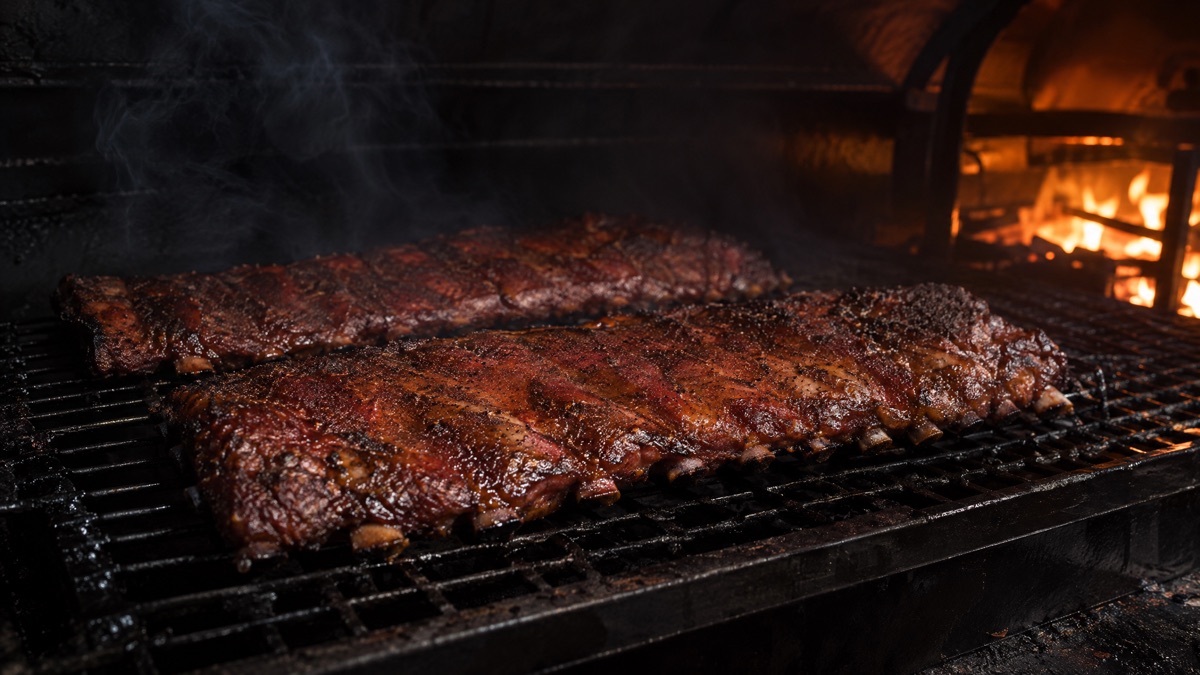
How long to smoke ribs?
At 250°F, baby backs take 4 to 5 hours and St. Louis or spare ribs take 5 to 6. Drop the pit to 225°F and add about an hour. Push it to 275°F and take about an hour off.
Every hour of that is foreplay, and the rack knows when you skip it.
Ribs are thin and full of connective tissue, so they finish on feel long before a clock says they should. Let the table plan the evening. Let your hands decide when she comes off.
| Cut | At 225°F | At 250°F | At 275°F |
|---|---|---|---|
| Baby back ribs | 5–6 hr | 4–5 hr | 3½–4 hr |
| St. Louis cut | 6–7 hr | 5–6 hr | 4–5 hr |
| Spare ribs | 6–7 hr | 5–6 hr | 4–5 hr |
| Beef plate ribs | 9–10 hr | 8–9 hr | 6–7 hr |
Forget the Time. Use Your Fingers.
The bend test. Lift the rack a third of the way down with tongs. A finished rack droops toward breaking and the surface cracks across the top. A rack that stays stiff isn’t finished with you yet. Give it more time.
The toothpick test. Slide a probe between the bones. It should go in with no resistance at all, like warm butter. Stay off the bone itself. It runs hot, and it will swear the rack is done when it is not.
By temperature, pork ribs finish between 198 and 203°F. Baby backs land at the low end, spares and St. Louis cuts at the top because they carry more fat to render.
Everybody Wants to Try 3-2-1
Three hours of smoke, two hours wrapped, one hour back on the heat. It was written for full spare ribs at 225°F and it works there.
On baby backs it lasts too long — they come out falling apart, which is overcooked, not done. Run 2-2-1 instead, and check at the five hour mark.
The wrapped hours are where bark goes soft. Butcher paper holds the crust better than foil, and either way the last stretch should be unwrapped so the surface dries back down.
How Long to Smoke Ribs Depends on How You Handle Them
Opening the lid. Every peek costs about ten minutes. Keep it closed and keep your hands to yourself for the first three hours.
Cold weather and wind. A pit in an open yard in November runs longer than the same pit in July, even holding the same grate temperature.
Size doesn’t matter. Thickness does. Two racks of the same weight can finish forty minutes apart if one is thicker through the middle.
Membrane on or off. Strip the silverskin off the bone side. It never gives in, and it keeps smoke and seasoning from getting to the meat.
Before you get to the counter, the meat calculator works out how many pounds of ribs to buy per guest, using the USDA yields for bone and trim.
How long to smoke ribs at 225?
Five to six hours for baby backs and six to seven for St. Louis or spares. Dropping from 250 to 225 buys you about an hour, and what you get for it is a little more smoke and a wider margin for error — ribs at 225 are harder to overshoot while you are doing something else.
Slower, longer, and worth every minute you spend standing there with it.
What you give up is bark. Lower heat renders fat more slowly and the surface stays wetter for longer, so the crust sets late and sets soft. If you are running 225 and want bark, leave them unwrapped the whole way and accept the extra hour.
How long to smoke ribs at 275?
Three and a half to four hours for baby backs, four to five for spares. This is the weeknight setting. The fat renders fast, the bark sets early and hard, and the whole thing is over before the afternoon is.
The risk at 275 is that the window between done and dry is narrower. Start the bend test at the three hour mark rather than waiting for a clock to tell you, and do not walk away for an hour at the end.
Do you have to wrap ribs?
No, and plenty of good ribs never see foil. Wrapping does two things: it pushes you through the stall faster and it steams the meat soft. Both are useful and both cost you crust. If you wrap, do it once the bark has set and the color is where you want it, because whatever the surface looks like going into the wrap is roughly what it looks like coming out, only softer.
Some like it wrapped up tight. Some like it bare all night. Both get there.
Unwrapped ribs take about an hour longer and come off with more chew and more bark. That is a preference, not a mistake, and anyone who tells you otherwise is describing the ribs they like.
How many ribs per person?
Half a rack an adult alongside sides, a full rack if ribs are the whole meal. In weight, about a pound of raw spareribs per adult — ribs lose more to bone than anything else on the pit, and a pound as purchased comes back as roughly four tenths of a pound of meat. The meat calculator works it out for a crowd from the USDA yields.
Don’t Stop Now
Sources
The 0.39 buying yield for pork spareribs is from the USDA Food Buying Guide for Child Nutrition Programs, Section 1, Meats and Meat Alternates yield table. The 145°F safe minimum for fresh pork and the three minute rest are from USDA Food Safety and Inspection Service, Fresh Pork From Farm to Table, last updated December 2024. Ribs are well past that number long before they are tender, so the temperatures on this page are about collagen rather than safety. Times by cut and pit temperature are Dutch’s own, measured at the grate. Read September 2026.