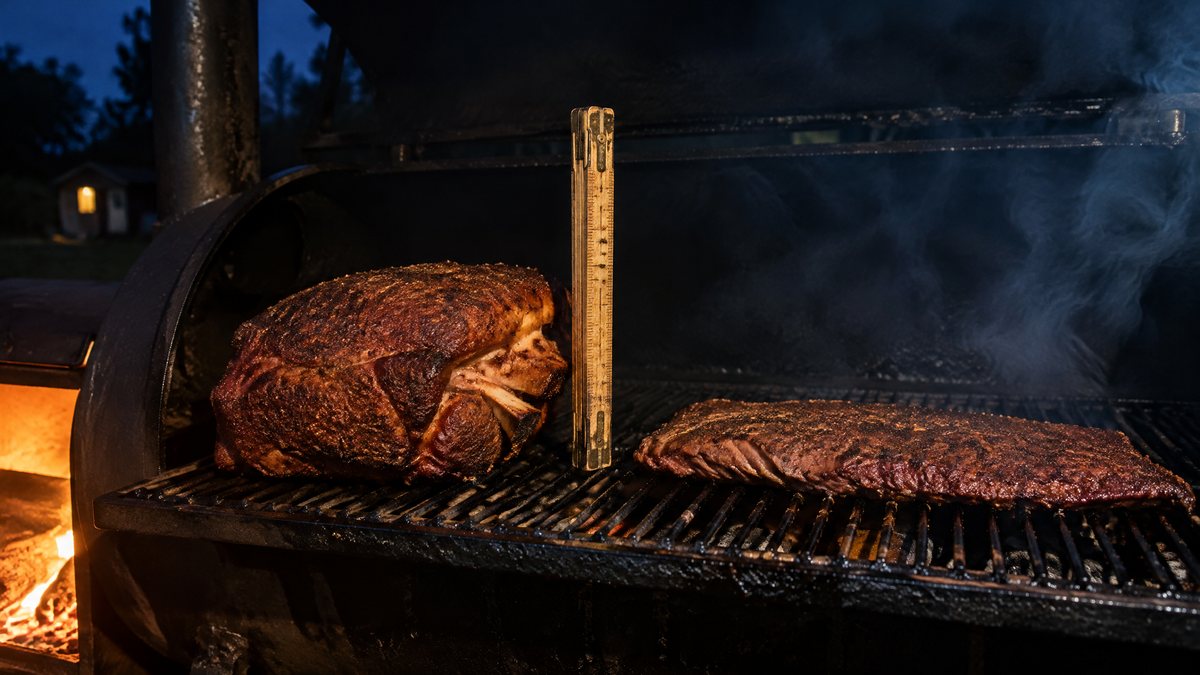
Size Doesn’t Matter. Thickness Does.
How long would it take to smoke …
Two thousand things to put on the pit, and every temperature and time on this page is real.
Not on the list? Give me a weight and a thickness.
Thickness is the distance from the outside to the deepest point, doubled. It is the only number that matters. Weight is just there for show.
Why Thickness Beats Size Every Time
Nearly every barbecue site on the internet gives you times in minutes per pound. It is a shape rule wearing a mass rule’s clothes, and once those come off, it is wrong almost everywhere.
Heat comes in from the outside and works its way deep. What sets the time is how far the center sits from the surface — the thickness — and that distance is squared. Double the thickness and you quadruple the time. Add weight without adding thickness and almost nothing happens.
Which is why a manta ray, three thousand pounds and ten inches through, comes off in thirty-seven hours, while minutes-per-pound insists on four months. And why a blue whale finishes ahead of an Argentinosaurus that weighs half as much: the sauropod is thicker through the body, and thickness is the only thing the heat can feel.
It is also why your sixteen-pound packer and your twelve-pound packer come off within an hour of each other, no matter how big the bag talks.
The real brisket numbers, laid bare with nothing absurd in them →
Everything here is treated as solid muscle — no cavity, no bone — which is why this page’s turkey runs longer than a real one. A real turkey is mostly a hole. And this works out when the heat arrives, not how long collagen takes to give up, so thin tough cuts like spare ribs take longer in a real pit than the arithmetic alone says. Both of those are on the technique pages, where the numbers are serious and the nights run long.