Just the hard numbers · Times, temperatures and charts · No foreplay
After Dark BBQTechnique · Ham
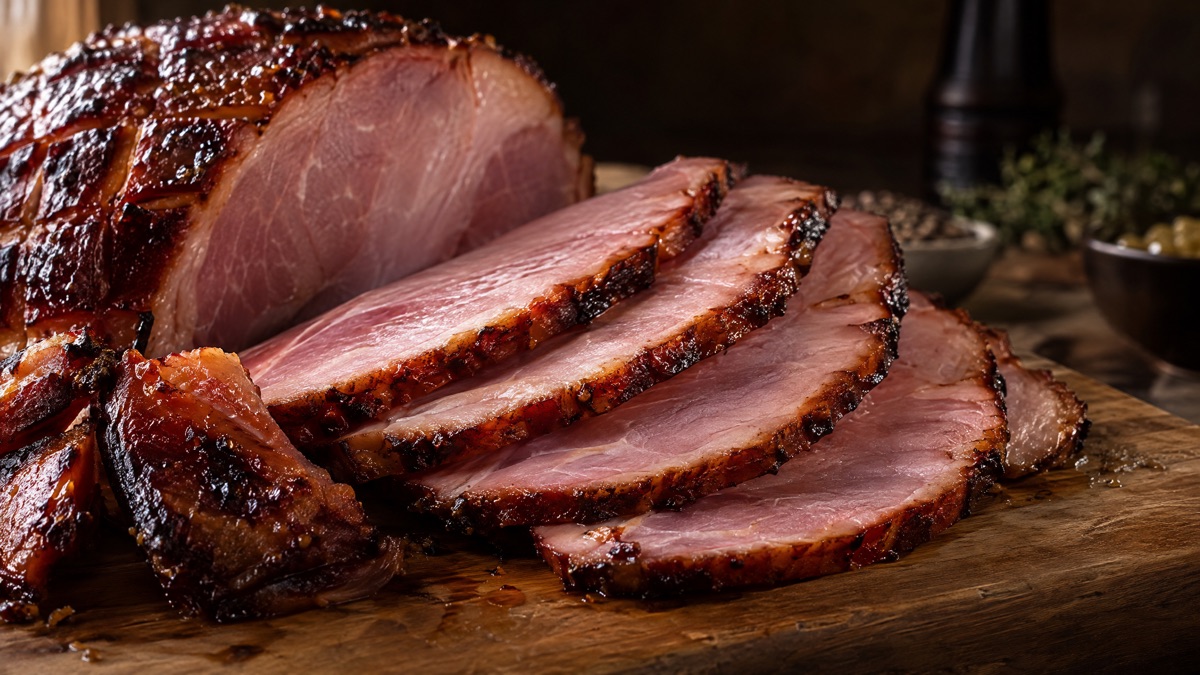
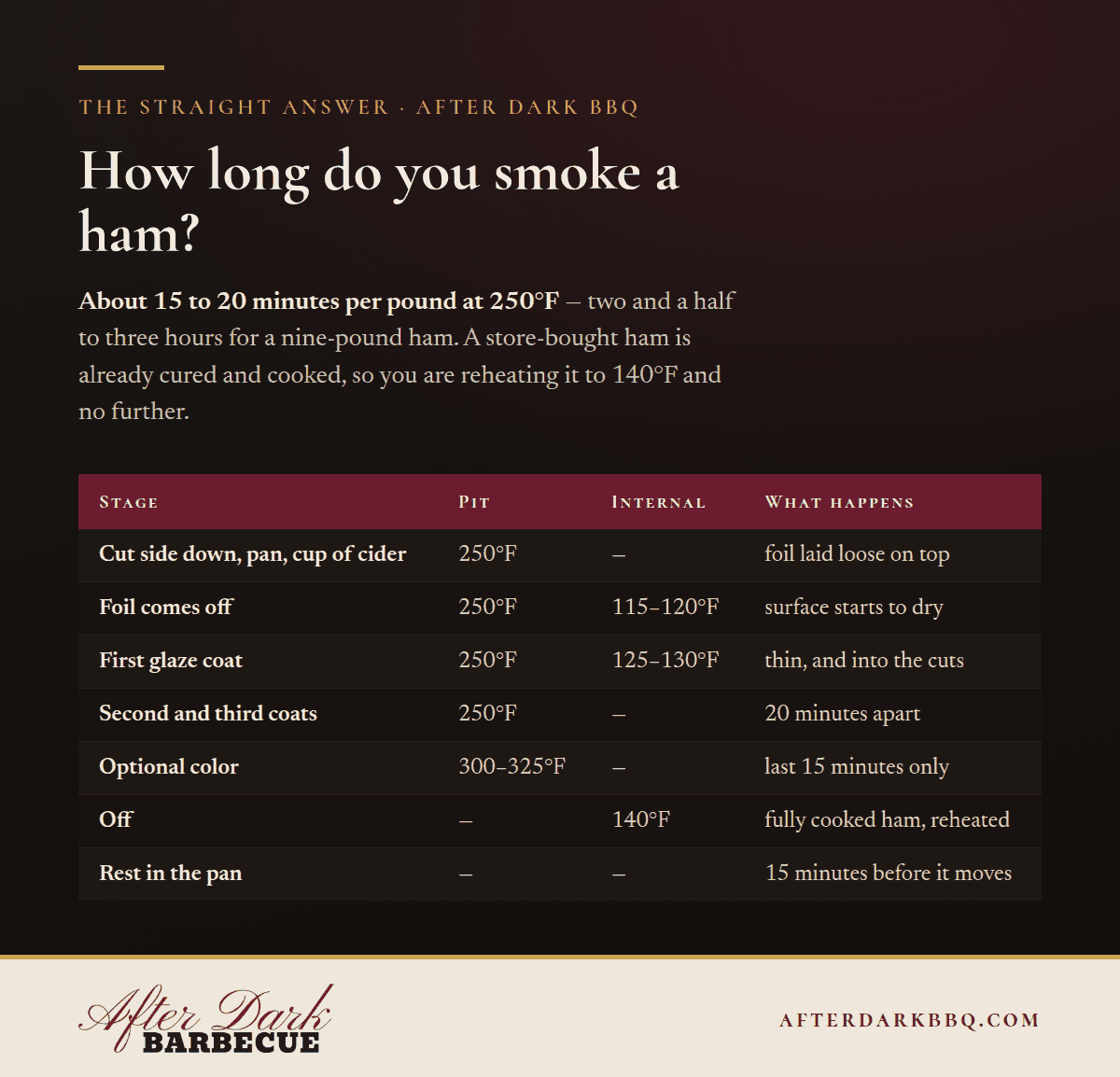
How long do you smoke a ham: about 15 to 20 minutes per pound at 250°F — two and a half to three hours for a nine-pound ham. A store-bought ham is already cured, smoked and fully cooked, so you are reheating it to 140°F internal and no further.
How long do you smoke a ham?
About 15 to 20 minutes per pound at 250°F, to 140°F internal. That is two and a half to three hours for a nine-pound ham. It goes cut side down in a foil pan with a cup of cider or stock and foil laid loose on top; the foil comes off at about 115 to 120°F, and the glaze goes on in the last 30 to 45 minutes.
Slow and gentle, with the glaze going on in layers. A ham likes to be teased.
| Stage | Pit | Internal | What happens |
|---|---|---|---|
| Cut side down, pan, cup of cider | 250°F | — | foil laid loose on top |
| Foil comes off | 250°F | 115–120°F | surface starts to dry |
| First glaze coat | 250°F | 125–130°F | thin, and into the cuts |
| Second and third coats | 250°F | — | 20 minutes apart |
| Optional color | 300–325°F | — | last 15 minutes only |
| Off | — | 140°F | fully cooked ham, reheated |
| Rest in the pan | — | — | 15 minutes before it moves |
How long per pound, by weight and pit temperature?
Fifteen to twenty minutes a pound at 250°F is the working rule, and a bone-in half ham runs a little longer than a boneless one of the same weight.
Lower and slower gets you more smoke; run it hotter and you finish sooner. All three columns land at the same place, which is 140°F internal.
| Weight | At 225°F | At 250°F | At 275°F |
|---|---|---|---|
| 6 lb | 2½–3 hr | 2–2½ hr | 1¾–2 hr |
| 8 lb | 3–3½ hr | 2½–3 hr | 2–2½ hr |
| 10 lb | 4–4½ hr | 3–3½ hr | 2½–3 hr |
| 12 lb | 4½–5 hr | 3½–4 hr | 3–3½ hr |
What internal temperature does a smoked ham come off at?
140°F. A supermarket ham is already cured, smoked and fully cooked, and the USDA reheat figure for a fully cooked, USDA-inspected ham is 140°F.
Taking it further than that does not make it any safer, it just leaves it dry. The only ham that needs 145°F with a three minute rest is a fresh, uncured one, which is a different cook entirely.
When does the foil come off?
At about 115 to 120°F internal. Up to that point the pan and the loose foil are keeping the ham from drying out while it warms through.
The last stretch it lies uncovered, so the surface dries enough for the glaze to grab hold and for the smoke to color it. Strip it bare from the start and a ham ends up with a leathery outside and a cold middle.
When does the glaze go on, and how many coats?
The first coat at 125 to 130°F, then two more, twenty minutes apart. Three thin coats, not one thick one.
Thin and slow, one coat at a time. Nobody likes it all at once.
Let each coat set and get tacky before the next one goes on, and you end up with a lacquer instead of a puddle. Brush it down into the cuts on a spiral-sliced ham, or the slices in the middle taste like nothing.
How do you get it darker without burning it?
Run the pit up to 300 to 325°F for the last fifteen minutes. That is enough to take the glaze from amber to bronze.
Do not reach for a torch, no matter how impatient you get. The sugar in a ham glaze goes from bronze to bitter in about four seconds, and there is no recovering it.
Which ham should you buy?
A shank or butt portion that has not been spiral cut. It holds moisture far better and costs less per pound.
Do the slicing yourself, with your own hands, after the rest. A spiral-cut ham is already opened up on every face, which is exactly where the moisture leaves from over three hours on a pit.
What do you do with what is in the bottom of the pan?
Skim the fat, pour the rest into a jug and put it on the table with a spoon in it.
It is cider, rendered ham fat and every drop of glaze that ran off, and it is the best surprise on the table all night.
Don’t Stop Now
Sources
The 140°F reheat figure for a fully cooked, USDA-inspected ham, and the 145°F with a three minute rest for a fresh uncured ham, are from the USDA Food Safety and Inspection Service Safe Minimum Internal Temperature Chart.
The 250°F pit, the foil coming off at 120°F and the three thin glaze coats are After Dark BBQ’s own, measured on a backyard offset and written up in chapter eight.