Just the hard numbers · Times, temperatures and charts · No foreplay
After Dark BBQTechnique · Turkey
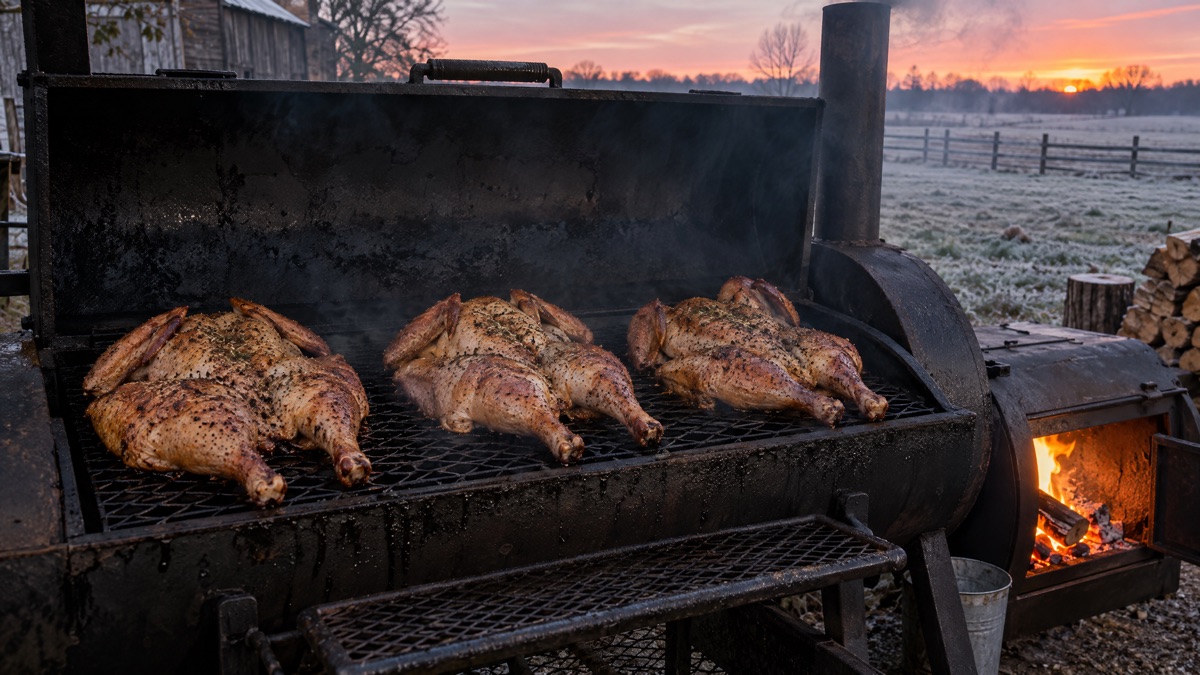
How long to smoke a turkey: about four hours at 250°F for a 12- to 14-pound bird that has been spatchcocked, which works out to 15 to 20 minutes per pound. Left whole, the same bird takes six or seven hours, and the breast is dry before the thigh is safe.
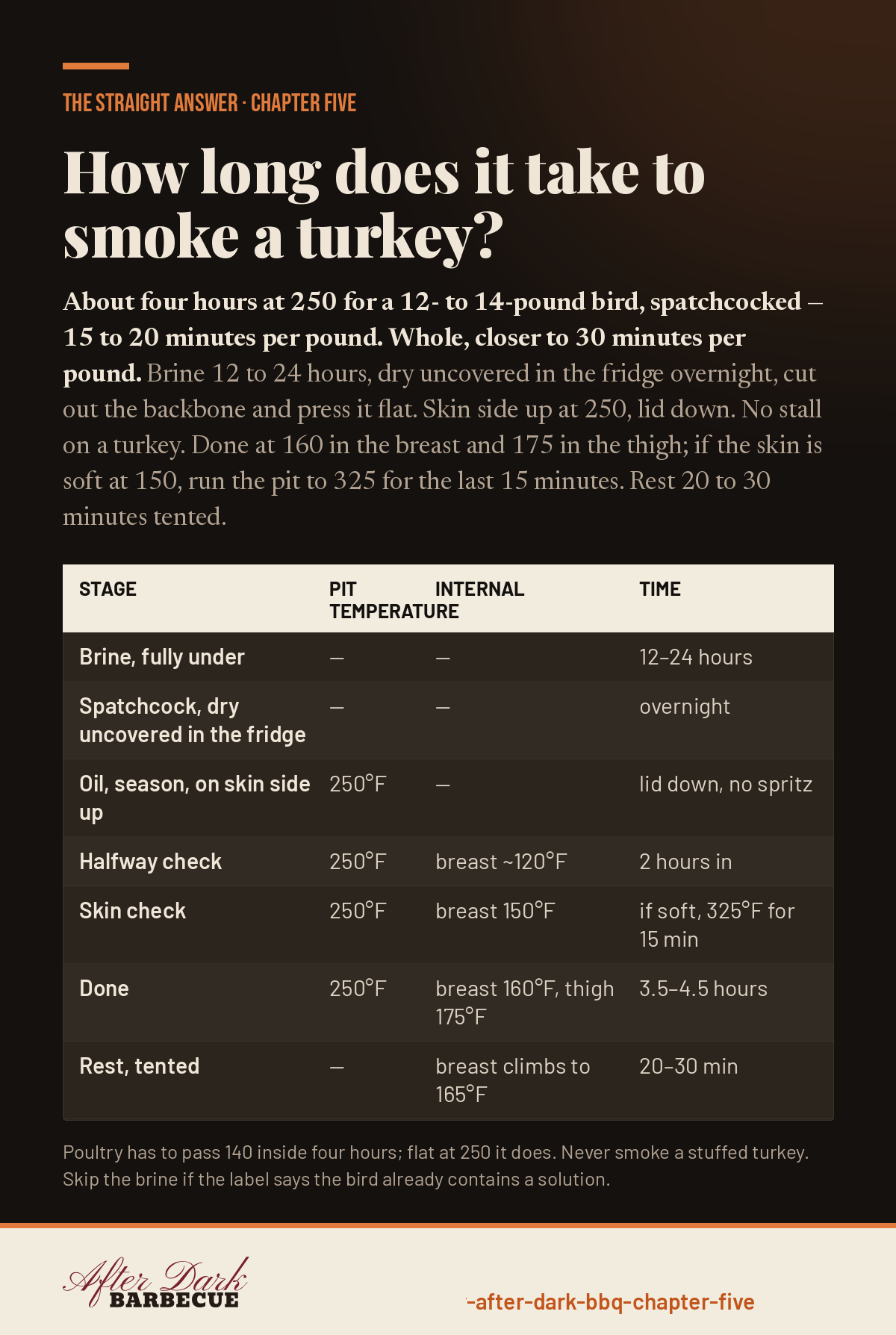
How long does it take to smoke a turkey?
About four hours at 250°F for a 12- to 14-pound turkey, spatchcocked — 15 to 20 minutes per pound. Breast off at 160°F, thigh at 175°F, then 20 to 30 minutes of rest. A turkey is lean. There is no fat cap to hide behind, no collagen to melt and no stall to wait out, so the clock runs straight through and the only real decision is when to take it off.
A turkey wants it hot enough to get her skin going and steady enough to take her all the way.
| Stage | Pit / internal | Time |
|---|---|---|
| Brine, fully under | refrigerated | 12 to 24 hr |
| Spatchcock, then dry uncovered in the fridge | refrigerated | overnight |
| Oil, season, on skin side up | 250°F | lid down, no spritz |
| Halfway check | 250°F / breast about 120°F | 2 hr in |
| Skin check | 250°F / breast 150°F | if soft, pit to 325°F for 15 min |
| Off — breast 160°F, thigh 175°F | 250°F / 160 / 175 | 3.5 to 4.5 hr |
| Rest, tented loosely | breast climbs to 165°F | 20 to 30 min |
What temp do you smoke a turkey at?
250°F. Low enough that the bird takes smoke and the thigh has time to get where it needs to go, high enough that the skin renders instead of sitting there steaming. A turkey wants a clean 250 and a small, bright fire — not a smolder.
The one time the pit goes higher is at the end, and only as a rescue. If the skin is still soft when the breast reads 150°F, crank the pit up to 325°F for the last 15 to 20 minutes. It works. It is also exactly what that long night in the refrigerator was supposed to spare you.
How long to smoke a turkey at 250?
Three and a half to four and a half hours for a 12- to 14-pound bird laid flat — call it four. That is 15 to 20 minutes per pound. A 13-pound turkey put on at six o’clock comes off around ten.
Left whole at the same 250°F, the same bird runs six to seven hours, because the thigh hides in the shadow of the breast and takes that much longer to come up to 175°F. By the time it finally gets there, the breast has been lying past 160 for an hour.
Should you spatchcock a turkey or leave it whole?
Spatchcock it. Cut the backbone out with shears and press the bird flat, and the breast and the thigh sit in the same heat at the same time instead of the thigh hiding behind the ribs. Flat, they finish within minutes of each other. Whole, they never do.
Spread flat, everything finishes together. That is the whole idea.
Flat also cuts the cook from seven hours to four, which on the day before Thanksgiving is the difference between one bird and six. The only argument for keeping her whole is wanting her carried to the table looking like a postcard, and that is a real reason — it is just not a cooking reason.
What internal temp for a smoked turkey?
Breast at 160°F, thigh at 175°F, and off the pit. The breast climbs to 165°F on its own while it rests, tented loosely in foil, which is where the United States Department of Agriculture’s safe minimum for poultry sits.
The thigh is different meat. It is dark, it holds on to its connective tissue, and at 165 it is safe but still tight. Taking it to 175 gives that tissue time to finally let go, which is why the thigh number is higher than the safety number and the breast number is lower.
Probe the thickest part of the breast and a thigh separately, away from the bone. The bone runs hot and will tell you she is finished before she is.
How do you get crispy skin on a smoked turkey?
Dry it, uncovered, in the refrigerator for 12 to 24 hours before it goes anywhere near the pit. Skin crisps when its water is gone and its fat has rendered. At 250°F the fat renders fine — what does not happen is the drying, because a wet bird in a humid smoker spends its first two hours steaming its own skin.
Dry her out overnight and the skin does the rest of the work.
A bird dried overnight goes on tight and translucent and comes off bronzed and begging to be bitten. A bird that went on wet comes off pale and rubbery no matter how good the fire was.
Do you brine a turkey before smoking it?
Yes, unless the bird has already been brined for you — and read the label before you decide, because most of them have. A turkey sold as “enhanced” or “self-basting” or “contains up to 8 percent solution” came out of the plant already in salt water. Brining it again makes ham.
Wet brine, if the bird is not enhanced: one cup of kosher salt and a half cup of brown sugar per gallon of cold water, bird fully under, 12 to 24 hours in the refrigerator or in a cooler with ice.
Dry brine, if you have no cooler to spare: a half teaspoon of kosher salt per pound, rubbed all over and up under the skin, then left bare on a rack in the refrigerator. The dry brine has a second job — it is also the overnight drying the skin needs, which is why it is the one to use if you are only doing one of them.
How long to smoke a turkey per pound?
Fifteen to twenty minutes a pound at 250°F, spatchcocked. Left whole, closer to thirty minutes a pound.
Use it to pick when to start, not when you finish. A turkey does not stall, so the clock is unusually honest here — but it is still a clock, and the probe gets the final say. Put the bird on early enough that the rest is a pleasure, not a panic.
How long can a turkey sit in the smoker before it is unsafe?
Poultry needs to pass 140°F inside within four hours of going on. Laid flat at 250°F it does that easily — the breast is already around 120°F at the two-hour mark and through 140 well before the window closes.
The way cooks get into trouble is running the pit too low for the size of the bird, usually at 225°F with a whole 20-pounder, where the inside can loiter in the range where bacteria multiply for longer than it should. Flat at 250 that problem does not come up.
How many people does a smoked turkey feed?
A 12- to 14-pound turkey feeds eight to ten adults as the only meat on the table, and more like twelve if there is a ham or a brisket beside it. Bone and carcass are roughly half the weight of a whole bird, so a 14-pound turkey is about seven pounds of meat.
If the turkey is the whole meal and you want sandwiches the morning after, take home two smaller birds instead of one enormous one. Two 12-pound turkeys cook in the same four hours as one, and both of them are better than a 22-pound bird that spends seven hours drying out from the outside in.
What wood goes with turkey?
Something mild, and not much of it. Turkey takes smoke quickly and there is no fat to soften it. Fruit wood — apple or cherry — or a little oak is plenty.
Hickory and mesquite are too rough for a bird this lean. Small splits, small fire, thin blue smoke: if the smoke rolling out of the stack is white and thick, the turkey will taste like it.
Don’t Stop Now
Sources
The 165°F safe minimum internal temperature for all poultry — whole birds, breasts, legs, thighs and wings alike — is the figure set by the United States Department of Agriculture’s Food Safety and Inspection Service, and it is the number the breast reaches while it rests after coming off at 160°F. The same agency sets the two-hour limit for food held between 40°F and 140°F, which is where the four-hour window in the table above comes from.
Labeling terms are the agency’s too: a bird described as “enhanced,” “self-basting” or carrying a “contains up to 8 percent solution” statement has been injected with a salt solution at the plant, which is why brining it a second time oversalts it.
Everything else on this page — the 250°F pit, the 15 to 20 minutes a pound, the 160 and 175 pull, the overnight drying — is the method as it is cooked in chapter five of the story, on a backyard offset, six birds at a time.