Just the hard numbers · Times, temperatures and charts · No foreplay
After Dark BBQtechnique · the hard numbers
Pork butt internal temp: 203°F is the number for pulled pork. The real window is 195 to 207°F, and probe tender beats any reading on the dial every time.
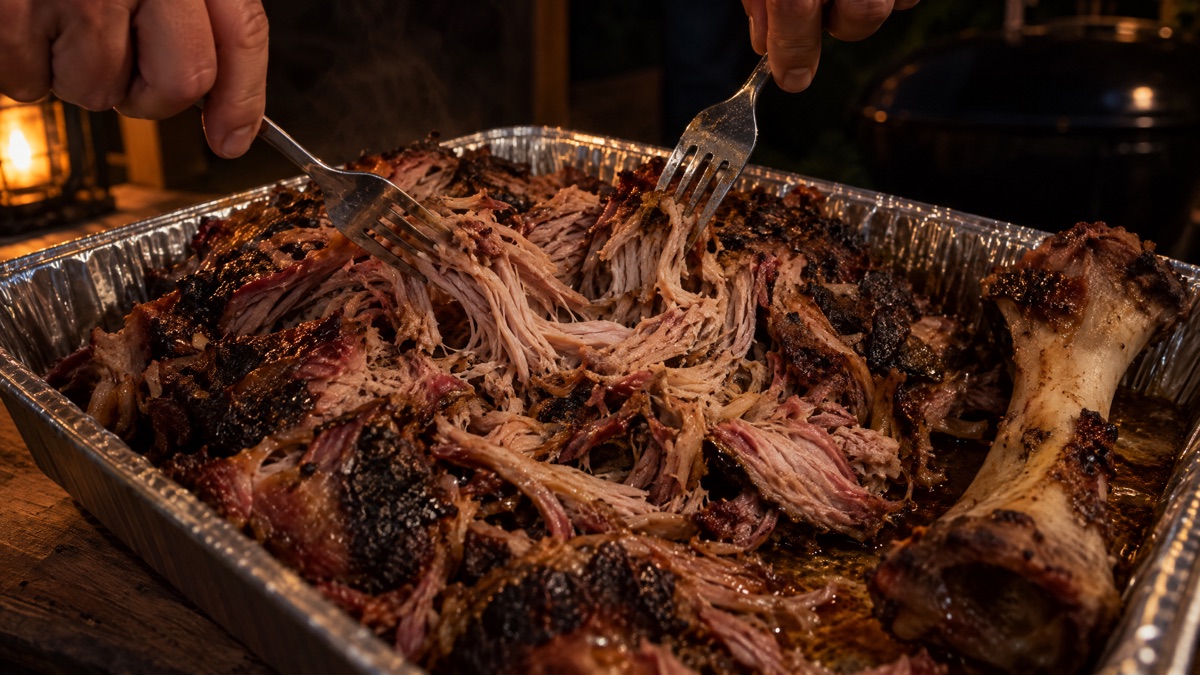
Pork butt internal temp: what temp do you pull it?
203°F for pulled pork. The real window is 195 to 207°F, and probe tender beats any number on the dial.
When the probe slides in like it was invited, that is your number.
Collagen turns to gelatin somewhere around 195°F and keeps going. That is why a butt pulled at 195 slices cleanly and one taken to 203 falls into strands. Both are done. They just satisfy different appetites.
| You want | Pull at | What you get |
|---|---|---|
| Pulled pork | 203°F | Strands, blade bone slides out clean |
| Sliced pork | 195°F | Holds together on the knife |
| Chopped | 200–203°F | Between the two |
| Too far | 210°F+ | Mushy, and the fat has run out of it |
Probe Tender Is the Only Test That Counts
Numbers vary because every butt has a different amount of connective tissue in it. Slide the probe into the thickest part, away from the bone. There should be no resistance at all — the phrase people use is like warm butter, and it is accurate.
If it fights you at 203, it is not done with you. Give it another twenty minutes and go back in. The blade bone is the other tell: when it wiggles free with a twist, the shoulder is ready.
Let It Rest, and Hold It as Long as You Need To
An hour of rest is the minimum. Loosely covered, lying on the counter, is enough for that.
For longer, vent it until the middle reads about 170°F, wrap it, and hold it at 150 to 160°F in an oven on its lowest setting. It will sit there for hours and improve. A cooler packed with towels holds it above 140°F for four to five hours.
The one thing not to do is let it go cold below 140°F and then try to warm it back up.
Get Your Hands on It
Forks rough it up into threads and squeeze the juice right out of it. Gloved hands break it along the grain and leave the texture intact. Pull out the fat seams and the unrendered gristle as you go, and put the drippings back in at the end rather than sauce.
Is 195 enough for pulled pork?
Sometimes, and it depends entirely on how it got there. A butt that crept from 185 to 195 over two hours has had time for the collagen to let go and can be perfect. One that raced there in forty minutes has not, and it will shred stringy and tight. The thermometer measures temperature; it does not measure how long the meat has been hot.
This is why the probe beats the number. At 195 start checking, and if the probe still meets resistance leave it on. Most butts land somewhere between 200 and 205, and the ones that need 207 are not doing anything wrong.
Can you overcook a pork butt?
Harder than any other cut on the pit, but yes. Past about 210°F the muscle fibers give up entirely and the meat goes from pulled to mushy — it smears rather than shreds, and the texture never comes back. The fat is what protects you: a pork butt carries so much of it that it stays moist thirty degrees past where a brisket flat would be ruined.
It forgives a lot. It does not forgive a man who never knows when to stop.
The more common failure is not overcooking but holding on too long. A butt sitting in a warm cooler for six hours keeps cooking gently, and a butt pulled at 205 and held that long can arrive at the table well past where you wanted it.
Sliced Pork Butt Likes It Firmer
If you want slices rather than pulled pork, pull it at 185 to 190°F. At 203 there is not enough structure left to hold a slice together — it falls apart under the knife, which is exactly what you want for pulling and exactly what you do not want on a plate.
Sliced butt is worth knowing about because it is faster by an hour or more and it eats like a roast rather than barbecue. Different dish, same cut, lower number.
The USDA says 145°F. Why are we at 203?
Because they are answering a different question. The USDA safe minimum for fresh pork roasts is 145°F with a three minute rest, and that is where the meat stops being a food safety problem. It is a floor, not a target, and a pork butt crosses it in the first few hours of a twelve hour cook.
Everything after 145°F is texture. A pork shoulder is loaded with connective tissue, and connective tissue does not start letting go until the high 180s. At 145 a pork butt is perfectly safe and completely inedible — tough, rubbery, and nothing like barbecue. You keep the fire going for another six or seven hours for the collagen, not for the bacteria.
The same gap explains the rest. The USDA asks for three minutes because that is what carries a 145°F roast through to safety. An hour is what a pork butt needs for the juices to settle back into the meat, which is a texture problem again and not a safety one.
Where the 140 Line Gets Drawn
The number that matters once the pit is off is 140°F. That is the top of what the USDA calls the danger zone — the 40 to 140°F band where bacteria grow fastest, doubling in as little as twenty minutes. Below 140 the clock starts. Above it, nothing is growing.
That is why holding at 150 to 160°F works and why a slow drift down on the counter does not. Two hours out of the pit and out of a holding oven is the outside limit, and one hour if the day is above 90°F. If a butt has gone under 140°F and sat there, reheating it to 165°F is the fix, and the texture will not be what it was.
Don’t Stop Now
Sources
The 145°F minimum for fresh pork roasts and the three minute rest are from the USDA Food Safety and Inspection Service, Fresh Pork From Farm to Table, last updated December 2024, and the Safe Minimum Internal Temperature Chart, last updated April 2025. The 40 to 140°F range, the twenty minute doubling time, the two hour limit and the 165°F reheat figure are from the FSIS Danger Zone (40°F to 140°F) fact sheet, last updated June 2023. Pull temperatures and probe technique are Dutch’s own. Read September 2026.