Just the hard numbers · Times, temperatures and charts · No foreplay
After Dark BBQtechnique · the hard numbers
When to wrap a brisket: Wrap when the bark is set, usually 150 to 170°F internal and six to eight hours in. Color and feel decide it, not the clock.
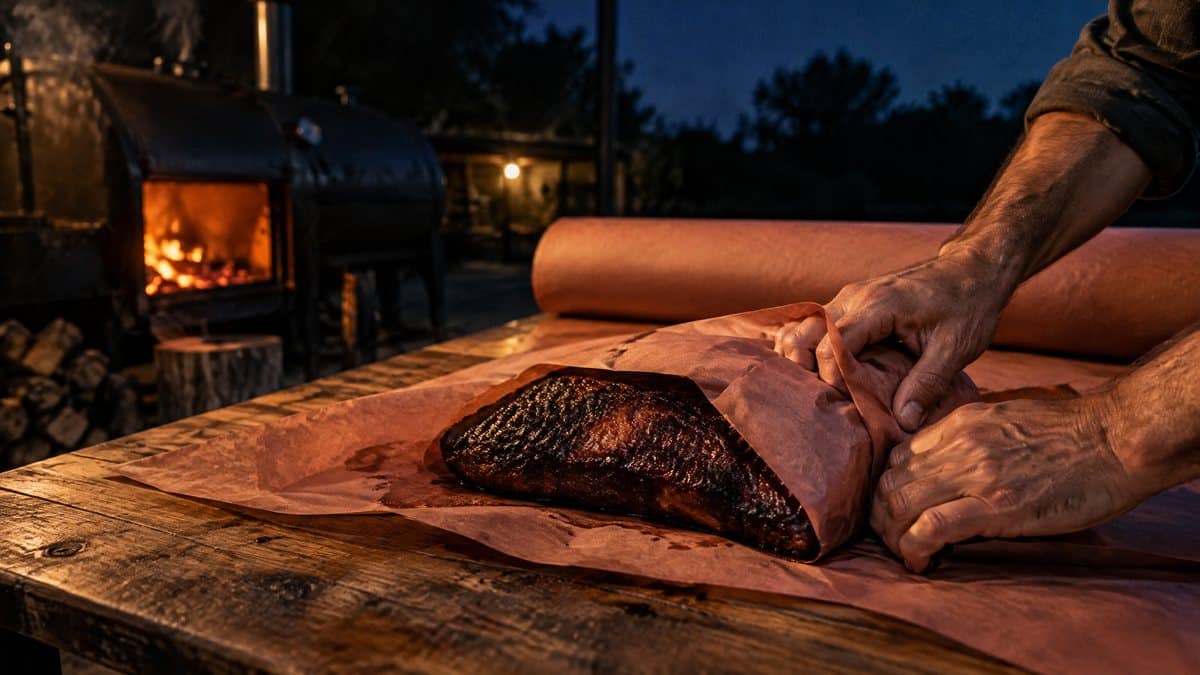
When to wrap a brisket
Wrap when the bark is set, which is usually between 150 and 170°F internal and about six to eight hours in. Color and feel decide it, not the clock.
The stall is what sends people looking for answers in the dark, but the stall is not the signal. Bark is. Wrap before the crust has set and you trap it soft; wrap after and you keep it.
| Signal | What you are looking for |
|---|---|
| Color | Deep mahogany, even across the top, no wet patches |
| Feel | Does not dent when you press it with a thumb |
| Temperature | Usually 150–170°F, but it is a symptom, not the test |
| Clock | About 6–8 hr at 250°F on a 14 lb packer |
Paper, Foil, or Bare
Butcher paper is the default for brisket. It is porous, so it holds enough moisture to beat the stall while letting steam escape, and the bark survives. Figure it lasts an hour longer than foil.
Foil is airtight. It braises, which is the fastest way through the stall and the surest way to soften the crust you built. Use it when you are in a hurry and care less how it feels.
No wrap gives the best bark and the longest cook, and it puts the flat at risk of drying out. It is the purist route, and it wants a fire that behaves itself all night.
Whatever you use, open it for the last twenty to thirty minutes on the heat so the surface dries back down before the rest.
| Wrap | Time to finish | Bark |
|---|---|---|
| Butcher paper | About 1 hr longer than foil | Intact |
| Foil | Fastest | Soft |
| None | Longest | Best |
| Open the last 20–30 min | — | Recovers most of a softened crust |
What the Stall Really Is, and Why She Makes You Wait
Between about 150 and 170°F the internal temperature stops climbing. Moisture is evaporating off the surface as fast as the fire drives heat in, and the two cancel out. She can hold out for four hours.
Wrapping ends it by stopping the evaporation. Waiting it out ends it when the surface finally dries. Neither is wrong. One costs time, the other costs nothing but nerve.
After You Wrap Her Up
Back on the heat, a wrapped brisket climbs fast. Start probing at 195°F. It is done when a probe slides into the thickest part of the flat with no resistance, usually between 200 and 205°F.
Then let it lie there and rest. An hour minimum, two to four for most, and eight or more if you vent it to 170°F, wrap it and hold it at 150 to 160°F.
What temp do you wrap a brisket at?
150 to 170°F, and the temperature is the signal rather than the instruction. What you are really waiting for is the bark. Drag a finger across the surface: if the rub stays put and the crust does not dent under a thumb, it is set and it will survive the wrap. If the rub smears, it is not ready, whatever the probe says.
Wrap her too soon and you lose the crust. Wait for the bark, then tuck her in.
That range exists because it is where the stall lives, and the stall is what people are trying to escape when they reach for foil. On most briskets the bark and the stall arrive within an hour of each other, which is why the number is a useful shorthand. On a fatty packer running hot, the bark can set at 145; on a lean flat at 225, it might not be there at 175.
Can you wrap a brisket too early?
Yes, and it is the most common way to lose a brisket that was going well. Wrapping before the bark sets traps moisture against the surface and steams the crust you spent five hours building. You get a tender brisket with a soft, pale outside and no crunch anywhere on it.
Impatience costs a man more briskets than anything else on the pit.
The damage is not reversible on the pit. You can unwrap and run the last hour hot and naked to try to dry the surface back out, and it helps a little, but the deep crust is gone. If you are unsure, wait. A brisket wrapped an hour late is a brisket with better bark and a longer cook. A brisket wrapped an hour early is a different, worse brisket.
How long does a brisket take after wrapping?
Two to four hours in most cases, to carry it from the wrap point up to probe tender at 195 to 205°F. Foil is faster than paper because it seals; paper breathes and behaves more like no wrap at all, so budget nearer the top of that range.
The wrap is also where the clock becomes unreliable in the other direction. Once the evaporation stops, internal temperature climbs quickly and the last twenty degrees can go by in under an hour. Start probing again as soon as it passes 190 rather than setting a timer. The doneness window is here.
Don’t Stop Now
Sources
The 145°F safe minimum for whole beef cuts and the three minute rest are from the USDA Food Safety and Inspection Service Safe Minimum Internal Temperature Chart, last updated April 2025. A brisket is past that number before the wrap window opens, so everything on this page is a texture decision rather than a safety one. The 40 to 140°F danger zone and the two hour limit are from the FSIS Danger Zone (40°F to 140°F) fact sheet, last updated June 2023. Wrap temperatures and stall timings are Dutch’s own, measured at the grate. Read September 2026.