Chapter Two · Packer brisket at 235° · Twelve hours
Chapter Two
FORCED PROXIMITYSHE BROUGHT THE BEERALL NIGHT LONG
Heat Thin blue smoke
Chapter two of After Dark BBQ: a packer brisket eased in at 235° and twelve hours with the lid closed, for cooks with patience and a long night.
Twelve hours is not patience. Twelve hours is wanting something badly enough to wait for it.
An overnight smoked brisket can change the direction of a night. Henry has read a dozen overnight brisket recipe guides and watched videos insisting low and slow is simple, and he has convinced himself this is just another routine cook. A proper brisket after dark, especially one done Texas-style, does not just feed you. It keeps you up all night and makes you earn the finish.
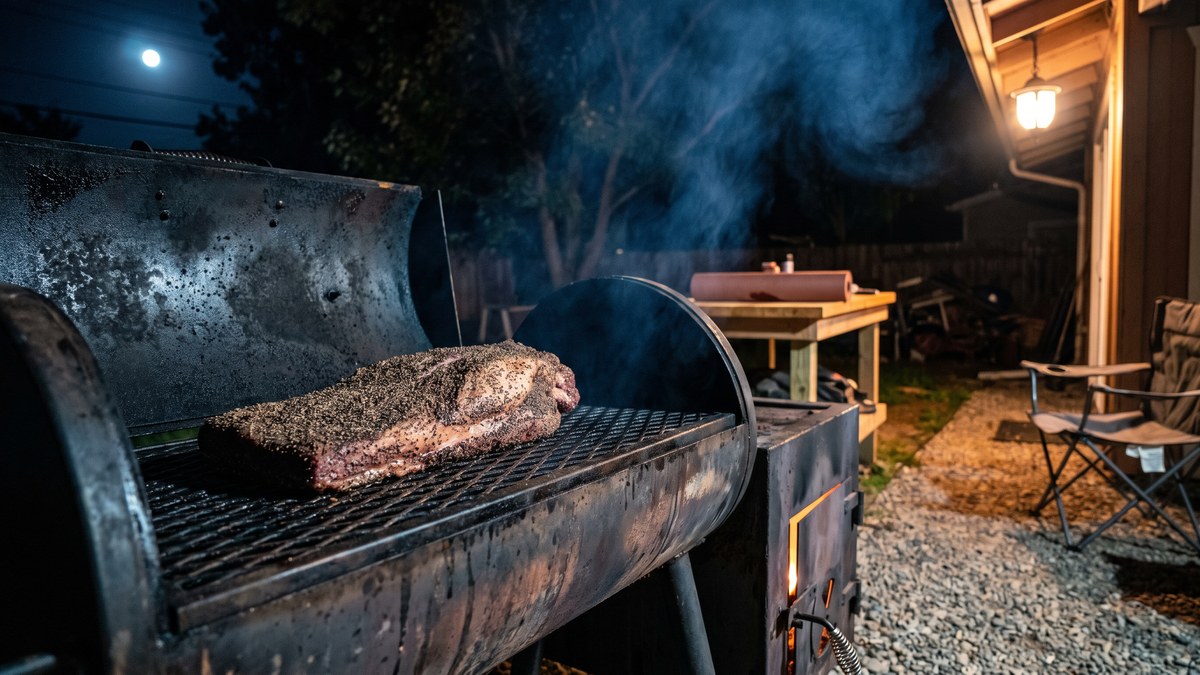
The yard is still. The workshop sits dark at the back of the lot with the alley behind it, and the only light comes from the porch and the soft orange glow inside the Ironbound. The brisket lies on the table — twelve pounds of chilled, uncommitted potential. Henry is working up the courage to trim it when he hears boots crunching on the gravel.
That is when she walks in.
The neighbor — mid-twenties, long Texas cattle line, which she mentioned once like it was weather, and the kind of calm confidence you usually only see in people who have survived both rodeos and family reunions — comes through his gate like she was invited. One hand holds a twelve-pack of Busch Light. The other carries two Meat Church rubs: Holy Cow and Holy Gospel.
She wears an American-flag tank top and cutoffs that do not look the least bit bothered by the breeze. The smoke shifts, Henry would swear, just to get a better angle.
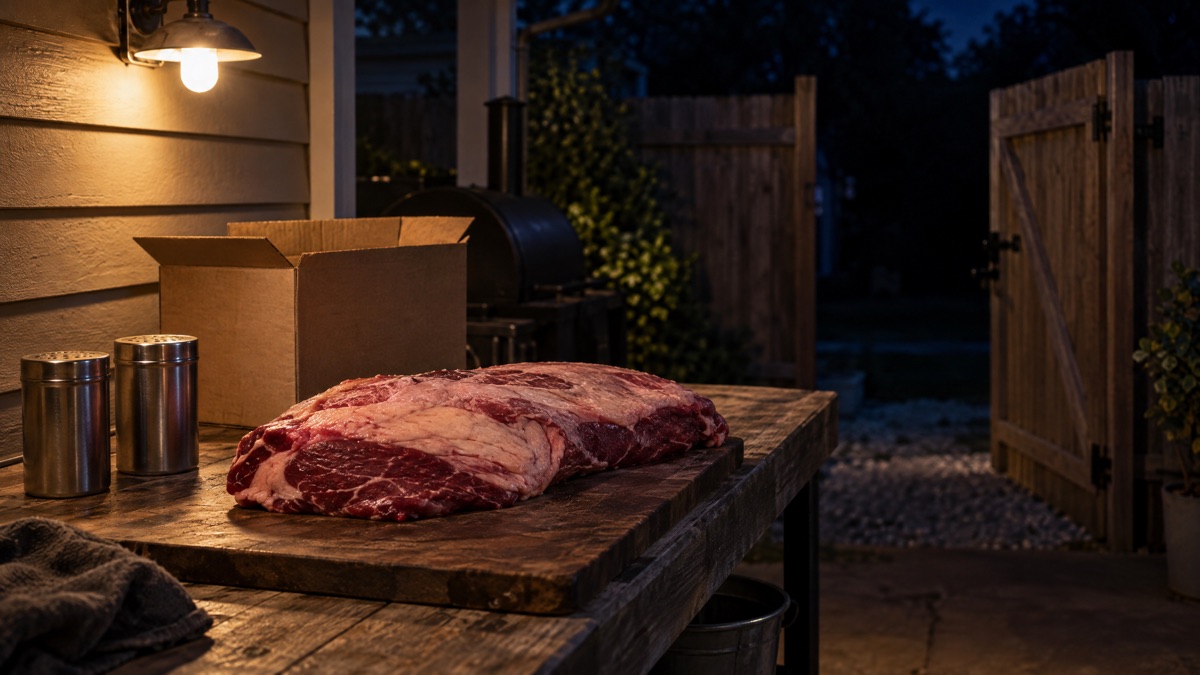
A whole packer is the first cook that will not let you fake it. Twelve pounds, a flat and a point that want different things, and a stall in the middle that looks like failure and is not. It was the first one Henry ever took through the night. He had help he did not ask for, and he kept the lid shut three hours anyway, which is the part I would have bet against.
You can read it for the neighbor. I read it for the stall. It parked at 163 for the better part of two hours and he never touched it. That is the whole cook.
— Dutch
She lifts the beer like an offering.
MaraEvenin’, darlin’. Saw your smoker goin’. Figured you might need company… or someone to keep you from losing that brisket before midnight.
Henry’s whole body snaps to attention. He nods a little too quickly, already reaching for his best folding chair — the one he wipes down for holidays and people he wants to impress.
HenryYou, uh… you want a seat?
He brushes it off and opens it slowly, like it matters, and she eases into it as if the chair had been waiting all summer just for her. She moved in two doors down in June. He has waved twice. She cracks a Busch Light, takes a slow sip, and nods toward the table.
MaraSo, what are we workin’ with tonight?
He is suddenly hyper-aware of how bare and stiff it looks in the porch light.
HenryBrisket. Full packer. I have run more racks of ribs through that pit than I could count, but this is the first whole brisket I have ever tried to take through the night. I’m, uh… committed.
Her smile brings the yard up ten degrees, quicker than any fire he has ever lit.
MaraNow that I understand. Grew up helpin’ my granddaddy in Llano. Summers full of smoke and men who thought they knew brisket until it proved ’em wrong. Texas-style brisket’s got a mind of its own. Treat it right, and it opens up for you. Rush it… and it locks up tighter than Sunday church.
She sets the rubs down, steps closer to the brisket, and hovers her hand just above it like she is reading heat only she can feel.
She lets the silence stretch long enough for his heartbeat to notice.
MaraThick through the point. Flat’s a little nervous, but it’ll come around. Cold, tense, full of promise. Warm it too fast and it’ll fight you. Take your time… and it’ll soften right up.
Somewhere between her voice and the smoke drifting around her, Henry understands that whatever happens tonight, he is not in charge of it.
She Made Him Trim It Slow
The brisket lies stiff on the table between them, cold and unshaped and entirely uncommitted, waiting to find out how serious he really is. She steps closer. The smoke curls around her like it has already made up its mind that she belongs here.
MaraFirst thing is makin’ it comfortable.
Her fingertip hovers just above the thick fat cap, not quite touching it.
MaraIf this is too thick, nobody’s gonna want to put it in their mouth. Too thin, and it’ll dry out before the night even gets interesting. You want just enough to keep things nice and moist for when the heat starts workin’ on it.
She slides the boning knife across the table to him. For a second he considers pretending he does not need any help with this, but his hands are already on the handle before his pride gets a vote.
MaraCold makes it easier. Meat yields slower. Let the knife do the work. You’re not punishin’ it. You’re shapin’ it for a long, slow night.
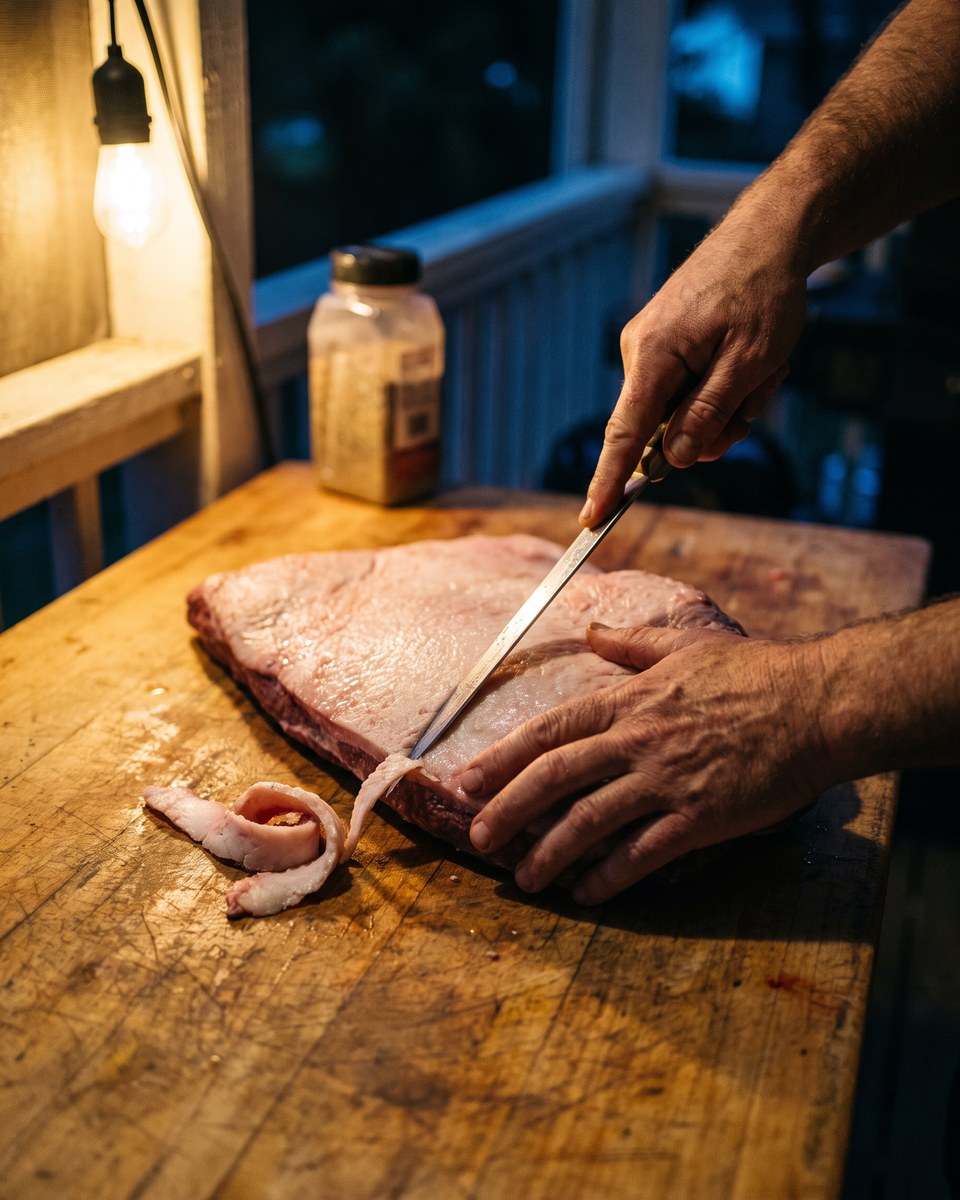
He works in shallow strokes, shaving the hard fat back, squaring the ragged edges, taking it down slow and not one bit further than it wants to go. Every so often he glances up to where she is watching him do it, just to see whether she will nod. When she finally does, it goes through him like passing an exam he never once studied for.
MaraThere you go. Now it looks ready to keep you up ’til dawn.
Technique Spotlight: Trimming the Fat Cap
For a whole smoked packer brisket, leave about 1/4 inch of fat on top and square the edges. Clean lines cook more evenly through a low and slow brisket session and keep the flat from going dry on you halfway through the night.
She Put Her Hands On It First
MaraMost folks season brisket like they’re trying to rush through a bad date. When you want somethin’ to stay all night… you take your time.
She picks up the Holy Gospel rub like it has been sitting on that shelf its whole life waiting for her hands specifically.
MaraMost folks season brisket like they’re trying to rush through a bad date. But when you want somethin’ to stay all night… you take your time.
She tells him to slick the brisket with a thin coat of oil.
MaraJust enough so it clings. Good flavor shouldn’t slide off at the first sign of heat.
He pours a little oil into his palm, rubs his hands together to warm it through, and works it over the meat — front, back, all the way to the edges and then back again — until every inch of it is slick and shining and ready to hold on to anything he gives it next. Her eyes follow his hands the entire time. His try very hard not to notice that hers are following.
She hands him the shaker.
MaraSalt first. Salt does the introducin’. It opens everything up so the rest can get in deep.
He shakes the kosher salt out slow, slower than the job needs, watching every grain fall and settle onto that trimmed and waiting surface. Nobody has ever regretted going slow at the start of a very long night.
MaraGood. Now pepper. That’s your pressure. Too much and you’re just fightin’ it the whole time. Just enough, and you’ll remember every bite later.
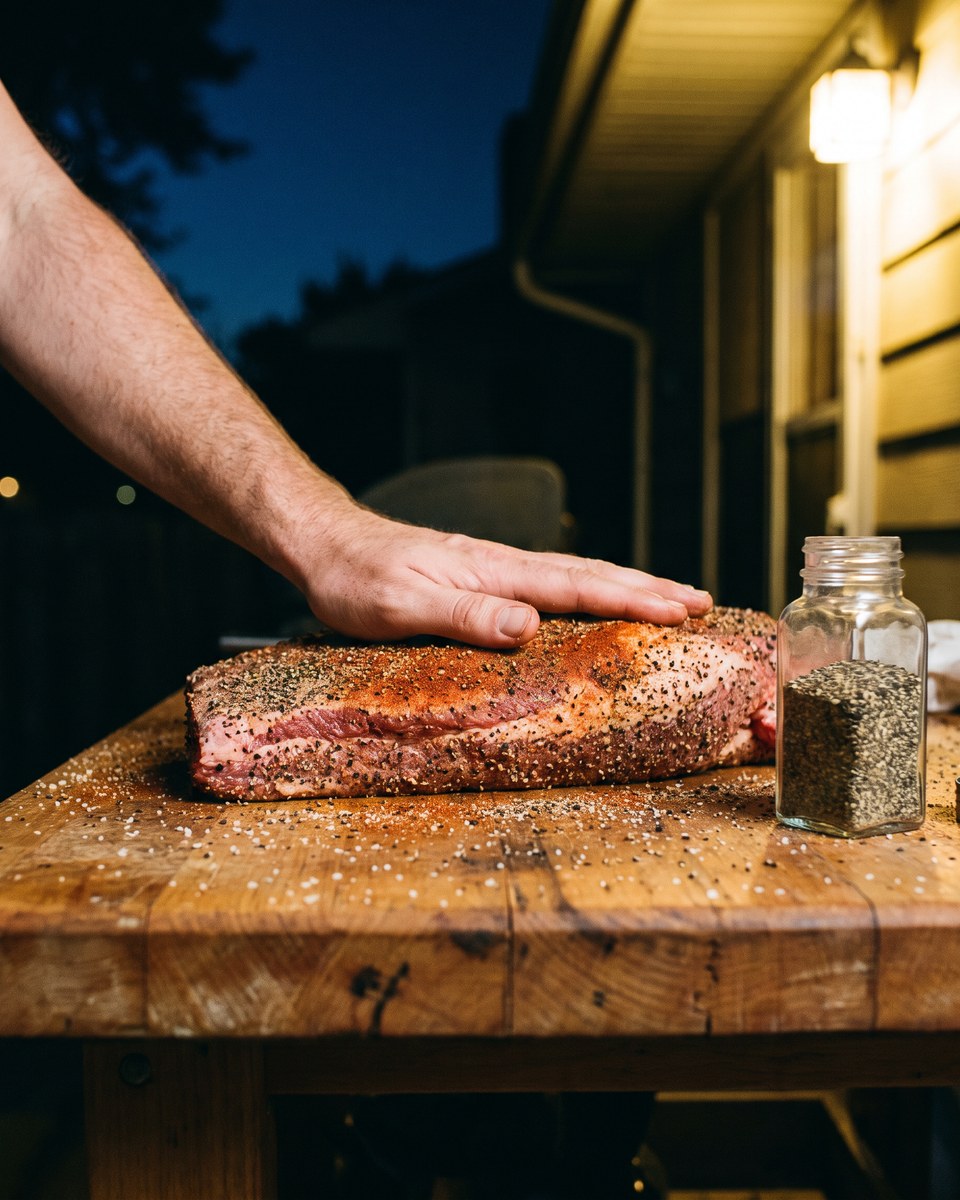
Coarse black pepper dots the surface, little dark promises. Smoked paprika drifts in next like a warm haze. Garlic powder, then onion powder — layers of comfort and tease.
She cracks a small smile.
MaraCayenne’s optional, only if you like a little trouble hangin’ around on your tongue.
He adds a light dusting. More than he would have if he were alone. She notices. Of course she does.
MaraNow, press it in. You’re not scrubbing a pan. You’re tellin’ it what kind of night you’ve got planned.
He presses the rub in with steady, open hands. Not rough. Not shy. The spices sink down into the surface and stay there, and that is the real beginning of this Texas-style brisket after dark.
Technique Spotlight: Building the Rub
Classic overnight brisket rubs lean on a 50/50 salt-and-pepper base, with smoked paprika, garlic, onion, and a touch of cayenne for heat. Let the seasoned brisket lie there while you get the smoker steady, so the salt can start working its way deep inside.
Ease It In, Then Walk Away
They carry the brisket out to the Ironbound together, both of them under the weight of it, her hands and his hands and twelve pounds between them, neither one willing to be the one who lets go first. The lid is putting out warmth already, soft and steady, like it knows exactly what kind of night this is going to be.
She rests her palm on the metal, feeling the heat the way some people check a pulse.
She glances at the dial, then back at him.
MaraMmm. Two-thirty-five. Perfect for a slow smoked brisket. Not in a hurry. But ready to go as long as it takes.
He opens the lid. Thin blue smoke rises up between them, curling around her face and catching in her hair, and she does not move out of it. It is the kind of smoke you only ever get from clean coals and good wood — post oak with a little apple underneath, the sort of mix that smells less like dinner and more like a promise.
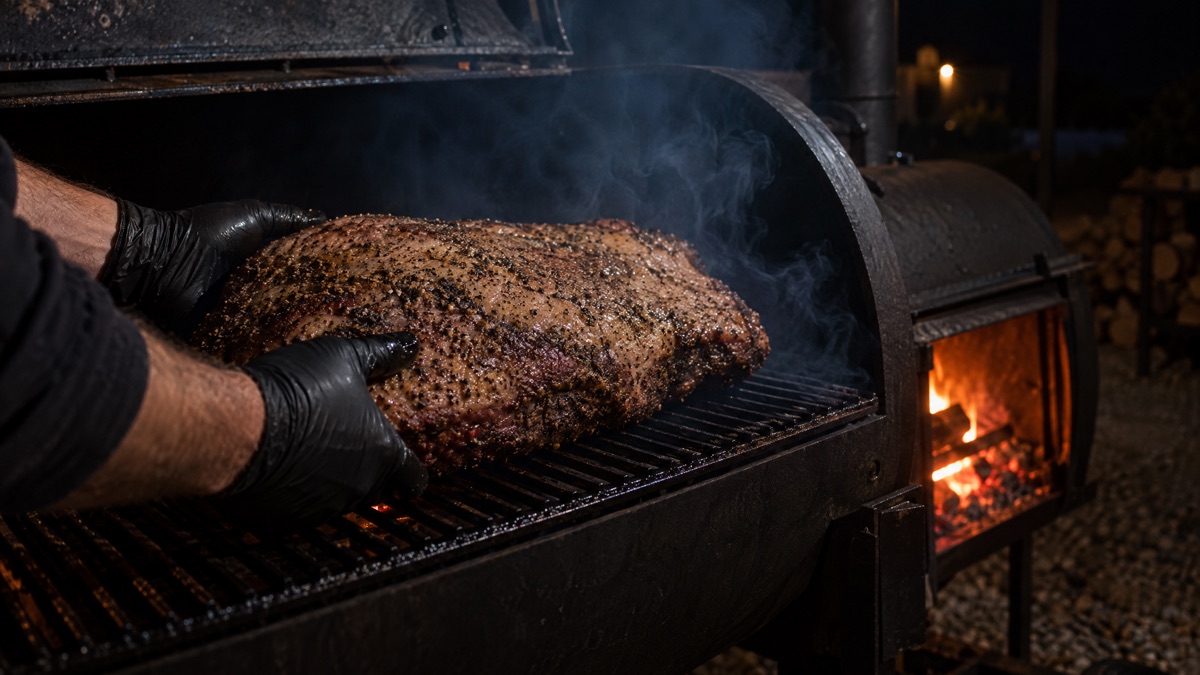
MaraA brisket doesn’t like bein’ dropped in. You settle it. Lay it down fat-side toward the heat, let it feel the warmth comin’ on slow. Then… you let it be.
He sets the brisket gently on the grate. For a second he would swear he can feel it exhale.
She closes the lid herself, fingers lingering on the handle.
Mara“Now we walk away.”
Henry“For how long?”
She takes another slow sip of Busch Light, eyes on the faint wisp of smoke from the stack.
MaraLong enough to forget what impatient feels like. First three hours of a midnight brisket? You keep that lid shut. Mystery builds bark.
Technique Spotlight: Fire and Smoke Setup
Run your smoker at 225–240°F with clean-burning fuel (charcoal or sticks) and steady airflow. Keep the lid closed for the first 2–3 hours to let bark form and smoke adhere. Thin, barely visible blue smoke beats thick white smoke every time; the quiet ones always do the best work.
The Stall, or When It Stops and Makes You Wait
Time slips sideways after that. The yard shrinks to the glow of the smoker and the sound of her voice telling stories about Llano. Henry is just starting to relax when she tilts her head like she has heard something inside the pit.
MaraYou’re easing up on the stall.
He says it like he has never heard the word before, even though he has read entire arguments about it online.
HenryThe… stall.
MaraThat moment, when your midnight brisket hits one-sixty, one-seventy, and just… parks. Drives backyard folks crazy. They stare at the thermometer like it owes them money.
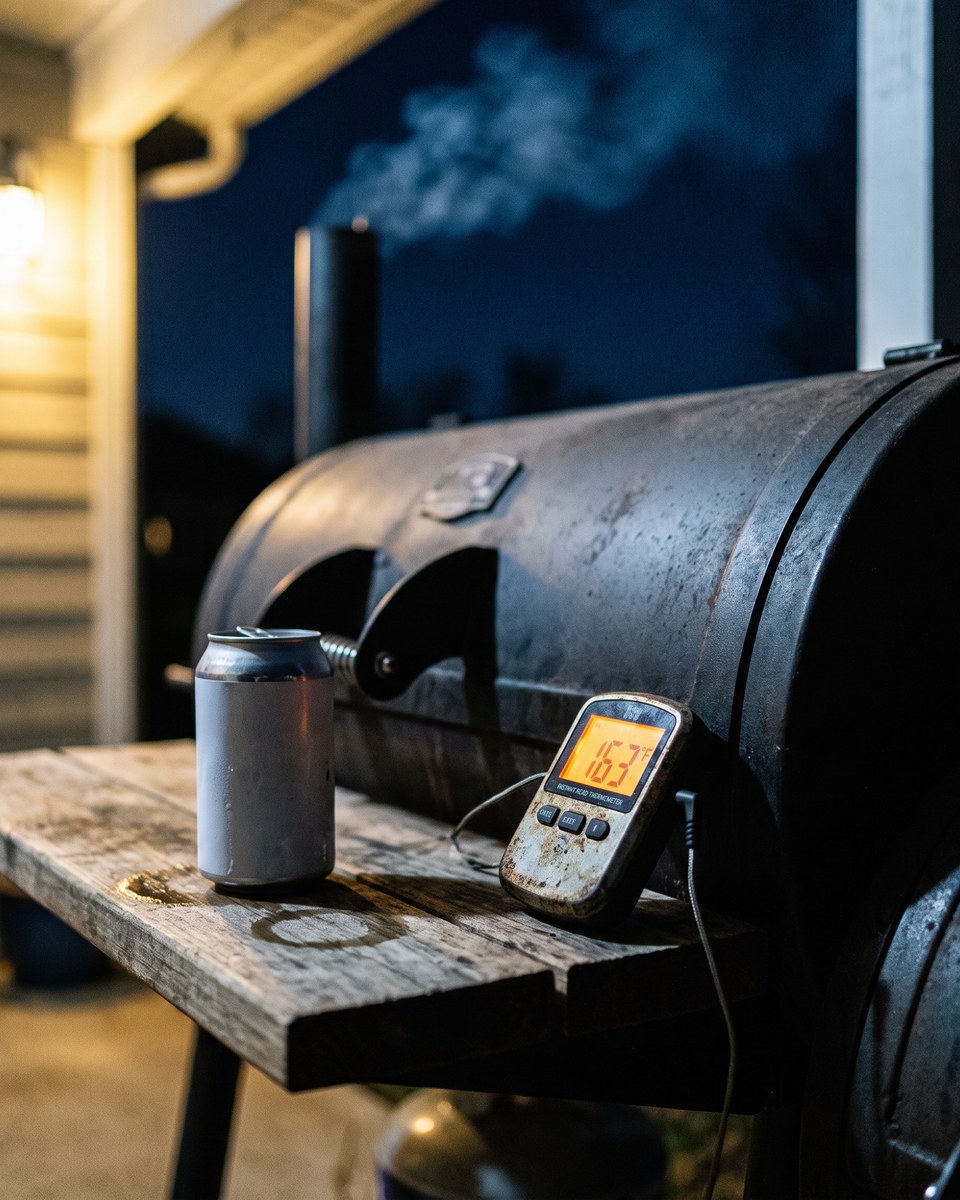
She leans on the smoker, drawing lazy spirals through the smoke with one finger.
MaraWhat’s really happenin’ is moisture’s lifting outta the surface and coolin’ it down. All that water leaving carries heat with it. Collagen deep inside starts loosening, thinkin’ about melting. Fat starts softening, slow, getting ready to render. From out here, it looks stubborn. From in there…
She pauses, watching the smoke drift past the porch light.
Mara“…it’s awakening.”
HenrySo I don’t touch it yet?
MaraNot unless you want to ruin the best part. This is where folks panic. They crank the heat, curse the meat, and blame the recipe. But if you hold that low and slow overnight, the stall turns from a fight into a surrender.
She taps the smoker lid, then taps the center of his chest.
MaraRight here’s where you decide what kind of story this cook’s gonna be. You either rush it and regret it… or you ride it out and remember it.
Science Spotlight: Why a Brisket Stalls
The “stall” usually happens between 160–175°F internal. Evaporative cooling from surface moisture slows the temperature climb. Hold your pit steady and do not chase it — this is when collagen finally gives in and turns a tough brisket into something tender. For a deeper science dive, check resources like AmazingRibs and Serious Eats.
When It Is Ready to Be Wrapped
Eventually the numbers stop being exciting. The fire holds. The night settles into that soft, heavy quiet that only ever shows up after midnight, when everybody sensible has gone to bed and whatever is left in the yard is nobody else’s business. She takes one last look at the glowing thermometer, and then at him.
MaraAlright. Let’s see if it wants wrappin’.
They lift the lid together. The brisket looks smaller somehow, and a great deal more sure of itself. The bark has gone from raw promise to dark, ridged and utterly resolute.
MaraTouch it. Go ahead. You can touch it now. But be gentle.
He brushes the surface with his fingertips. Firm without being rigid. Dry to the touch and still very much alive underneath. Like it has finally worked out what it wants to be, and who it wants to be it for.
She nods toward the table, where a wide sheet of unwaxed butcher paper has been waiting this whole time.
MaraFoil’s too pushy. Makes a brisket give in too fast, steams out the personality. Paper lets it finish in its own time, keeps that bark intact.
He lifts the brisket and she guides the paper under it. They fold it together, one side and then the other, ends tucked up underneath like a secret the two of them are wrapping up between them.
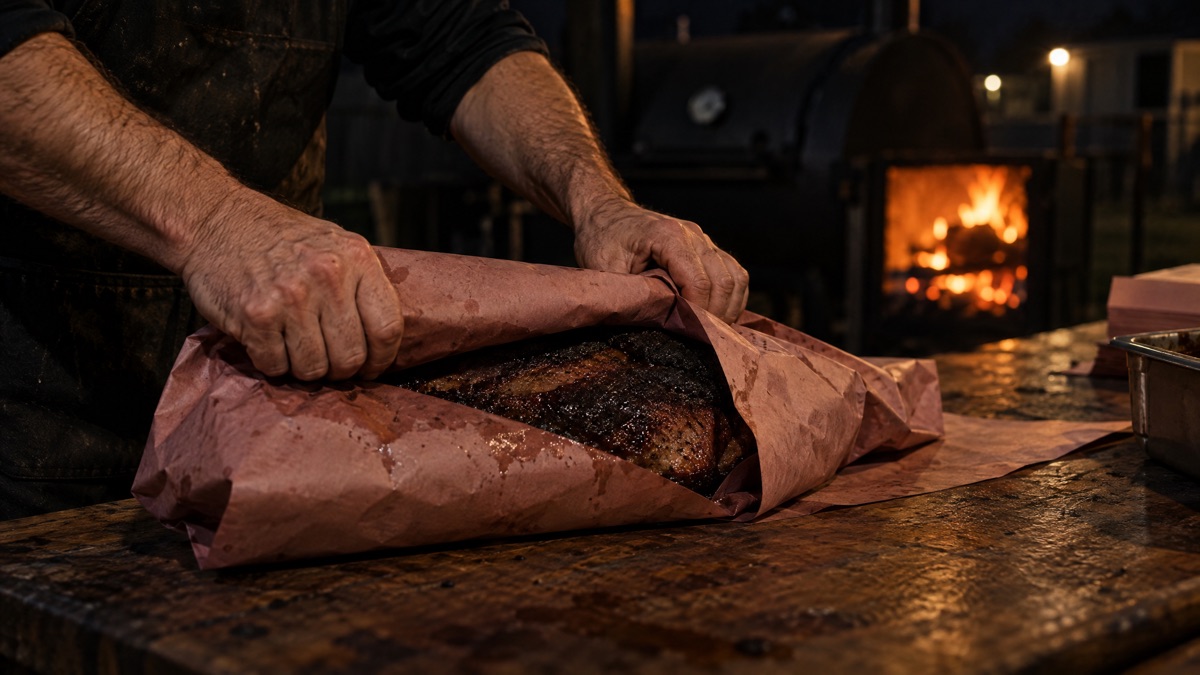
She says it as they slide it back into the smoker.
MaraThere. That’s how you treat somethin’ that finally opened up for you. You protect it ’til the very end.
How Long It Takes, and How You Know It Is Done
The fire settles in low and steady and does not need to be touched. Hours blur. She tells him story after story — about her granddad’s pit, about briskets that went wrong and nights that somehow still turned out right, about small-town competitions and one underground cook-off she swears she will tell him about another time.
At some point past three in the morning she checks the digital probe thermometer resting on the side table, the kind of instant-read tool Henry bought because the reviews online said to trust your thermometer. Tonight he trusts her more.
MaraYou ready to see how tender it is?
He picks up the probe like a mechanic holding a screwdriver he does not want to drop, and wishes immediately that he had worded it better.
HenryDo I just… stick it in?
She laughs softly, the sound slipping into the night like it knows the way, and steps closer.
MaraSweetie, this is no time to get clumsy with your tools.
She moves in behind him, close enough that he can feel her there the whole length of his back, one hand resting light on his shoulder and the other closing around his wrist to guide him toward the thickest part of the flat.
MaraYou don’t jab. You ease it in. Slow. Pay attention to every bit of resistance. The meat will tell you when it’s ready to say yes.
He eases the probe in. There is a give, and then a hesitation, and then a moment where it holds him out on principle — and then nothing at all. They try it again a little later and this time it goes all the way in with nothing behind it whatsoever, right to the handle, like the brisket has finally quit pretending it did not want this.
MaraThat is what ready feels like. Most folks pull on a number — two hundred, two-oh-three, whatever a blog told ’em. But a proper overnight smoked brisket? You pull it when it welcomes the probe. Warm honey. No fight.
Technique Spotlight: Probing for Tenderness
Start probing for tenderness around 195°F internal. Insert the thermometer probe into the flat in several spots. When it goes in with almost no resistance — like warm honey — you’re done, even if the number is slightly under or over 203°F. Use a reliable instant-read thermometer, and wear heat-proof gloves so your hands stay in control.
The Hardest Part Is Leaving It Alone
Once the internal temperature passes 200°F and every probe feels exactly the same going in — smooth, forgiving, ready — she flashes him a grin he has not seen from her all night.
His brain misfires for a second.
MaraIt’s time to get it off.
He takes the wrapped brisket up in both gloved hands, and it is heavier than it has any right to be. She moves in beside him and steadies the edge of the paper so nothing slips, and together they lower it down into a towel-lined cooler he set up hours ago on the off chance, and he does his level best to act like he always planned this part.
She folds the towels over it, slow and precise, and then rests both hands flat on the lid. When she looks up, her eyes hold his in a way that makes the whole night feel very small and very close.
MaraPay attention. You’ll want to remember this.
He is already bracing himself.
HenryHow long does it rest?
She smiles, the kind of smile people tell stories about later.
MaraOne hour is for amateurs. Two is respectable. Three… Three is what you do if you want your guest to come again.
They sit near the cooler while the brisket rests. The smoker cools. The night leans closer. She tells him about long summers watching her granddad pull briskets that made grown men quiet, and about how he used to say the meat does not remember the beginning, it remembers how you treated it when it was tired.
Henry does not know how long they talk. He knows that when the three hours finally pass he is nervous in a way he has not been all night.
Two Plates, and She Was Gone
They lift the brisket out of the cooler together. The butcher paper is dark and glossy now, stained through with everything it has been through. He sets it on the board and starts unwrapping, slow and careful, like the ending of a story he is in no hurry to reach.
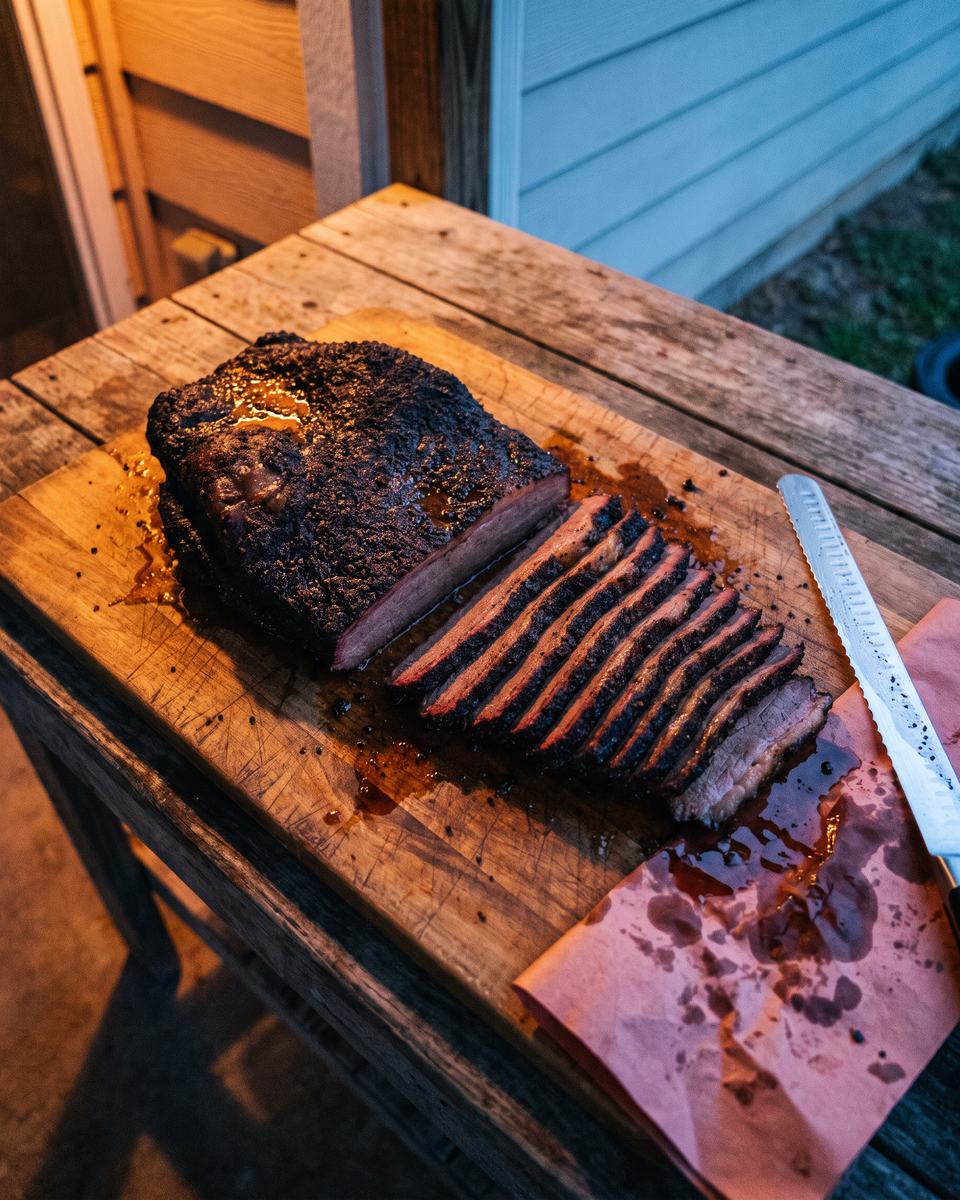
The bark crackles as the paper peels back. The point jiggles under its own weight. The flat lies there dark and glistening, every inch of it proof that low and slow overnight was never just a tagline.
He takes his longest slicing knife and lines up the first cut. The blade eases through the bark and into the meat with almost no argument at all. Each slice falls forward and bends over the board under its own weight, juices gathering along the edge in soft shining lines.
It is a true brisket after dark — the kind people whisper about at competitions and pretend they are not jealous of.
He lays two plates on the table and turns toward her chair with what he hopes passes for confidence.
HenryYou want the first slice?
The chair rocks once in the faint breeze, and then it stills.
No footsteps on gravel. No gate creak. No car door, no fading voice, no “thanks for the brisket, darlin’.”
Just a thin ribbon of smoke drifting exactly where she stood the first time she said evenin’, darlin’, curling up toward the sky as if it has somewhere better to be.
He stands there with two plates, a perfect midnight brisket, and the quiet feeling that something, or someone, has just passed through his life the way smoke passes through meat: invisible, irresistible, and impossible to get back once it is gone.
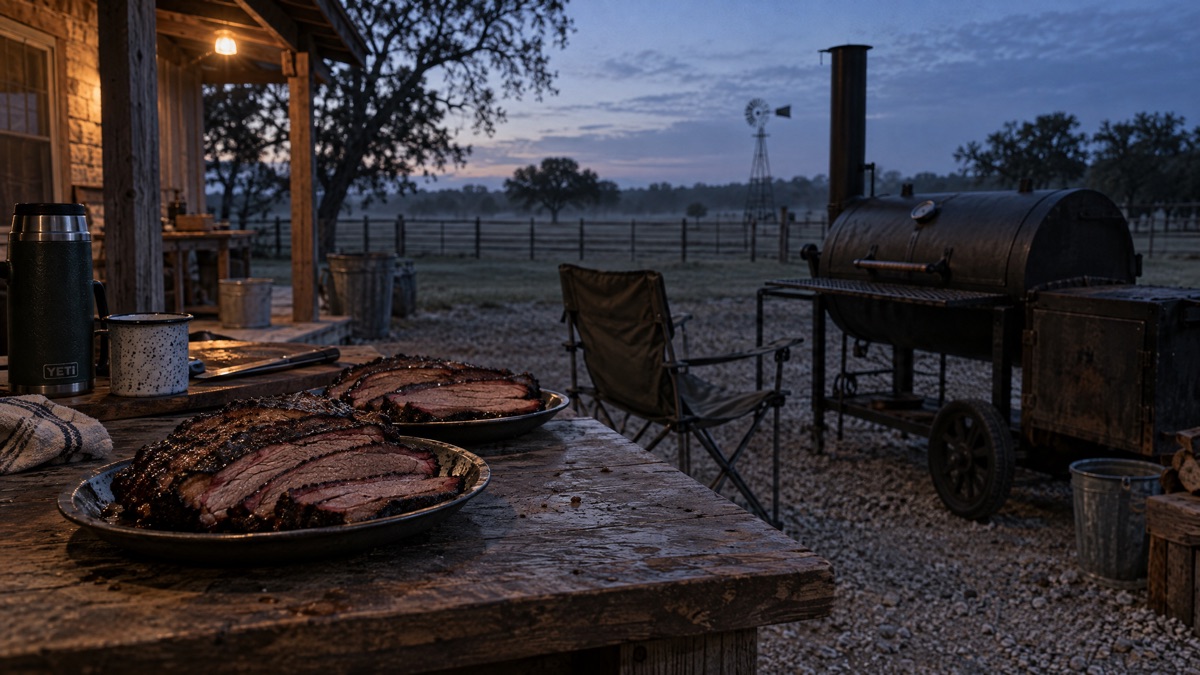
That is when Henry understands why people talk about an overnight smoked brisket like it is some kind of rite of passage. It is not the cook that changes you. It is the waiting. And who shows up while you wait.
Recipe: The Overnight Brisket
Below is the method she walked him through, in the order she gave it — about brisket, about patience, and about letting the heat do the talking.
Recipe: Ingredients
- 1 whole packer brisket (12–14 lb): “Start with somethin’ that makes you hesitate for a second — somethin’ worth sacrificin’ a night of sleep for.”
- 3 tbsp kosher salt: “Salt does the introducin’. Let it open everything up.”
- 3 tbsp coarse black pepper: “A little friction helps you remember it later.”
- 1 tbsp smoked paprika: “Your slow burn. Comes on gentle, stays all night.”
- 1 tbsp garlic powder: “Comfort first. Always.”
- 1 tsp onion powder: “The tease. Quiet, but you’d miss it if it were gone.”
- 1 tsp cayenne pepper (optional): “Only if you like your nights with a little risk.”
- 2–3 chunks post oak or apple wood: “Your smoke should smell like an invitation, not a warning.”
Substitutions: Table salt can work instead of kosher (use about 25% less). White pepper can replace black pepper for a sharper, brighter heat. Swap in cherry or hickory wood if that’s what you have on hand, but keep it clean, keep it dry, and keep it burning all night.
Recipe: Step by Step
- Trim with confidence. Start with the brisket cold from the fridge. Leave about 1/4 inch of fat on top, trimming away thick hard deposits and ragged edges. A clean, even shape helps your brisket cook evenly and keeps the flat from drying out during an overnight smoked brisket session.
- Season with intention. Lightly coat the meat with neutral oil. Season all sides with salt, then pepper, followed by smoked paprika, garlic, onion, and cayenne if you like a little heat. Press the rub in firmly so it clings. Let the brisket sit at room temp for 20–30 minutes while you stabilize the smoker.
- Stabilize your smoker low and slow. Set your smoker to 225–240°F using charcoal and chunks of post oak or apple wood. Aim for thin blue smoke — clean, faint, and steady. This is the airflow you want for a proper low and slow brisket after dark.
- Set it and don’t peek. Place the brisket fat-side toward your heat source (fat-side down for most offset and barrel smokers). Close the lid and keep your hands off it for at least 2–3 hours so the bark can set and the smoke can take hold.
- Ride out the stall. When the internal temp hits 160–175°F and hangs there, don’t panic. Keep your smoker steady. This stall phase can last 1–3 hours as moisture evaporates and collagen breaks down. This is where tenderness is born — let it happen.
- Wrap when the bark is ready. When the bark looks dark, firm, and set (it should feel dry to the touch but not flake off), remove the brisket and wrap tightly in unwaxed butcher paper. Avoid foil if you want the bark to stay crisp and flavorful.
- Cook to tenderness, not just temperature. Return the wrapped brisket to the smoker. Start checking internal temp and feel around 195°F. Probe the flat in several spots; when the probe slides in with almost no resistance — like warm honey — you’re done, even if that’s 198°F or 205°F.
- Rest longer than feels natural. Place the wrapped brisket in a towel-lined cooler and rest for at least 1 hour, ideally 2–3. This holds the heat, lets the fibers relax, and keeps the juices inside where they belong instead of all over your cutting board.
- Slice with respect. Separate the point from the flat if you like. Slice the flat across the grain into pencil-thick slices that bend but don’t break. Cut the point into thicker slices or cubes for burnt ends later.
Recipe: Serving and Pairings
Serve your slices with simple sides that know their place and let the brisket do the showing off:
- Sharp pickles or pickled onions to cut richness
- Soft white bread or buns to catch every drop of juice
- Creamy sides like smoked mac and cheese or BBQ beans
Drink pairings: Black coffee if the sun’s already up. A cold Busch Light if you’re still riding the night. A neat bourbon if you want the memory to stay warm a little longer.
Leftovers: Chop brisket into breakfast tacos, tuck it into grilled cheese, or simmer it into a deep, smoky chili that tastes like the night you pulled it.
If you want more of the lab-coat side — smoke rings, bark chemistry, fire control — she’d want you to know that AmazingRibs, Serious Eats, and the official USDA food safety guide will always be there to back you up.
She promises the roadhouse forty pounds of pork before she tells him.
Read the next chapterWhat do you do when a brisket stalls at 160 degrees?
Nothing, or wrap it. A brisket stalls between 160 and 175 degrees because moisture evaporating off the surface cools it as fast as the fire heats it, and it can sit there for hours. The stall breaks on its own once the bark dries out. Wrapping pushes through it faster at the cost of some bark. Start probing for tenderness around 195 degrees.
| Stage | Internal temperature | What to do |
|---|---|---|
| Bark setting | first 2–3 hours | Keep the lid shut |
| The stall | 160–175°F | Leave it, or wrap to push through |
| Start probing | around 195°F | Check by feel, not by the number |
| Done | roughly 198–205°F | Probe goes in with almost no resistance |
| Rest | — | 1 hour minimum, 2–3 in a towel-lined cooler |
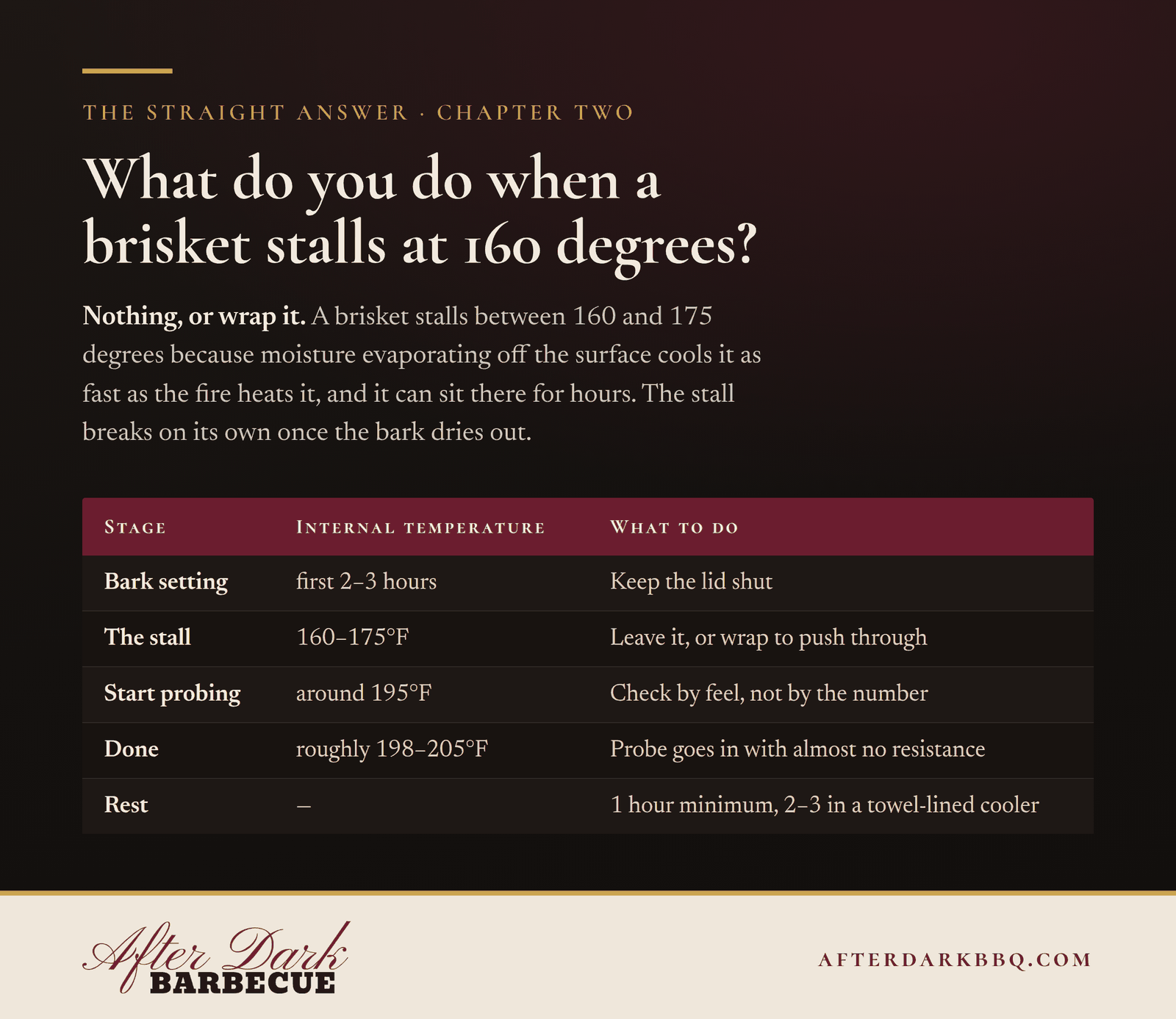
How to read this: Internal temperature is what the meat reads on a probe, not what the smoker reads. The stall is the long flat stretch where the number stops climbing — it is normal and it is not a fault in your fire. Doneness here is a feel, not a number: a brisket can be ready at 198 or still tight at 205.
The full method, straight: the smoked brisket guide, what to do about the stall, and how bark actually forms.
This is the cook from the story above with nothing left on: just the numbers, ready for your own pit.
The Hard Numbers, Laid Out Bare
How long does it take to smoke a brisket — the chart, the stage table and the questions people actually ask, with no story attached.
Sources
The 145°F safe minimum with a three-minute rest for whole cuts of beef is from the USDA Food Safety and Inspection Service Safe Minimum Internal Temperature Chart. The stall range, the overnight schedule and the cooler rest are After Dark BBQ’s own, measured at the grate and stated as ours rather than dressed up as research. Read October 2026.
Stay a While Longer
The chapters: Chapter One — Midnight Ribs · Chapter Three — Overnight Pork Butt · Chapter Four — Smoked Beef Ribs · Chapter Five — Smoked Whole Turkey
Letters to Dutch: How Long to Smoke St. Louis Ribs at 250 · The Night the Brisket Would Not Let Me Sleep
Everything at the After Dark BBQ hub · Who Dutch Cobb is · Write to Dutch
Volume One, complete. Volume Two, a new chapter every Friday.All the chapters · Write to Dutch

Leave a Reply