Volume Two · Chapter Six · Whole duck at 275° · About three hours
Volume Two · Chapter Six
RUTHIE’S DUCKTHE FAT CAUGHT FIREHE SAW IT FROM THE POLE
Heat Somebody is going to get burned
Chapter six of After Dark BBQ, Volume Two: a whole duck salted bare overnight, the skin pricked all over, smoked at 275° over a drip pan for about three hours to 165°, then crisped hot.
Every Thanksgiving for nineteen years, Earl smoked one duck that was not for sale.
The Duck That Was Not for Sale
The duck page was in Ruthie’s handwriting, not Earl’s, which was the first thing Della noticed and the last thing Ruthie wanted to talk about: DUCK. FOR R. THANKSGIVING. SALT IT AND LEAVE IT BARE. PRICK THE SKIN, NOT THE MEAT. 275. PAN UNDER IT. ALL THE FAT HAS TO COME OUT. 165. THEN HOT AT THE END.
DellaYou wrote this.
RuthieHe dictated it. The year after your uncle passed, your father showed up at my door on Thanksgiving with a smoked duck and a bottle of wine and said nobody should have to eat turkey alone. He did it every year after.
DellaEvery year.
RuthieNineteen of them. I am not asking you for a duck, honey. I am telling you where the page is.
Della ordered two from the locker plant that afternoon, whole Pekin ducks, a little over five pounds apiece, and asked the man behind the counter to leave the necks and the giblets in the bags, because the ledger had a line about gravy at the bottom that she was not ready to read yet.
Salted and Left Bare
A duck is mostly skin and fat wrapped around a little dark meat. That is the whole problem and the whole reward. Under every inch of that skin is a thick white layer of fat, and if the fat does not render out of it, the skin sits on the bird like a wet coat and the meat underneath tastes greasy instead of rich.
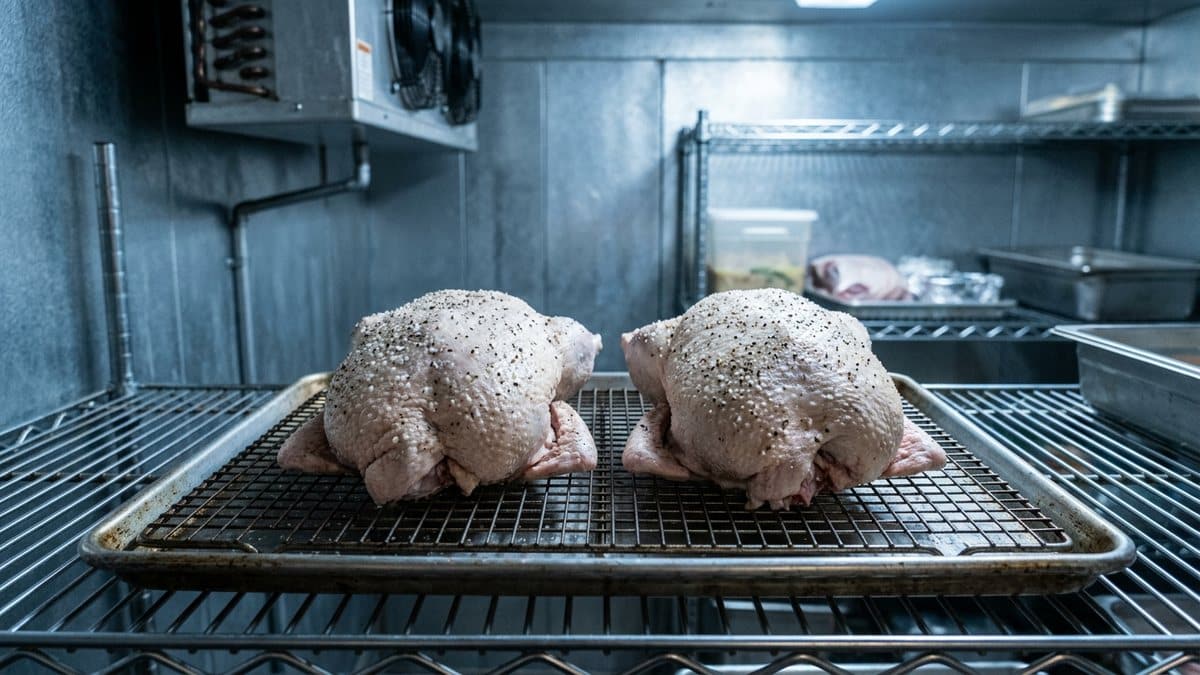
So she did the same thing the ledger had taught her with the thighs. She patted both ducks dry, inside and out, salted them heavy with kosher salt all over the skin, and set them breast up on a rack in the walk-in cooler, uncovered, for the night and most of the next day, while the cold air pulled the water up out of the skin and left it tight and dry and faintly translucent.
A duck is the opposite of a turkey. A turkey has too little fat and you spend the whole cook trying to keep it from drying out. A duck has too much, and you spend the whole cook letting it go. Low and slow is not about tenderness here. It is about giving that fat time to melt and run out of the bird before the skin sets.
You can read this one for the fire and the man who saw it. I read it for the drip pan, which is the one piece of equipment in this chapter that would have saved everybody a great deal of trouble.
DutchRuthie“You have to let it all out of him slow.”
Della“The fat?”
Ruthie“The fat.”
Technique Spotlight: Prick the Skin, Not the Meat
The USDA says to prick the skin of a whole duck before roasting or smoking so the fat can render, and that the fat must have melted and disappeared for the bird to be done. Use a sharp skewer or the tip of a thermometer probe, held almost flat, and make dozens of shallow holes all over. Go through the skin and the fat, never into the meat.
A Hundred Little Holes
Wednesday night, with the stand closed and the gravel empty, she stood at the steel counter under the bulb and pricked the skin of the first duck with the tip of her father’s probe, held almost flat, a hundred little holes, maybe more, slow and careful, never once deeper than she meant to go.

Her phone buzzed on the counter twice while she worked. Wes, both times. She let it buzz. She had not answered him since the parking lot, and she had not decided anything, and she did not want to say either of those things out loud to a man who read power lines for a living and could tell when something was about to give.
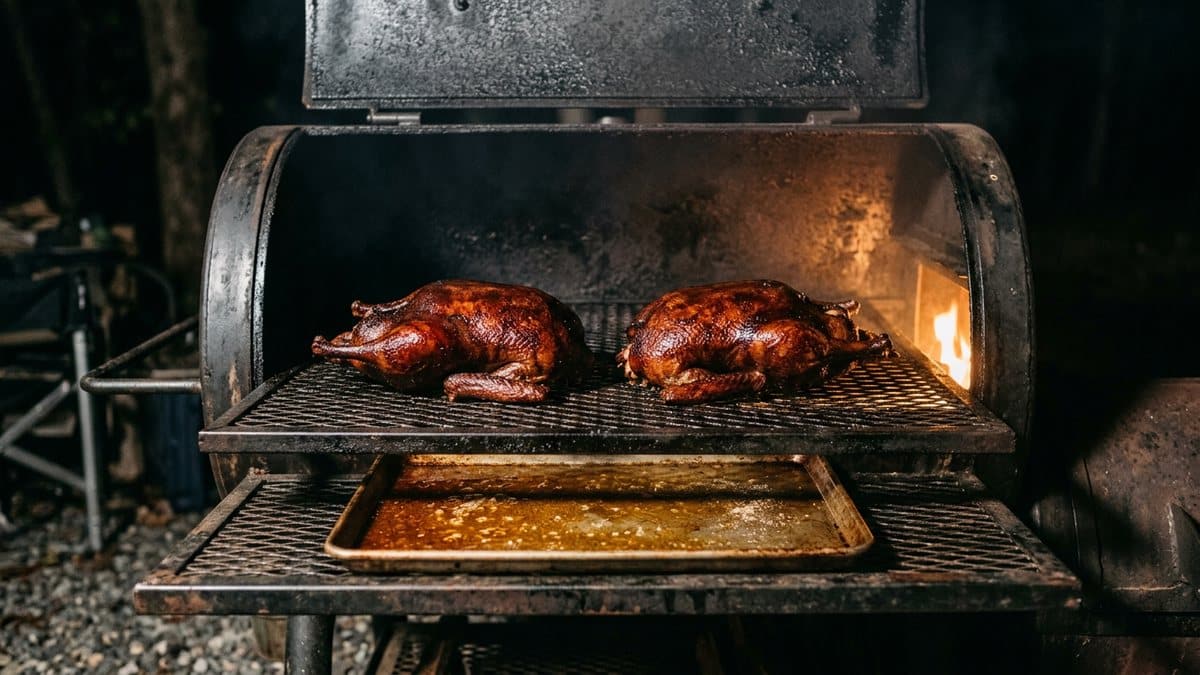
The Old Man was at two seventy-five by ten. Both ducks went on breast up, side by side on the grate, and she stood back and looked at them, glistening and tight under the lid, and only then remembered the line at the top of the page.
PAN UNDER IT.
She had not put a pan under it.
All of It, All at Once
For the first hour, nothing. The skin went from pale to gold and the little holes she had made began to glisten and then to weep, one bead of clear fat at a time, rolling down the sides of each bird and dripping through the grate onto the steel below.
The second hour, it ran. Every one of those hundred holes opened up and gave, and the fat came out of those ducks the way the ledger said it would, all of it, more than she would have believed two birds could hold, pouring down off the breasts and the thighs in thin bright streams and pooling on the floor of the cook chamber, and from there, finding the seam at the firebox end, the way a liquid always finds the low spot, and running toward the fire.
She smelled it before she saw it. Then she saw it.

The firebox went up in a sheet of yellow flame that came out the door and out the stack at once, roaring, lighting up the whole gravel lot and the side of the stand and the grain elevator across the road, and Della stood there with a towel in her hands for one long stupid second not knowing which way to throw it.
He Saw It From the Pole
She did what her father would have done, mostly. She shut the firebox intake all the way down. She did not open the cook chamber. She did not reach for the hose. She grabbed the bag of kosher salt from the counter and was on her way to the firebox door with it when the co-op truck came off County Road 9 so fast it threw gravel against the side of the stand.
He had been a mile down at the substation, up a pole, and he had seen it, a column of orange light where the stand should have been, and he had come down that pole faster than he had come down anything in his life.
WesIntake.
DellaShut.
WesStack.
DellaLeave it open or the smoke backs up on the birds.
WesThen give me the salt.
He took the bag from her, opened the firebox door a crack with his gloved hand and threw two big fistfuls of salt in low across the burning fat, and then a third, and shut it. The roar dropped to a growl, and then to a mutter, and then to the old steady tick of the fire as it had been ten minutes before. Neither of them said anything for a while.
Wes“You forgot the pan.”
Della“I know I forgot the pan.”
One Sixty-Five, and Then Hot
He held the lid up while she slid a sheet pan onto the grate underneath both ducks, and the last of the fat ran down into it, clear and golden, a pint of it at least, and it stayed there where it belonged.
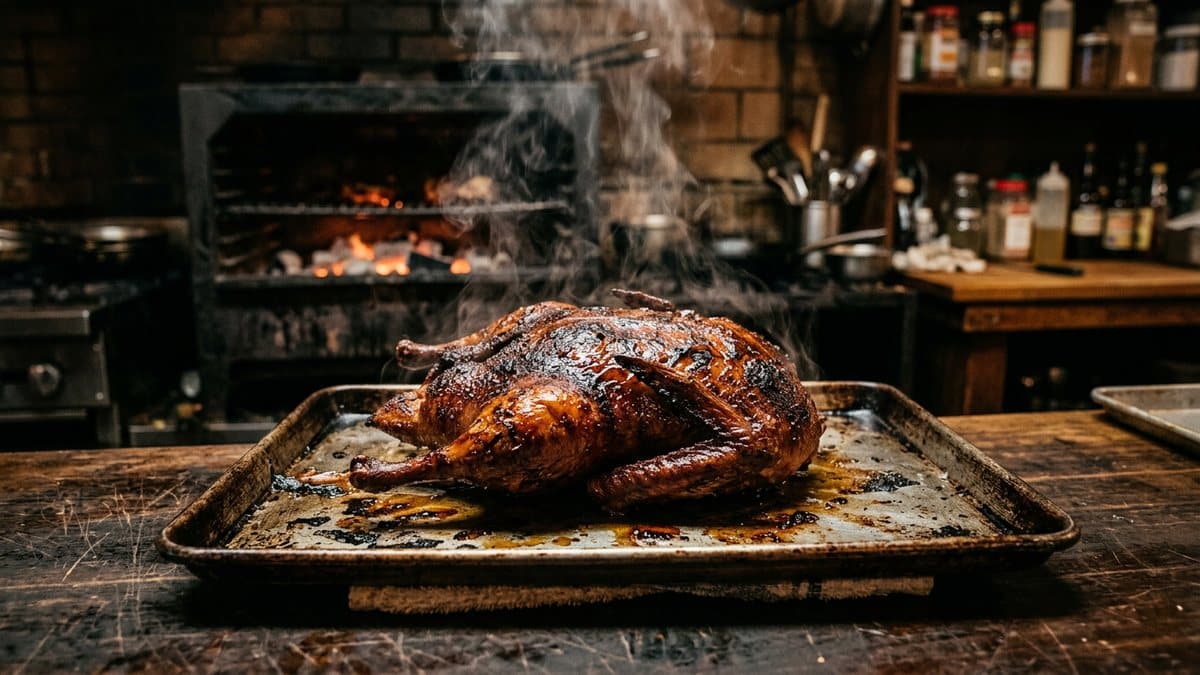
At one-forty in the morning the probe in the thickest part of the thigh on the bigger duck read one sixty-five, and the skin was a deep lacquered mahogany, and when she pressed the breast with the back of a spoon there was no soft layer of fat sliding around beneath it anymore. Just skin, tight to the meat. That is how you know a duck is done: the thermometer says 165 and the fat is gone.
The ledger said hot at the end. The stand had an old oven with a broiler in it, and she put both ducks under it, breast up, for three minutes and not one second longer, and stood in front of the window and watched the skin blister and crackle and go glassy while Wes stood behind her and watched her watching it.
WesYou never answered me.
DellaI was busy setting my father’s pit on fire.
WesBefore that.
DellaI know when before that.
What Earl Said About the Fire
They sat on the tailgate of his truck while the ducks rested on the counter under a loose tent of foil, close enough that their shoulders touched through two canvas jackets, and the cold came down off the river, and the Old Man ticked behind them, settled and easy now, like nothing had ever happened.
WesI called Garrett because I could not stand the idea of somebody cutting him up for steel. That is all it was. I could not have paid for the dirt under him.
DellaThe last page in the book says he stays with whoever keeps his fire.
WesHe told me that too. He said it the week before he went into the hospital.
DellaWhat did you say?
WesI said I just come by to eat. He laughed at me for a long time.
She turned on the tailgate to look at him. He was already looking at her. The fat in the pan on the counter inside had gone still and golden and quiet, and the only light on the whole of County Road 9 was the bulb over the order window, and neither one of them reached over to shut it off.
Ruthie’s Duck
At seven in the morning Ruthie came in and found one whole duck wrapped in foil and a clean dish towel with her name on it in marker, a mason jar of strained duck fat beside it, and the second duck sitting on a plate at the counter with its legs gone and its skin missing in two places the exact size of two people who had been up all night.

Ruthie“What happened to this one?”
Della“It caught fire.”
Ruthie“Sure it did, honey.”
Duck, Explained Once
Buy a whole Pekin duck, about five pounds, the farm-raised white duck in most American grocery stores and the one every number on this page is for. A wild duck spends its life flying, its breast meat is as dark as its legs, and it is a different cook entirely.
Always cook a duck over a drip pan. Under the skin of a farm duck is a layer of fat thick enough to keep it floating, and every bit of it has to come out before the bird is done. On a smoker, fat that misses the pan finds the fire.
Save the fat. Strain it into a clean jar and roast potatoes in it.
Ten dozen eggs for the Thanksgiving orders, a deadline on Thursday, and a pen she has not decided what to do with.
All the chaptersHow long do you smoke a whole duck?
About 30 minutes a pound at 275°F, which is roughly 2½ to 3 hours for a 5-pound duck. Cook it to 165°F in the thickest part of the thigh, the USDA’s safe minimum for duck. Salt it and leave it uncovered in the refrigerator overnight, prick the skin all over without piercing the meat, and set a drip pan underneath to catch the fat. Finish it under a broiler for 2 to 3 minutes for crisp skin.
| Stage | Pit | Internal | Time |
|---|---|---|---|
| Salt, uncovered, refrigerated | — | — | overnight, up to about 15 hr |
| Prick the skin all over | — | — | 10 min |
| On, breast up, over a drip pan | 275°F | fridge cold | — |
| Done, fat rendered out | — | 165°F | about 2½–3 hr |
| Crisp under the broiler | broil | — | 2–3 min |
| Rest, loosely tented | — | — | 15 min |
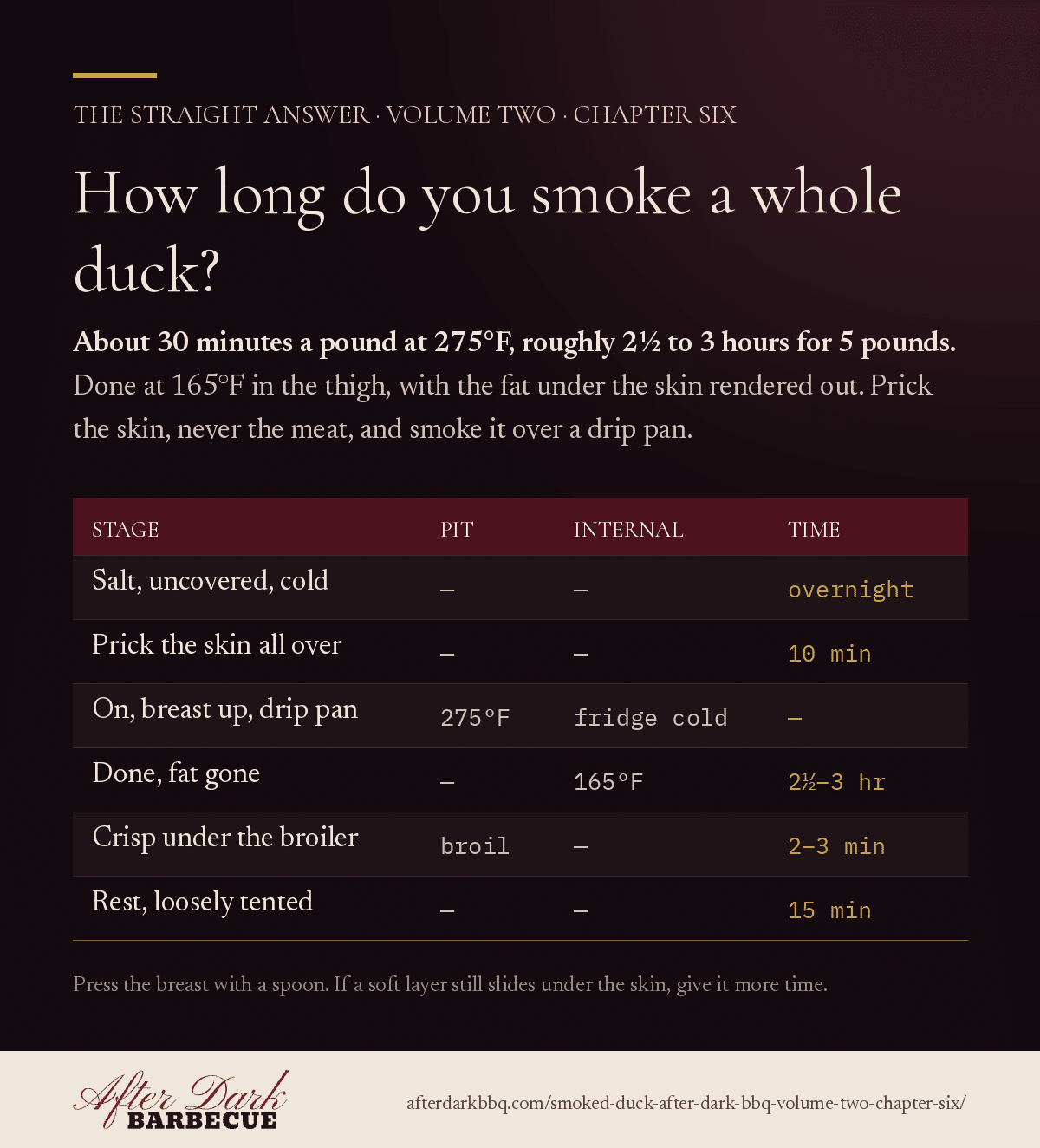
A duck is done when two things are true: the thigh reads 165°F, and the fat under the skin is gone. Press the breast with the back of a spoon. If a soft layer still slides under the skin, give it more time.
Recipe: The Short Version
Bird: one whole Pekin duck, about 5 pounds, neck and giblets removed
Salt: kosher salt all over the skin, then uncovered on a rack in the refrigerator overnight
Prick: dozens of shallow holes through the skin and fat, never into the meat
Smoke: 275°F, breast up, over a drip pan, cherry or maple
Done: 165°F in the thigh, about 2½ to 3 hours, fat rendered out
Crisp: 2 to 3 minutes under the broiler, watched the whole time
Rest: 15 minutes, loosely tented
Next Friday: ten dozen eggs for the Thanksgiving orders, a deadline on Thursday, and a pen she has not decided what to do with.
The Hard Numbers, Laid Out Bare
For the bird everybody else is cooking that Thursday, Volume One, Chapter Five spreads a whole turkey flat and keeps it low, and Chapter Fourteen does the breast on its own.
Sources
The 165°F safe minimum for whole duck and duck parts, pricking the skin so the fat can render, the rule that the fat must be melted and gone for the bird to be done, and the drip pan for indirect cooking are from the USDA Food Safety and Inspection Service, Duck and Goose from Farm to Table, which gives about 2½ hours for a whole duckling by indirect smoking. Hey Grill Hey’s smoked duck salts a 5-pound duck uncovered for about 15 hours, smokes it at 275°F for about 30 minutes a pound and finishes it under the broiler for 2 to 3 minutes. Read October 2026.
Volume Two · a new chapter every Friday.All the chapters · Write to Dutch

Leave a Reply