Just the hard numbers · Times, temperatures and charts · No foreplay
After Dark BBQTechnique · Sausage
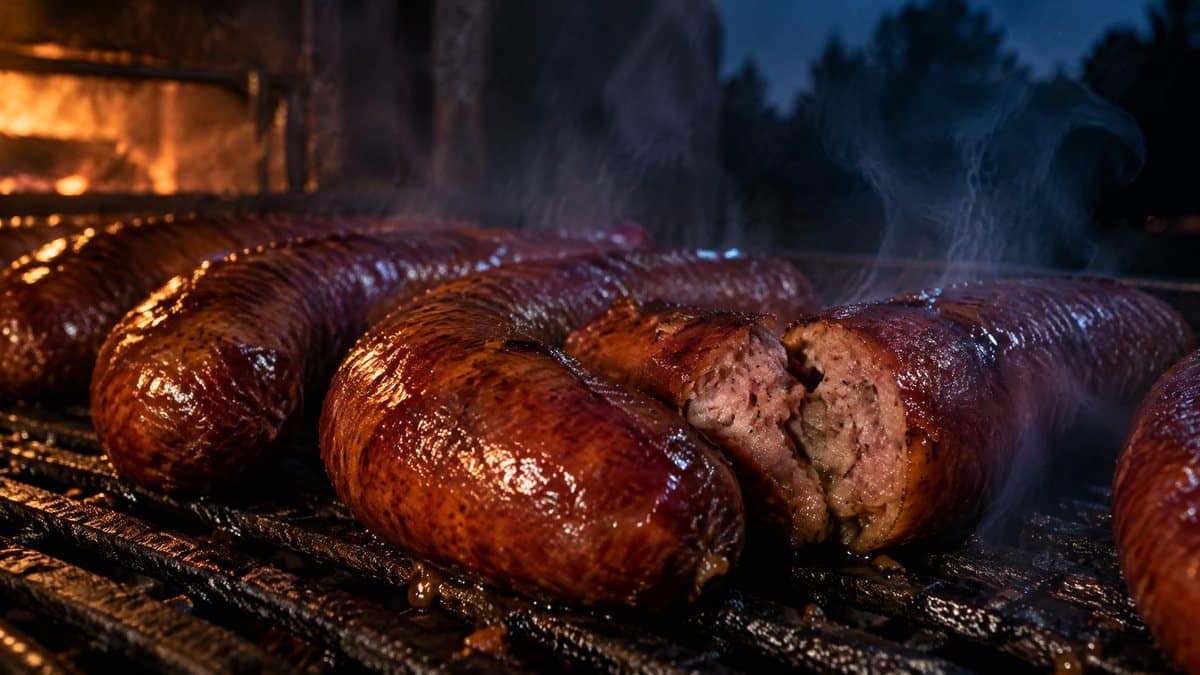
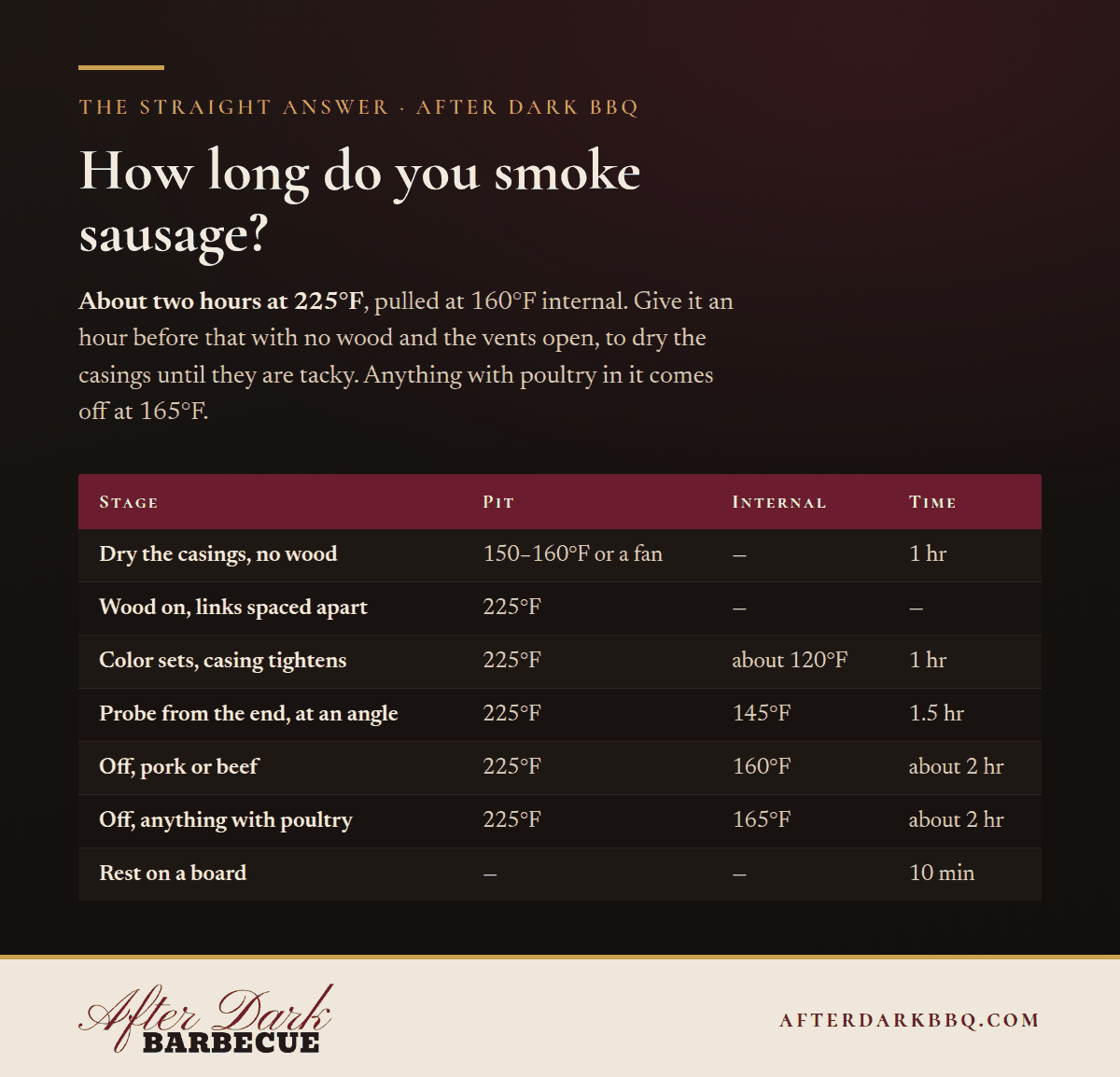
How long do you smoke sausage: about two hours at 225°F, pulled at 160°F internal. Give it an hour before that with no wood and the vents open, to dry the casings until they look like parchment. Anything with poultry in it comes off at 165°F.
How long do you smoke sausage?
About two hours at 225°F, off at 160°F internal. Before that, give the links an hour with no wood and the vents open — a warm dry pit at 150 to 160°F, or a fan on a rack — until the casings look like parchment. Fresh pork and beef sausage comes off at 160°F; anything with poultry in it comes off at 165°F.
Dry first, slow second, and you will hear the snap when you bite.
| Stage | Pit | Internal | Time |
|---|---|---|---|
| Dry the casings, no wood | 150–160°F or a fan | — | 1 hr |
| Wood on, links spaced apart | 225°F | — | — |
| Color sets, casing tightens | 225°F | about 120°F | 1 hr |
| Probe from the end, at an angle | 225°F | 145°F | 1.5 hr |
| Off, pork or beef | 225°F | 160°F | about 2 hr |
| Off, anything with poultry | 225°F | 165°F | about 2 hr |
| Rest on a board | — | — | 10 min |
What internal temperature is smoked sausage done at?
160°F for fresh pork and beef. Anything with poultry ground into it — and a lot of supermarket sausage has some — goes to 165°F. Those are the USDA safe minimums for ground meat, and sausage is ground meat by definition.
Go in from the end of the link at an angle, never through the side. Poke a hole in the side of a casing and that is the hole the fat slips out through.
Why dry the casings first?
A wet casing is a closed door. Smoke rolls across it and slides straight off, and the water sitting on the surface turns to steam under the lid and cooks the outside before the inside has warmed up.
Rush it wet and you get a pale link, a soft skin and a burst seam. Dry it until it looks like parchment and feels slightly tacky, and the color and the snap both follow.
What temperature do you smoke sausage at, and why not hotter?
225°F. A good fresh sausage is twenty to thirty percent fat, and that fat is suspended in a matrix of salt-solubilized protein — the bind. Heat it gently and the bind holds, the fat stays distributed, and every bite is juicy.
Push the pit to 275°F and the bind gives out. The fat renders out, pools inside the casing and runs the moment it is cut, and what is left is dry and crumbly. Once it is gone, there is no taking it back.
What makes the snap?
The casing failing all at once instead of gradually. For that it has to be dry, thin and under tension — stretched tight by the meat expanding inside during the cook, then set as it cools.
A natural hog casing does this beautifully, every time. A thick collagen casing resists and tears rather than snapping, and a wet casing goes soft and gives way in stages.
Should you poke holes in sausage before smoking it?
No. The holes are there to let the fat out, and the fat is the reason to eat it.
Keep your hands off it. Everything good stays inside.
If your links keep splitting open on the pit, the fix is a lower temperature, not a fork. A split seam almost always means the heat climbed faster than the bind could take.
How far apart should the links sit?
A finger of space between them, so smoke can reach all the way around each one. Links touching each other leave pale stripes where they met, and those stripes stay pale.
This is also why a rack beats a grate for two dozen links: you can spread them all out without anybody getting crowded.
What wood goes with sausage?
Hickory and apple together is the house answer — the hickory carries and the apple keeps it from getting sharp. Pecan works the same way.
The links are only in there for two hours, so this is one of the few nights a heavier wood will not overpower the meat.
Don’t Stop Now
Sources
The 160°F safe minimum for ground pork and beef, and the 165°F minimum for anything containing poultry, are from the USDA Food Safety and Inspection Service Safe Minimum Internal Temperature Chart.
The drying hour, the two hours at 225°F and the finger of space between links are After Dark BBQ’s own, measured on a backyard offset and written up in chapter thirteen of the story.