Chapter Thirteen · Sausage at 225° · Two hours
Chapter Thirteen
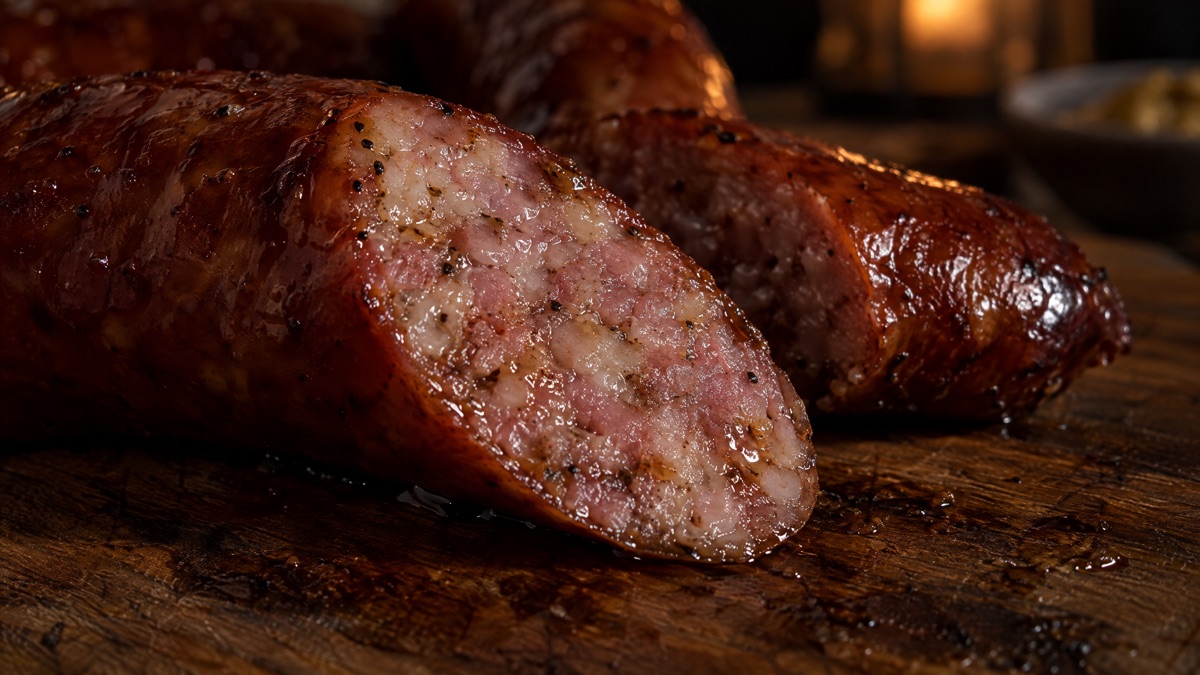
DO NOT POKE THEMSHE MADE HIM WAITTHE HALF SECOND
Heat Somebody is going to get burned
Chapter thirteen of After Dark BBQ: sausage at 225° for two hours, cooked gently enough that the casing still snaps when you bite it.
Everything before it is in service of the half second when it snaps.
Two Dozen Links and No Hurry
They came coiled in butcher paper, natural casing, made that morning by a man three towns over who does not take appointments. Henry laid them out on the counter in a row, all two dozen of them, like something he was being inspected for.
LenaThey are wet.
HenryThey are fresh.
LenaThey are wet, and if they go on wet you will steam them and they will never snap, and I will be polite about it in front of your neighbors.
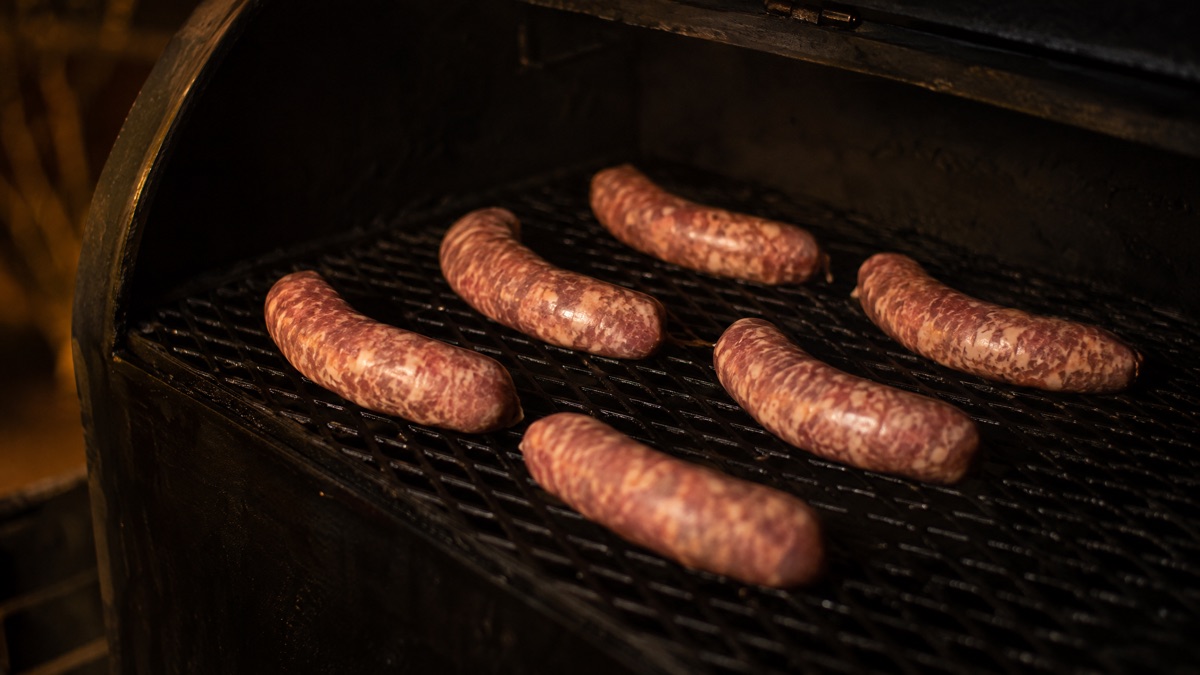
She hung them on a rack in front of a fan for an hour and made him wait. That is the whole secret and almost no man has the patience for it.
The First Hour Is for the Casing
A wet casing is a closed door. Smoke rolls across it and slides right off, and the water sitting on the surface turns to steam under the lid and cooks the outside before the inside has so much as warmed up. What a man gets for his hurry is a pale link with a soft skin and a burst seam.
Dry the casing until it looks like parchment and feels slightly tacky — the same tack as the salmon, and for the same reason. An hour in front of a fan, or an hour on the pit at one hundred and sixty degrees with the vents wide open, no wood on the fire at all, and nobody touching anything.
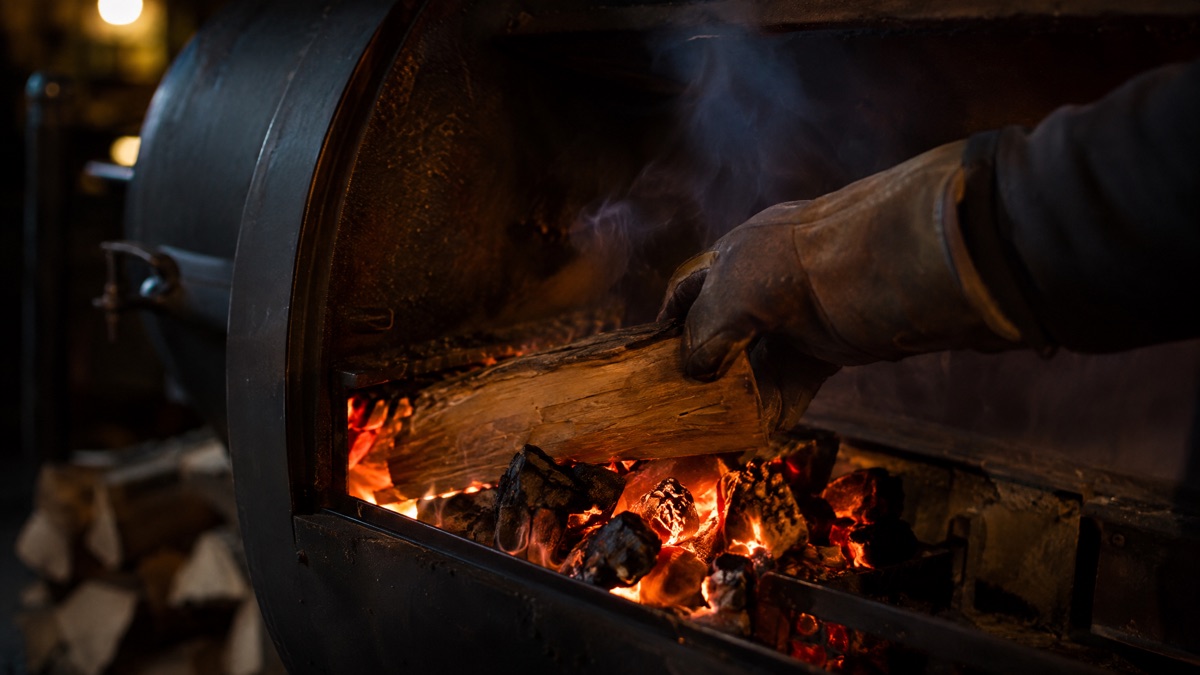
Then, and only then, put wood on.
A sausage is judged in the first half second. Either it gives a man the snap or it gives him nothing at all, and everything in this chapter happens in service of that half second.
You can read this one for the two of them standing at the pit not talking. I read it for the first hour, which is the hour every man wastes throwing smoke at something that is still far too wet to take it.
DutchHenryAn hour of doing nothing before the good part.
LenaTake notes.
Technique Spotlight: Fresh or Cured, and Why It Matters
Fresh sausage — the kind from the butcher that morning — is cooked, not cured, and goes on at 225°F and comes off at 160°F. Cured sausage, the kind that stays pink and keeps for weeks, needs curing salt and a slow schedule that climbs from 130 to 170 degrees over several hours. This chapter is the fresh kind. If you are going to hold sausage for hours under 200°F without curing salt, do not.
Two Hours, and Do Not Poke Them
Two hundred and twenty-five degrees, hickory and apple, links laid out with a finger of space between them so the smoke can get all the way around every one of them. Two hours, give or take twenty minutes, depending on how thick the man three towns over made them that day.
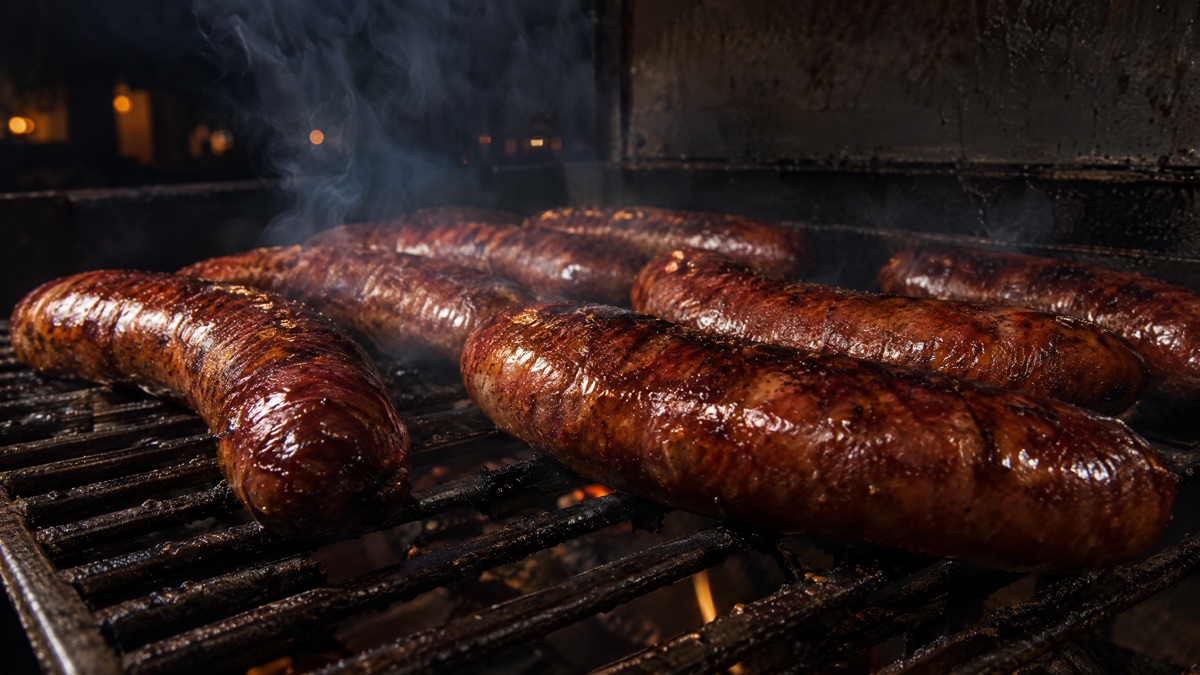
Do not prick the casings. That instruction gets repeated in kitchens for sausages that are being fried in a pan, where the fat needs somewhere to go. On a pit it is sabotage. Every hole is a place for fat to leave, and the fat is the reason anyone is here.
They will fight you anyway if the fire gets too excited. Above about two hundred and sixty degrees the fat inside renders faster than the casing can stretch, and a link splits down its length and empties itself onto your coals. That is the burst seam, and no one has ever fixed one.
Henry“One of them opened up.”
Lena“Because you got excited. Bring the fire down and leave the rest alone.”
The Half Second
He pulled them at one hundred and sixty degrees, on a probe slid in at an angle from the end, which is the only way to get a thermometer into a sausage without opening a hole in the side of it.
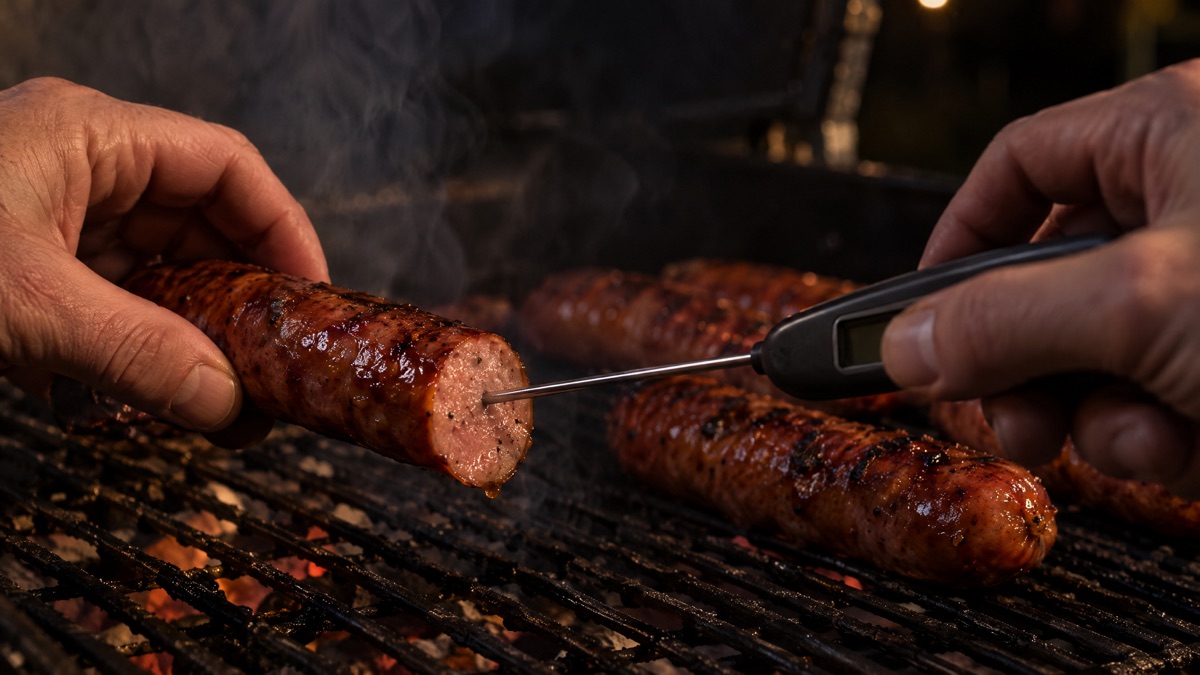
Ten minutes on a board, and not one minute less. She picked one up with her fingers, still far too hot, and bit into it before he could get a plate under it.
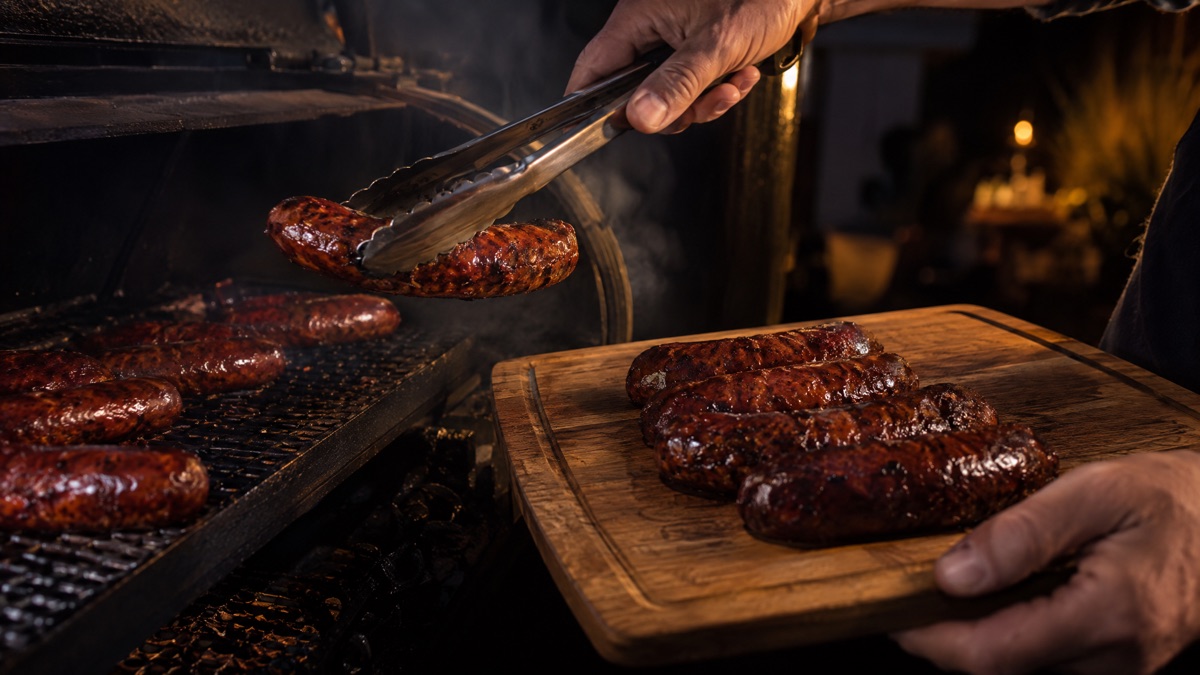
It snapped. The sound is small and sharp and there is nothing else on earth like it, and once a man has made it happen on his own pit he will chase it for the rest of his life.
LenaThere it is.
HenryWorth the hour of nothing.
LenaThe hour of nothing is where the snap comes from. Write that down somewhere you will see it.
What Is Actually in the Casing
Natural casing is hog or sheep intestine, cleaned and salted, and it is the only kind that snaps. It is a membrane with give in it, so it shrinks snug around the meat as the sausage cooks and then holds out against your teeth for exactly as long as it takes to break.
Collagen casing is manufactured from cattle hide. It is uniform, it is cheap, and it gives you a softer bite that is closer to a tear than a snap. It will still be good. It just will not make that sound.
Cellulose casing is the kind that gets peeled off before eating — used for skinless sausage and for some cured products. If you can see a seam, that is what you have.
Ask the butcher. A man who makes his own sausage will tell you what he stuffed it into before you finish the question, and he will be flattered somebody finally asked.
Lena“Hog casing or do not bother.”
Henry“And if the store only has the other kind.”
Lena“Then you make something else and you drive further next Saturday.”
The Fat, and Why 225 and Not 275
A good fresh sausage is somewhere between twenty and thirty percent fat, and that fat is the whole reason it is worth eating. It is also the most delicate thing on the pit, and it punishes a man who hurries it.
Fat in a sausage is suspended in a matrix of salt-solubilized protein — the bind. Heat it gently and the bind holds, the fat stays right where it belongs, and every bite is juicy. Heat it fast and the fat melts before the protein sets, pools, and runs. What is left behind is a link that looks fine and eats dry and crumbly, with a greasy ring on the paper underneath it.
That is what people mean when they say a sausage broke, and it happens well below the temperature that splits a casing. Two hundred and seventy-five degrees will do it quietly, and you will not know until you cut one open.
Two hundred and twenty-five. Two hours. Taking it slow is not superstition, it is the bind.
Two Dozen Links Is Never Two Dozen Links
There were four left at midnight, which he wrapped and put in the refrigerator, and two at noon the next day.
Smoked sausage keeps better than almost anything else in this story. Four days covered. Three months in the freezer, vacuum sealed, with no meaningful loss.
To reheat: a dry pan over medium, turning, until the casing tightens again. Not the microwave, which steams it limp and undoes the two hours you spent drying it. Not a hot pan with oil, which fries the outside and leaves the middle cold.
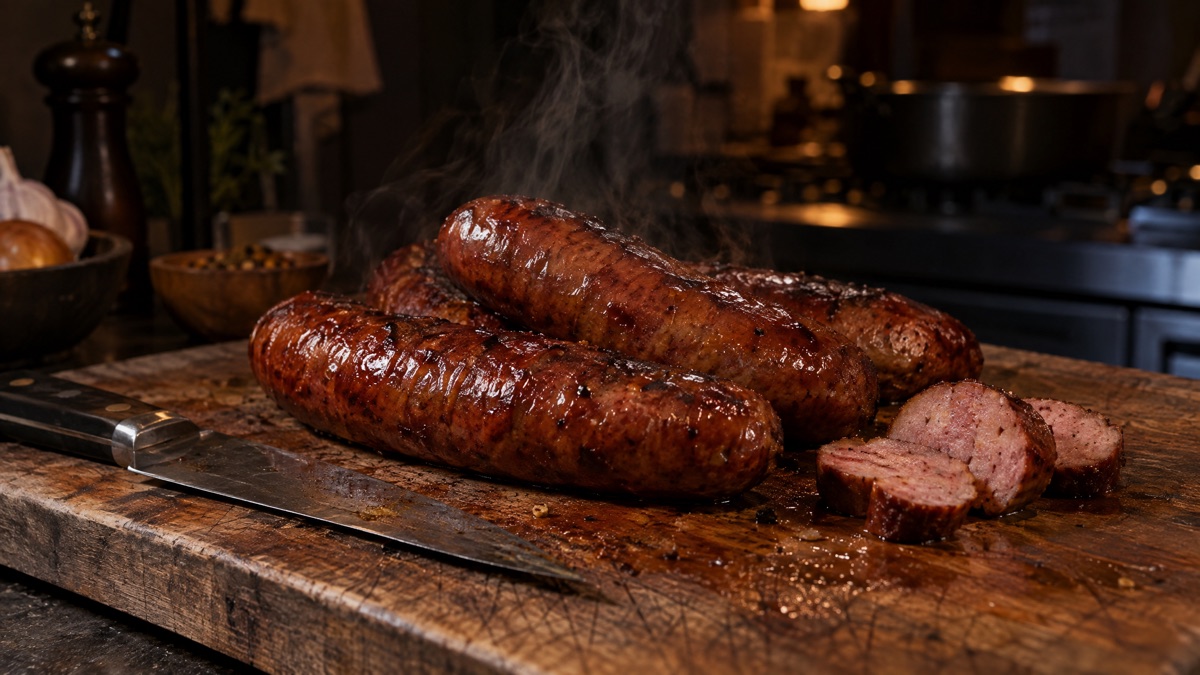
Sliced on a bias into a pot of beans, or into a skillet with peppers and onions, or into a pan of the macaroni from two Fridays ago. A link that has already been smoked does not need to be cooked again. It needs to be warmed up, and it needs good company.
Henry“There were four.”
Lena“There were four when you went to bed.”
The Snap, Explained Once and Then Never Again
It is worth knowing exactly what a man is chasing, because once he knows it he stops making the mistakes that kill it.
The snap is the casing failing all at once instead of gradually. For that to happen the casing has to be dry, thin and under tension — stretched tight by the meat expanding inside it during the cook and then set in that position as it cools.
Every enemy of the snap follows from that sentence. A wet casing never tightens, it steams. A pricked casing releases the tension through the hole. A sausage that is served straight off the pit, still at one hundred and sixty degrees, has a casing that is soft and pliable because it has not cooled and set — which is why ten minutes on a board is not a resting step borrowed from brisket, it is the step where the snap actually forms.
And a sausage reheated in a microwave has had the casing softened again by steam from the inside out, which is why a leftover link never snaps twice unless you bring it back in a dry pan.
LenaDry, tight, and let it cool a little.
HenryYou are enjoying this.
LenaI have been waiting thirteen chapters to say all three of those in a row.
What to Put Next to It
Nothing, is the correct answer, standing at the pit, with the first one, in your fingers. After that there are rules.
Mustard, sharp and yellow or coarse and brown, and never both on the same plate. White bread, the cheap kind, folded rather than sliced. Pickles, because the fat needs an argument. Raw onion if a man is among people who will forgive him for it.
Texas serves it on butcher paper with saltines and that is not a joke, it is a structure: something bland to carry the fat and something acid to cut it.
A pot of pinto beans with a link cut into it turns lunch into dinner. And two links split down the middle and laid face down on a griddle for three minutes make a sandwich that has ended more than one argument in that yard.
No holiday, no table of relatives, and five degrees is the whole window.
Read the next chapterHow long do you smoke sausage?
About two hours at 225°F, pulled at 160°F internal. Add an hour before that with no wood and the vents open, to dry the casings until they are tacky. Fresh pork and beef sausage comes off at 160°F; anything with poultry in it comes off at 165°F.
| Stage | Pit | Internal | Time |
|---|---|---|---|
| Dry the casings, no wood | 150–160°F or a fan | — | 1 hr |
| Wood on, links spaced apart | 225°F | — | — |
| Color sets, casing tightens | 225°F | about 120°F | 1 hr |
| Probe from the end, at an angle | 225°F | 145°F | 1.5 hr |
| Off, pork or beef | 225°F | 160°F | about 2 hr |
| Off, anything with poultry | 225°F | 165°F | about 2 hr |
| Rest on a board | — | — | 10 min |
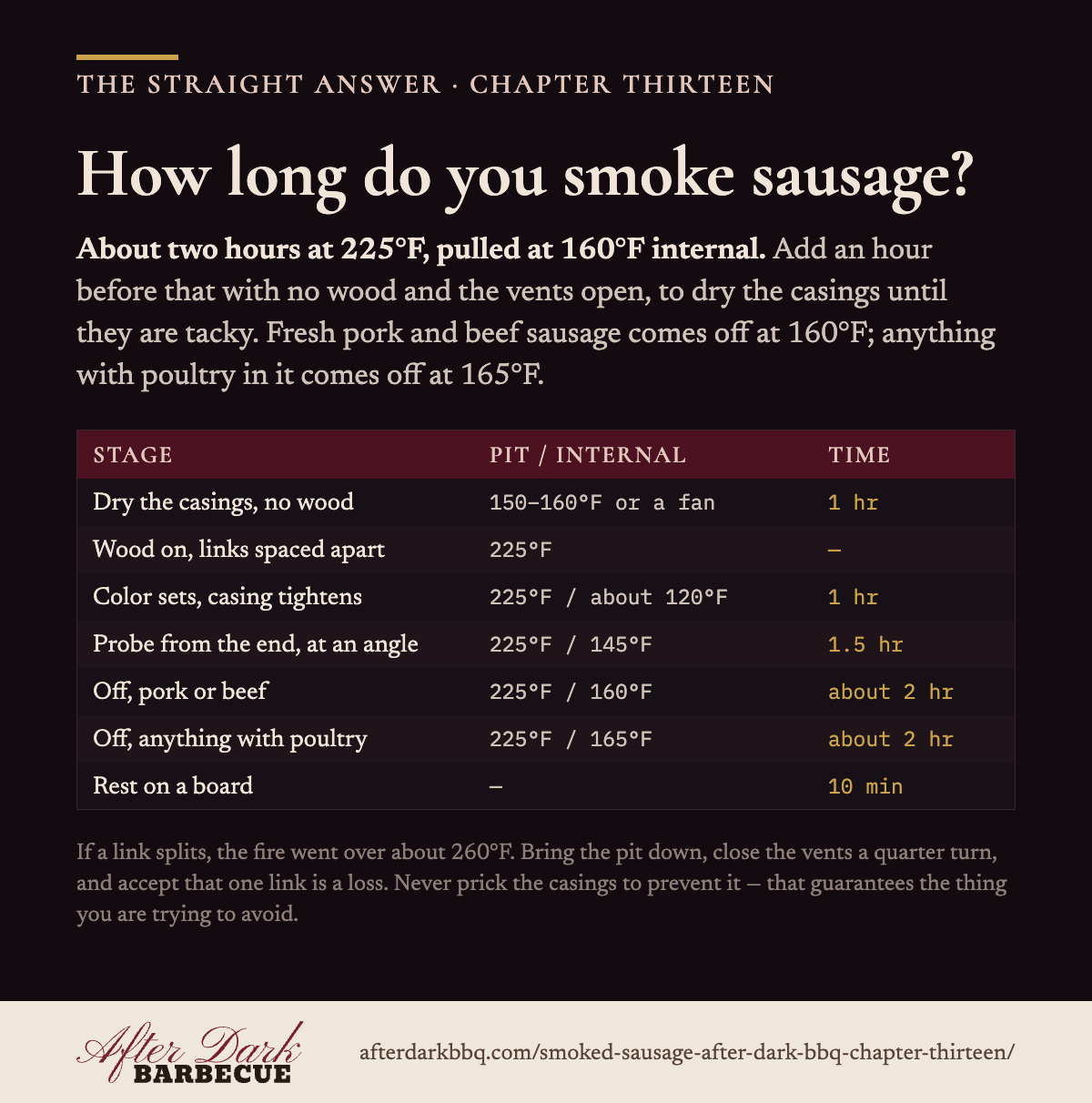
If a link splits, the fire went over about 260°F. Bring the pit down, close the vents a quarter turn, and accept that one link is a loss. Never prick the casings to prevent it — that guarantees the thing you are trying to avoid.
Recipe: The Short Version
Dry: hang the links in front of a fan, or on the pit at 150 to 160°F with no wood, for 1 hour, until the casings are tacky like parchment.
Smoke: 225°F, hickory and apple, spaced a finger apart.
Time: about 2 hours.
Pull: 160°F for pork and beef, 165°F for poultry, probed from the end.
Never: prick the casings, or let the pit climb past 260°F.
Rest: 10 minutes, then bite one standing up.
Next: a turkey breast and nobody to share it with, and the brine that keeps white meat from giving up on you.
The Hard Numbers, Laid Out Bare
How long do you smoke sausage — the chart, the stage table and the questions people actually ask, with no story attached.
Sources
The 160°F minimum for ground pork and beef and the 165°F minimum for anything containing poultry are from the USDA Food Safety and Inspection Service Safe Minimum Internal Temperature Chart. The 40 to 140°F range and the two hour limit out of refrigeration are from the FSIS Danger Zone (40°F to 140°F) fact sheet. The drying hour, the wood timing and the probe-from-the-end method are After Dark BBQ’s own, measured at the grate and stated as ours rather than dressed up as research. Read September 2026.
Volume One, complete. Volume Two, a new chapter every Friday.All the chapters · Write to Dutch

Leave a Reply