Just the hard numbers · Times, temperatures and charts · No foreplay
After Dark BBQTechnique · Brisket
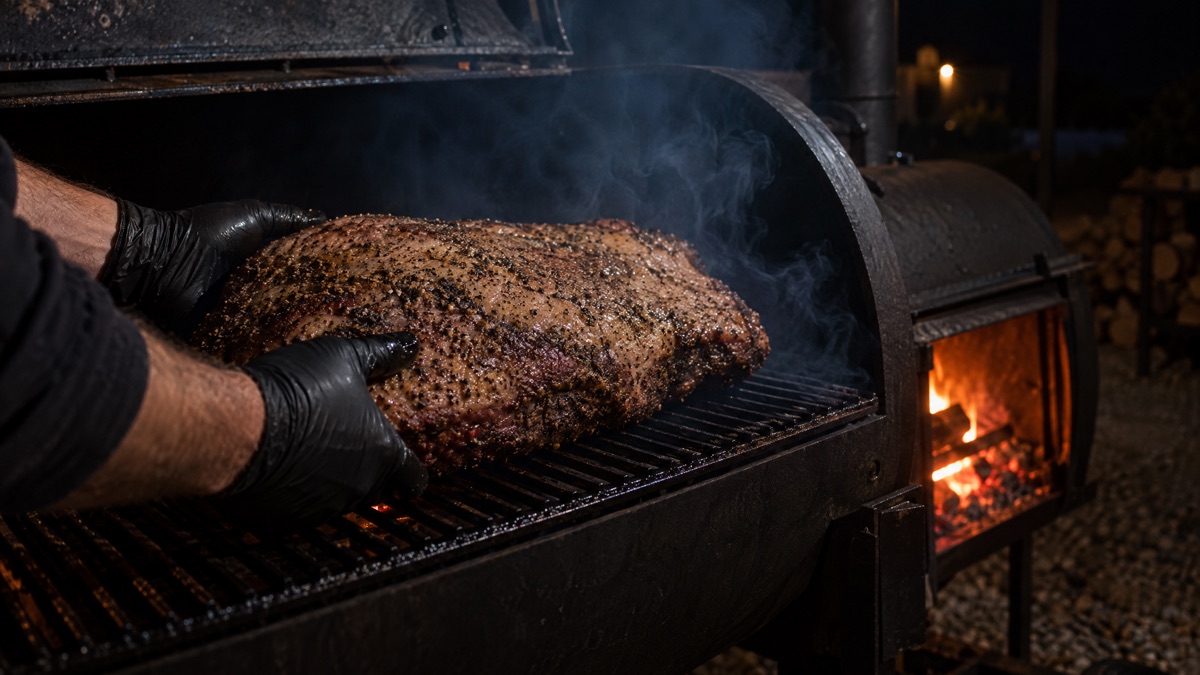
Brisket is done between 195 and 205°F, most often near 203°F. The probe decides it: no resistance in the thickest part of the flat.
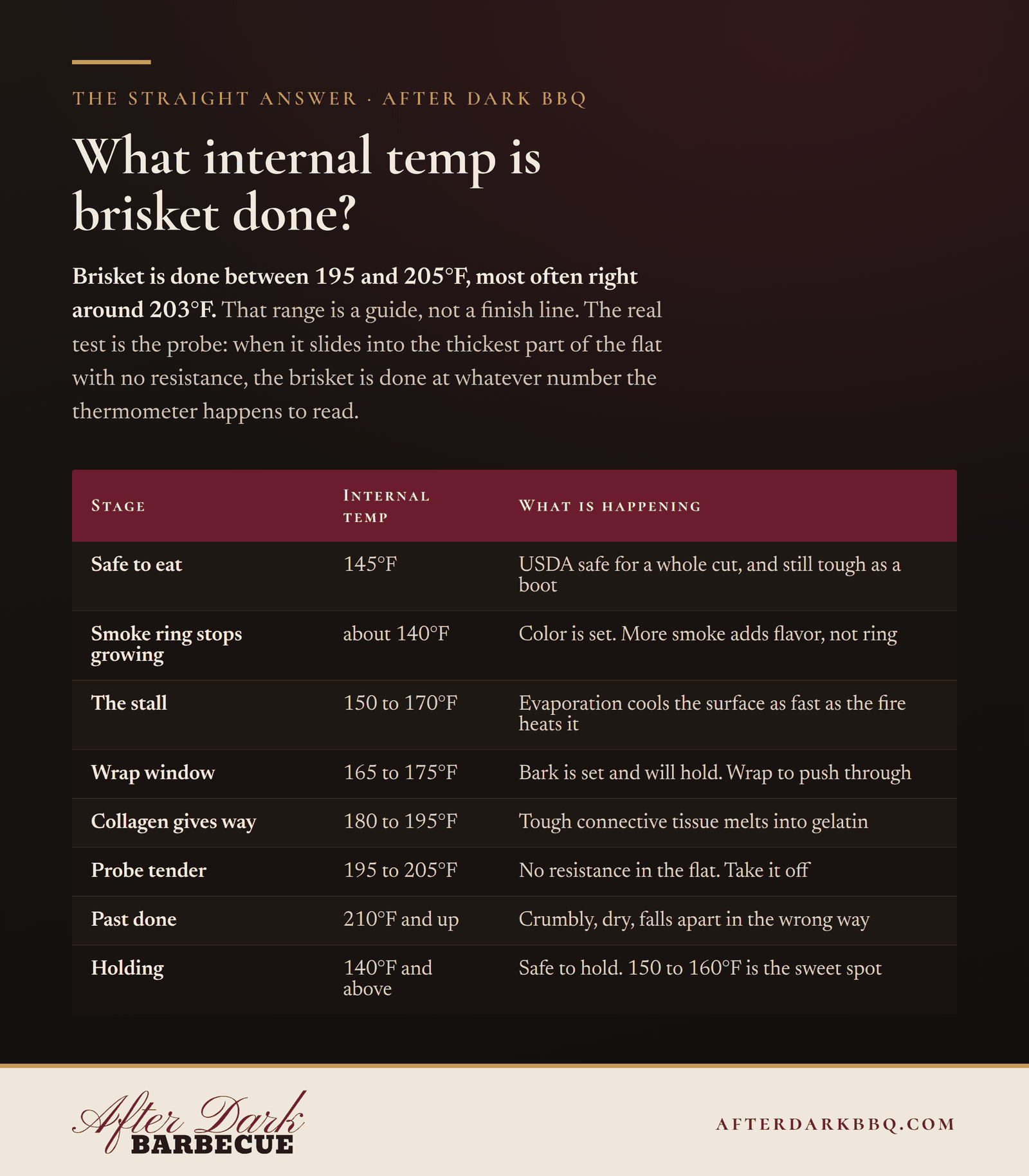
What internal temp is brisket done?
Brisket is done between 195 and 205°F, most often right around 203°F. That range is a guide, not a finish line. The real test is the probe: when it slides into the thickest part of the flat with no resistance, the brisket is done at whatever number the thermometer happens to read.
Trust your hands over the dial. She tells you when she is ready.
Two briskets off the same rack will finish twenty degrees apart. One gives in at 197 and the next one plays hard to get until 207. Nothing is wrong with either. Collagen turns to gelatin over time as much as temperature, so a brisket that has been sitting at 190 for an hour is further along than one that just got there.
| Stage | Internal temp | What is happening |
|---|---|---|
| Safe to eat | 145°F | USDA safe for a whole cut, and still tough as a boot |
| Smoke ring stops growing | about 140°F | Color is set. More smoke adds flavor, not ring |
| The stall | 150 to 170°F | Evaporation cools the surface as fast as the fire heats it |
| Wrap window | 165 to 175°F | Bark is set and will hold. Wrap to push through |
| Collagen gives way | 180 to 195°F | Tough connective tissue melts into gelatin |
| Probe tender | 195 to 205°F | No resistance in the flat. Take it off |
| Past done | 210°F and up | Crumbly, dry, falls apart in the wrong way |
| Holding | 140°F and above | Safe to hold. 150 to 160°F is the sweet spot |
Is brisket done at 190 or 200?
At 190°F most briskets are close but not there. The flat will still push back on a probe and slice a little tight. At 200°F most are ready. If you want one number to cook to, use 203°F, then check by feel before you commit.
The exception is the brisket you have kept low and slow all night long. One that crept from 185 to 195 over two hours has had time to break down and can be perfect at 196. One that shot from 175 to 200 in forty minutes has not, and it needs to sit up there longer.
The Point and the Flat Never Finish Together
A whole packer is two muscles with different amounts of fat, stacked at different thicknesses. The point usually runs 5 to 10 degrees ahead of the flat and takes more heat without suffering. The flat is lean, thin at one end, and it is the part that goes dry.
Probe both, and cook to the flat. If the flat is at 203 and probe tender, the point can take it at 208 and will make better burnt ends for it.
Why is my brisket at 200°F and still tough?
Three reasons, in the order they usually apply. It got there too fast, so the collagen has not had time to break down — leave it on and keep probing. The probe is in the wrong place, hitting a fat seam or the point instead of the thick part of the flat. Or it went in the wrap too early, before the bark set, which steams the meat and slows the render.
Some just take longer to give in. Keep your hands on it and keep probing.
Still firm at 200 is almost never a reason to pull out. Give her another 30 to 45 minutes and probe again.
Can you eat brisket at 160°F?
Safely, yes. The USDA calls a whole beef cut safe at 145°F with a three minute rest. Pleasantly, no. At 160 the connective tissue is still intact and brisket eats like a tough roast. Everything that makes barbecue brisket worth the night happens between 180 and 205.
What internal temp do you wrap a brisket at?
Between 165 and 175°F, and only once the bark is set. Drag a finger across it — if the rub stays put, it is ready to wrap. Wrapping earlier locks moisture against the surface and softens the crust you spent five hours building.
Some cooks wrap at 150 to hurry her through the stall. It works, and it costs bark. The full wrap timing is here.
Where to Slide the Probe In
Into the thickest part of the flat, from the side, parallel to the grate, with the tip in the middle of the meat and not touching fat or a pan. A probe sitting in a fat seam reads high and will have you pulling a brisket that is fifteen degrees short.
Feel around in three or four spots before you call it. The one that matters is the spot that reads lowest.
Temp for sliced brisket, chopped brisket and burnt ends
Sliced brisket wants the lower end, 195 to 200°F, so the slices hold together instead of shredding under the knife. Chopped brisket can go to 205 and past it, since it is coming apart anyway. Burnt ends start from the point at about 195, cubed and sauced and put back on for another hour, which carries them well beyond 205 on purpose.
Resting and Holding: The Afterglow Temperatures
Off the pit a brisket keeps climbing 5 to 10 degrees, so pull a touch early if you are already at the top of the range. Vent it on the counter until it drops under 190, then wrap it in towels in a dry cooler or hold it in an oven set to 150 to 160°F.
An hour is the minimum. Two to four is better. Hands off her. Above 140°F it is safe to hold as long as you like, and barbecue restaurants hold briskets eight to twelve hours on purpose, because the extra time keeps tenderizing without cooking. How long to rest a brisket is here.
Brisket internal temp in Celsius
Done is 91 to 96°C, most often 95°C. The stall runs 66 to 77°C. Wrap at 74 to 79°C. Safe to hold above 60°C.
If you are still at the store, the meat calculator works out how much brisket to buy per person, using the USDA yields for trim and cooking loss.
Don’t Stop Now
Sources
The 145°F safe minimum for whole beef cuts and the three minute rest are from the USDA Food Safety and Inspection Service Safe Minimum Internal Temperature Chart, last updated April 2025. The 40 to 140°F danger zone and the two hour limit are from the FSIS Danger Zone (40°F to 140°F) fact sheet, last updated June 2023. Buying yields behind the meat calculator are from the USDA Food Buying Guide, Meats and Meat Alternates yield table. Pull temperatures, probe technique and the stage table are Dutch’s own. Read September 2026.