Just the hard numbers · Times, temperatures and charts · No foreplay
After Dark BBQTechnique · Brisket
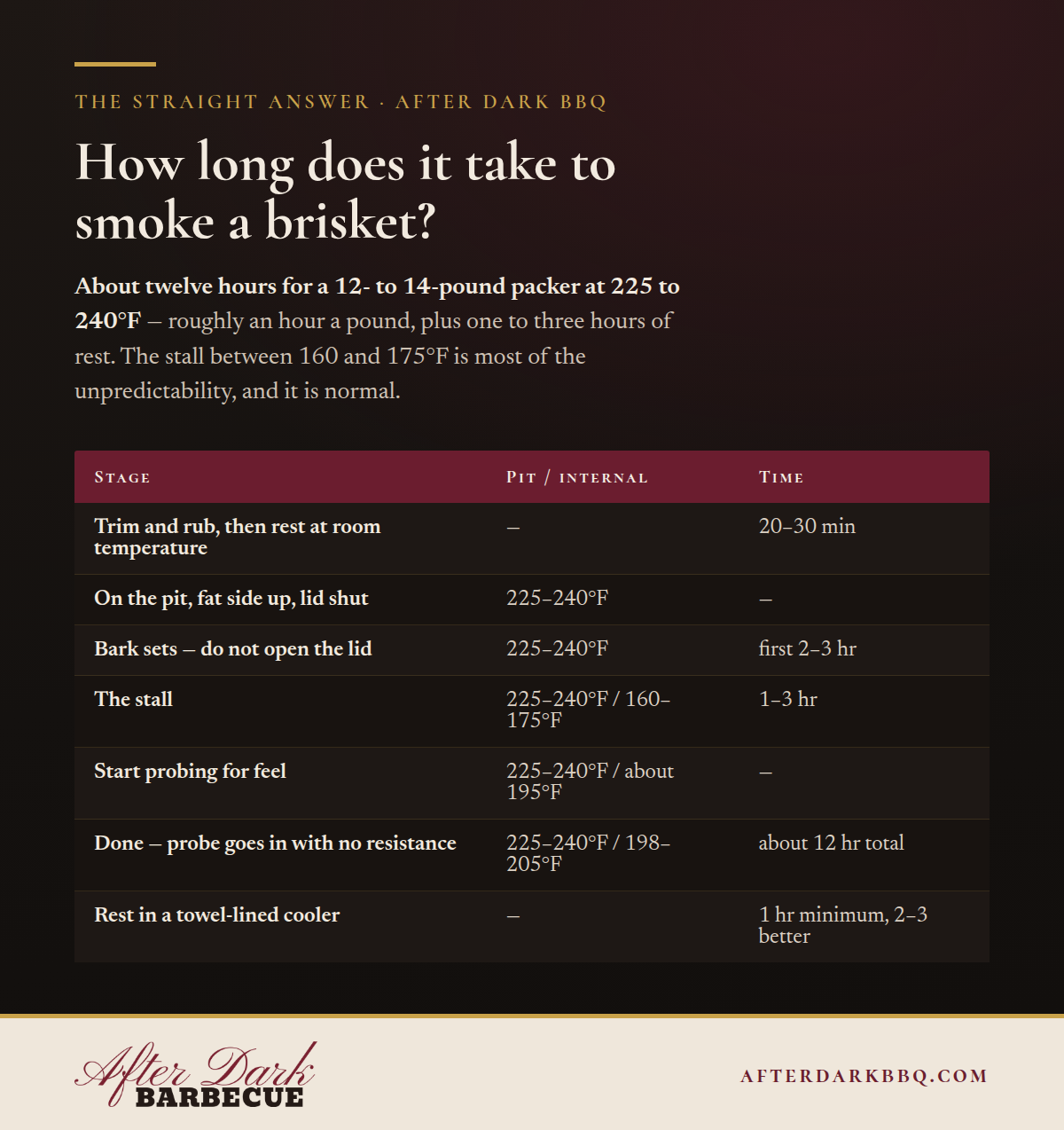
How long to smoke a brisket: about twelve hours for a 12- to 14-pound packer at 225 to 240°F, which is roughly an hour a pound, plus one to three hours of rest. The stall between 160 and 175°F is where the schedule goes wrong, and it is normal.
How long does it take to smoke a brisket?
About twelve hours for a 12- to 14-pound packer at 225 to 240°F — roughly an hour a pound — then one to three hours of rest. That is the honest average, not a guarantee. Two briskets of the same weight on the same pit can finish two hours apart, and the reason is almost always the stall.
It is a long night, and the good ones never rush.
| Stage | Pit / internal | Time |
|---|---|---|
| Trim and rub, then rest at room temperature | — | 20 to 30 min |
| On the pit, fat side up, lid shut | 225 to 240°F | — |
| Bark sets — do not open the lid | 225 to 240°F | first 2 to 3 hr |
| The stall | 225 to 240°F / 160 to 175°F | 1 to 3 hr |
| Start probing for feel | 225 to 240°F / about 195°F | — |
| Done — probe goes in with no resistance | 225 to 240°F / 198 to 205°F | about 12 hr total |
| Rest in a towel-lined cooler | — | 1 hr minimum, 2 to 3 better |
How long to smoke a brisket per pound?
About an hour a pound at 225 to 240°F. A 12-pound packer is a twelve-hour cook, a 14-pound packer is closer to twelve or thirteen, and neither of those numbers includes the rest.
Per-pound math is for picking when to start, not when you finish. Brisket is the cut that lies to the clock the most, because the length of the stall is set by the surface moisture and the airflow over it, not by the weight of the meat.
What time should you put a brisket on?
Work backwards from when people are eating, add the rest, then add two hours you do not intend to use. For a 12-pound packer on the table at six in the evening: on the pit around four in the morning, off by four in the afternoon, resting in a cooler until you slice.
A brisket that finishes early is no problem — it will lie in a towel-lined cooler for hours and come out better for it. A brisket that finishes late is a problem you cannot fix, which is the whole argument for keeping two hours in reserve.
Why does a brisket take so long?
Because the connective tissue has to melt, and that takes time at temperature rather than heat. The collagen running through a packer turns to gelatin slowly in the range between 160 and 205°F, and rushing the pit does not speed it up — it dries the outside before the inside gets there.
The other reason is the stall, and it is the one that catches people off guard. Somewhere between 160 and 175°F the number stops climbing and just lies there, sometimes for three hours. Moisture evaporating off the surface cools the meat as fast as the fire heats it. The fire is fine. Nothing is wrong.
How long is the stall on a brisket?
One to three hours, typically, between 160 and 175°F. It breaks on its own once the bark dries enough that evaporation slows down.
This is the part where she plays hard to get. Wait her out.
You can wait it out or wrap her up and push through. Wrapping in butcher paper cuts an hour or two and softens the bark slightly; leaving it bare keeps the bark at its best and costs you the time. Neither is wrong, and the choice belongs to whoever is staying up. When to wrap a brisket goes through it properly.
Does a brisket cook faster at 250 or 275?
Yes, and the trade is bark and margin for error. At 275°F a packer can come in around eight hours instead of twelve. At 225 to 240°F it takes longer and the bark is better, and there is more room to be a little wrong about the fire without paying for it.
Down here, the brisket goes on at 225 to 240 because the whole night is the point. If you need it faster, what temp to smoke a brisket lays out what each temperature costs.
How do you know when a brisket is done?
By feel, not by the clock and not really by the number. Start probing around 195°F. It is done somewhere between 198 and 205°F, when a probe slides into the flat with no resistance — the phrase everyone uses is warm butter, and it is accurate.
When the probe slides in with no resistance at all, you will know.
The number tells you when to start feeling for it, not when you are finished. Two briskets can be perfect at 198 and at 205. Brisket internal temp covers why 203 is a landmark rather than a rule.
How long should a brisket rest?
An hour at the absolute minimum. Two to three is better, wrapped and set in a towel-lined cooler with nothing else in it.
The rest is not idle time — it is the last part of the night. Cut into a brisket straight off the pit and the juice runs all over the board instead of staying in the meat. How long to rest a brisket has the holding times, including what to do when it finishes six hours early.
What wood goes with brisket?
Post oak, first and mostly. It burns clean, it burns long, and it is what central Texas has used on beef for a hundred years for good reason. Apple or a little hickory will do if oak is what you do not have.
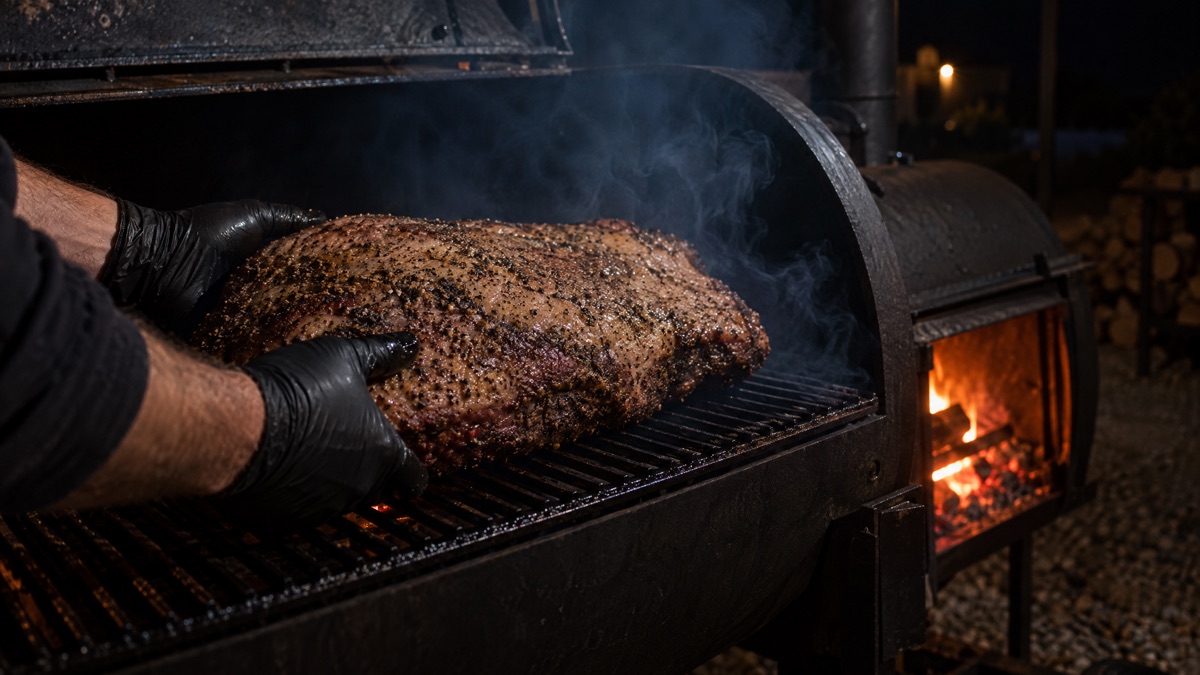
Whatever you burn, keep it small and bright. Twelve hours is a long night of smoke on one piece of meat, and a fire that smolders that long will make it taste like an ashtray. Thin blue smoke, or nearly nothing visible at all.
How much brisket per person?
Half a pound of raw brisket per adult is the working number, three quarters if brisket is the only meat and people are hungry. A whole packer loses roughly half its weight to trim, fat and moisture over twelve hours, so a 14-pound brisket feeds about fourteen people and leaves very little.
Buy more than the arithmetic says. Nobody ever woke up regretting leftover brisket. How much meat per person has the chart for a full table.
Don’t Stop Now
Sources
The stall is evaporative cooling, and it is well documented: moisture leaving the surface of the meat carries heat away at roughly the rate the fire is adding it, which holds the internal temperature flat between about 160 and 175°F until the surface dries. It is the same mechanism as sweat, and it is why wrapping — which stops evaporation — ends it.
The United States Department of Agriculture’s safe minimum internal temperature for whole cuts of beef is 145°F with a three-minute rest. Brisket goes far past that, to 198 to 205°F, for texture rather than safety: that is the range where the collagen has turned to gelatin and the meat gives up.
The times, the 225 to 240°F pit, the bare first three hours and the towel-lined cooler are the method as it is cooked in chapter two of the story, on a backyard offset, overnight.