Letters to Dutch · A reader confesses · Write in and yours may be next →
Letters to Dutch
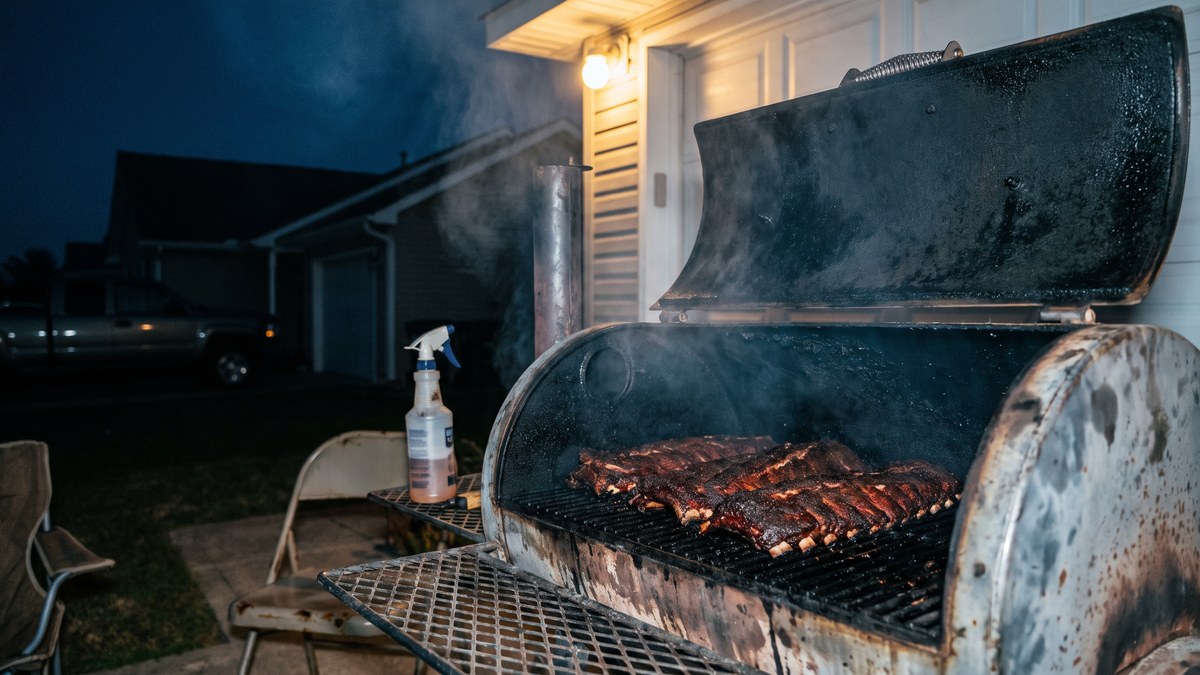
A reader held 250°F all night, stalled two hours and never reached for the foil. What that does to St. Louis ribs, and how long it really takes.
From Letters to Dutch. Every temperature, time and technique below is one you can run on your own pit tonight, after the lights go down.
Dear Dutch,
I never thought I would be writing to you about this. I have run the same offset for nine years, I drive a delivery route for a living, and in all that time nothing has happened to me at a pit worth telling anybody about.
It was a Thursday. My wife had driven her mother to Springfield and was not coming back until Sunday. I had two racks of St. Louis cut sitting in the second refrigerator that I had bought on sale, and no reason on earth to start them at ten o’clock at night.
I pulled the membrane off both of them on the counter under the range light. It came away clean on the first one and fought me the whole way on the second. I rubbed them down and then I let them sit, and I remember standing there a good deal longer than I needed to, just looking at them.
I am still not sure what I was waiting for.
The fire had been going since sunset. I brought it up to 250 and I held it there. Small corrections to the intake, a split every forty-five minutes, nothing dramatic. The smoke came off thin and blue, which is the only kind worth having, and I have cooked long enough to know the difference.
For ninety minutes I did not touch them. That is the part nobody tells you about. You want to open that door and you do not open it.
Then I started spritzing. Every forty-five minutes after that, light, just enough to keep the surface soft without washing anything off it.
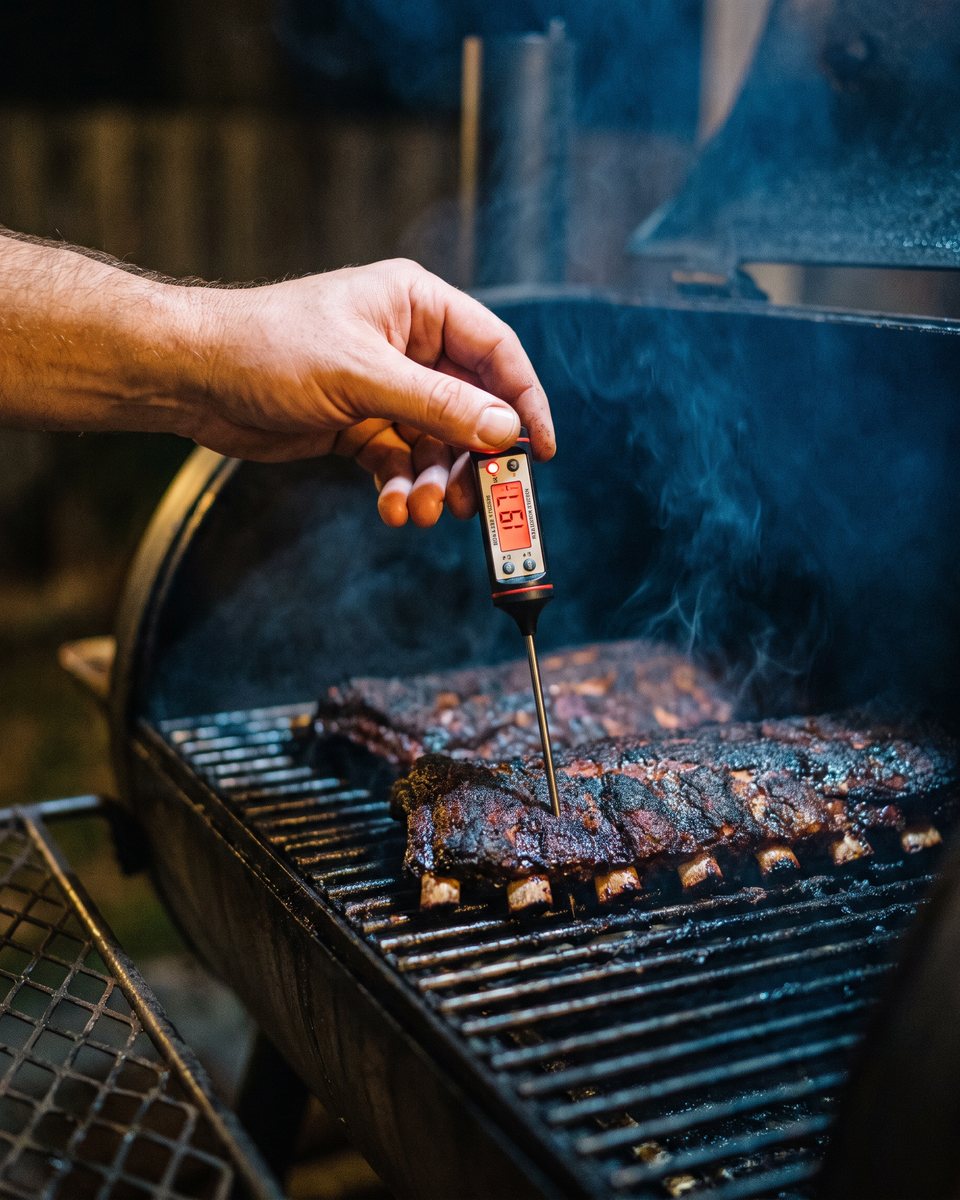
At the two-hour mark the probe stopped moving. 154. It sat there. 156. It sat there. Everything I have ever read told me to wrap it and push it through, and I did not. I let it work.
I would like to tell you I was patient about it. I was not patient. I was out there in the dark with a folding chair and a flashlight and I checked that probe more times than a grown man ought to admit to in writing.
The bark went dark and then it went tight, and somewhere around one in the morning it stopped dimpling when I pressed my thumb into it. Only then did I reach for the foil.
After that it moved. 178. 190. At 197 the probe slid between the bones and met almost nothing, and at 203 it met nothing at all.
I pulled them and I tented them and I gave them twenty full minutes, because I have ruined enough ribs in my life by being in a hurry at the end.
It was 2:40 in the morning. I stood out in the driveway in my work socks and I did not call one person to tell them.
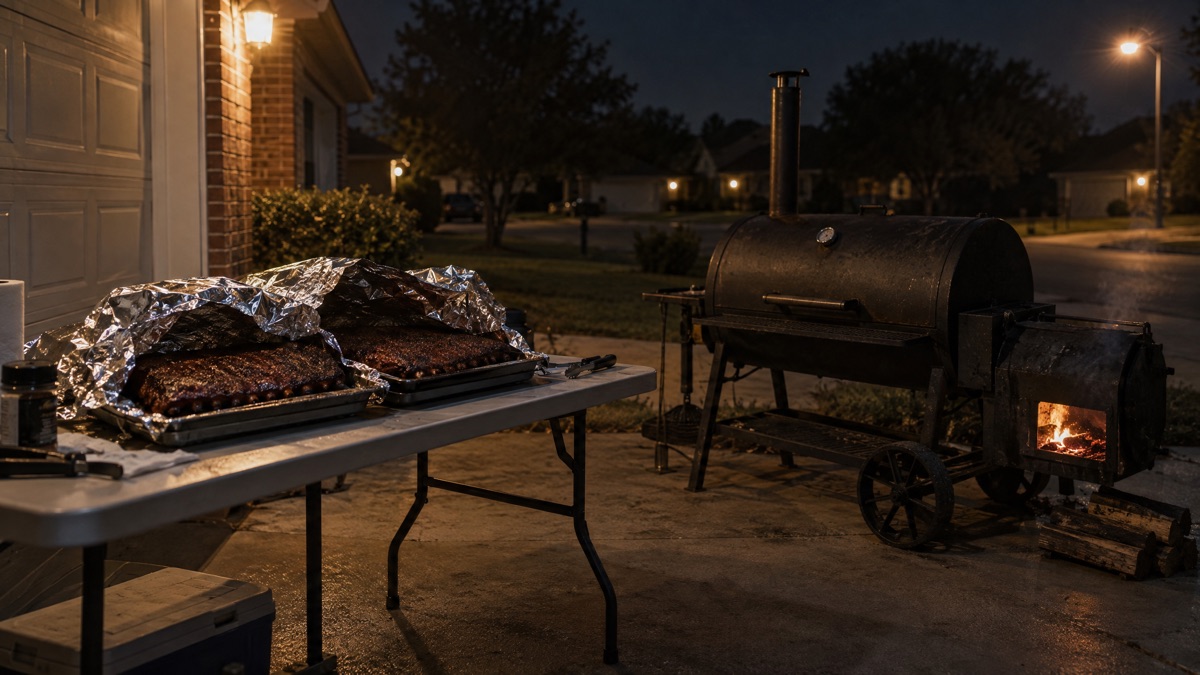
— Dale, Carthage
Dale, the hours you left it bare and unwrapped were the entire cook. Collagen gives in and turns to gelatin all the way from 160 to 203 degrees, and it wants to be held at temperature a good long while, not rushed by a man in a hurry to finish.
What you sat through at 154 is your meat sweating faster than the fire can warm it back up. It ends on its own when the bark firms up and stops sweating, which is exactly what you stayed up to watch at one in the morning.
Twenty minutes tented and lying still was right. Ten is the floor, never the goal.
— Dutch
How long does it take to smoke St. Louis ribs at 250 degrees?
Five to six hours at 250 degrees. Leave them untouched for the first 90 minutes, then spritz every 45 to 60 minutes to keep the surface flexible. Expect a stall around 154 degrees that can last two hours; it ends when the bark dries and stops dimpling under your thumb. Wrap at that point if you want to. Done is 195 to 203, probe tender. Rest 20 minutes tented.
| Stage | Pit temperature | Internal | Time |
|---|---|---|---|
| Untouched, no spritz | 250°F | — | first 90 min |
| Spritz on a cycle | 250°F | — | every 45–60 min |
| The stall | 250°F | around 154°F | up to 2 hours |
| Wrap, optional | 250°F | once the bark sets | — |
| Done | 250°F | 195–203°F | probe tender |
| Rest, loosely tented | — | — | 20 min (10 is the floor) |
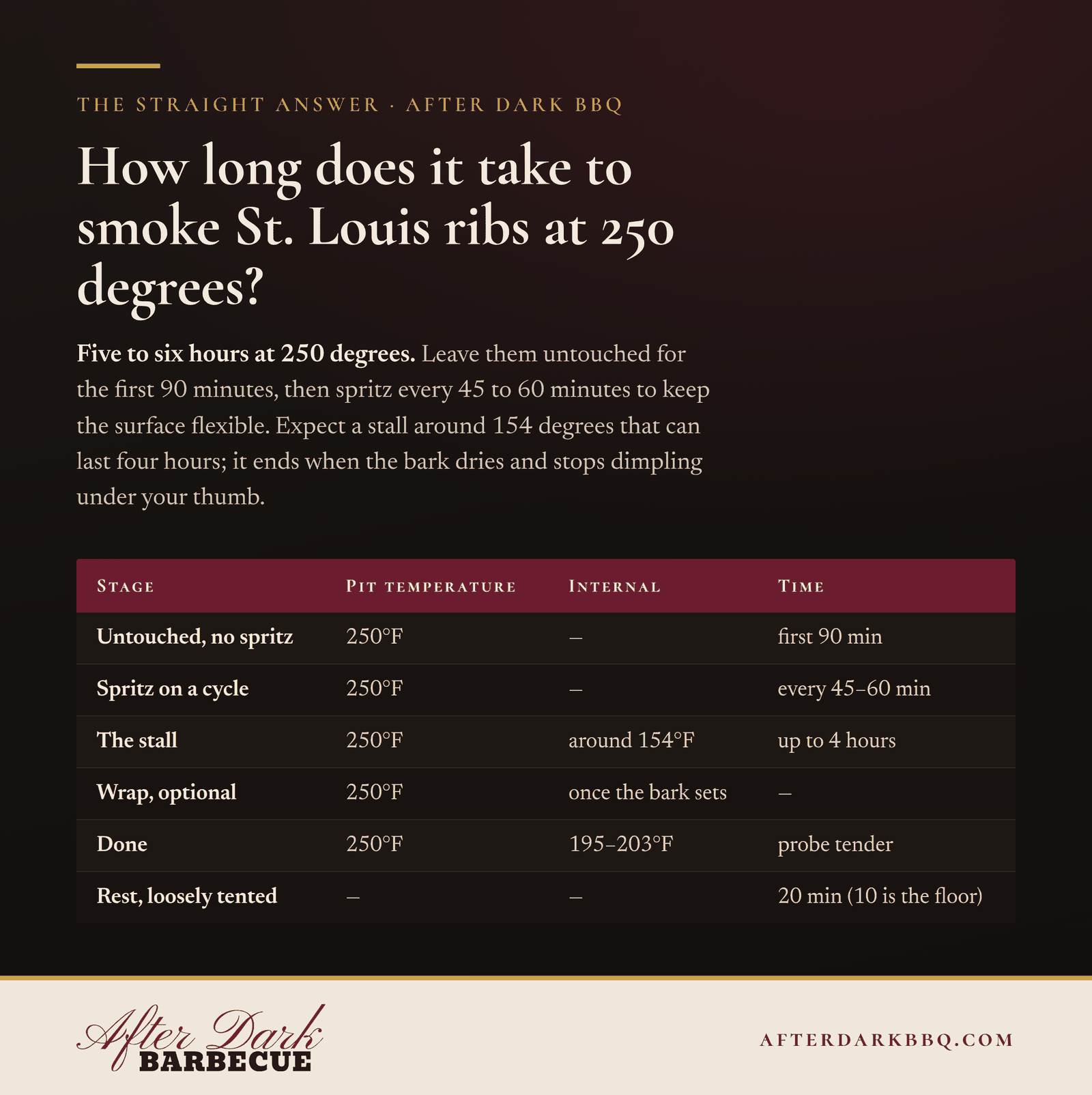
How to read this: Pit temperature is what the smoker holds; internal is what the meat reads on a probe. The stall is the long flat stretch where the internal number stops moving — it is normal. Wrapping is a choice, not a step: it shortens the stall and softens the bark. The finish is decided by how the probe feels, not by the clock.
The full method, straight: smoked rib technique, the 3-2-1 method compared, and the smoking time and temperature chart.
This is the cook from the story above with nothing left on: just the numbers, ready for your own pit.
Stay a While Longer
The chapters: Chapter One — Midnight Ribs · Chapter Two — Overnight Smoked Brisket · Chapter Three — Overnight Pork Butt · Chapter Four — Smoked Beef Ribs · Chapter Five — Smoked Whole Turkey
Letters to Dutch: The Night the Brisket Would Not Let Me Sleep · What Temp Are Ribs Done?
The technique pages: How Long to Smoke Ribs · How Much Meat Per Person · the whole technique library
Everything at the After Dark BBQ hub · Who Dutch Colburn is · Write to Dutch

Leave a Reply