Chapter Five · Whole turkey at 250° · Four hours
Chapter Five
THE RIVAL ARRIVESONE NIGHT A YEARHE LET HIM WATCH
Heat Somebody is going to get burned
Chapter five of After Dark BBQ: a whole turkey spread flat and kept low at 250, dried the night before, four hours instead of seven.
Flat is not a shortcut. Flat is admitting what you actually want.
A Turkey Is Not a Small Brisket
Everything Henry has cooked in this story so far wants time. A butt wants fourteen hours. A plate rib wants nine. A turkey wants none of it. A turkey wants to be finished with in one afternoon, and the men who ruin one ruin it by being patient, by taking all night over something that was done with them by half past ten in the morning.
A turkey is lean. There is no fat cap to hide behind, no collagen to melt, no stall to wait out, nothing to do but pay attention the whole way through. The breast comes off at 160, rests up to 165, and is ruined at 175, and the thigh will not give in until 175, which means the whole bird is two appetites on one clock and they do not want the same thing at the same time. Left whole, the thighs finish a full hour after the breast, and by then the breast has stopped speaking to anybody. Spread flat, backbone out and breastbone cracked, every part of it lies at the same height over the same fire and both of them finish together.
This chapter is the day before Thanksgiving, six birds, and a man who has spent eleven years doing them whole and has never once opened one up. The method underneath it is the one that works on any pit: brine, dry overnight uncovered, spatchcock, 250 degrees, skin side up, off at 160 in the breast and 175 in the thigh.
The One Night a Year Nobody Says No
Fridays have been beef ribs for two months. Lena comes on Tuesdays now, after dark, and leans on the fence, and Henry has stopped pretending he is not listening for her truck the whole rest of the week. This time she comes on a Sunday, which she has never done, and a man does not need it explained to him what it means when a woman stops waiting for her night.
It is four days off.
LenaThanksgiving. He feeds the highway. Every year. Closes to paying customers and feeds whoever comes in the door — truckers, the county’s strays, anybody with nowhere to be. Six turkeys. He does them himself, behind the roadhouse, on a pit older than you are.
HenryAnd.
LenaAnd the pit rusted through last week. Firebox is on the ground.
She rests her forearms on the rail.
LenaHe wants to bring the birds here Tuesday night. He wants to be here Wednesday when they go on. He’s not going to like anything you do.
Henry has had one turkey in his life, three Thanksgivings ago, whole, at 225, for seven hours, and he still cannot talk about what he did to the breast.
She says it like she was there.
LenaFlat. Every one of them. Backbone out, spread it flat, and keep the pit low. He’ll argue. Don’t let him.
She pushes off the fence.
LenaAnd dry them Tuesday night. Whatever you do to a turkey, you do it the night before.
Featured Fuel: Ashfell Fuelworks Cherry Splits
A turkey takes smoke faster than anything with a fat cap, and it takes too much of it just as fast. In the After Dark BBQ universe, Henry runs birds on Ashfell Fuelworks kiln-dried cherry because it is hard to overdo a turkey with cherry in four hours.
- Cherry is mild and a little sweet, and it turns poultry skin a deep bronze without the bitterness hickory leaves on a short cook.
- Apple and pecan do the same job. Post oak is fine. Mesquite and heavy hickory are not — four hours of either tastes like a campfire.
- Small splits, small fire, thin blue smoke. A turkey wants it clean and steady at 250, not a slow smolder that never gets anywhere.
- One bag does six birds. It is a short night, and a bird does not need all of it.
He Brought Them Himself
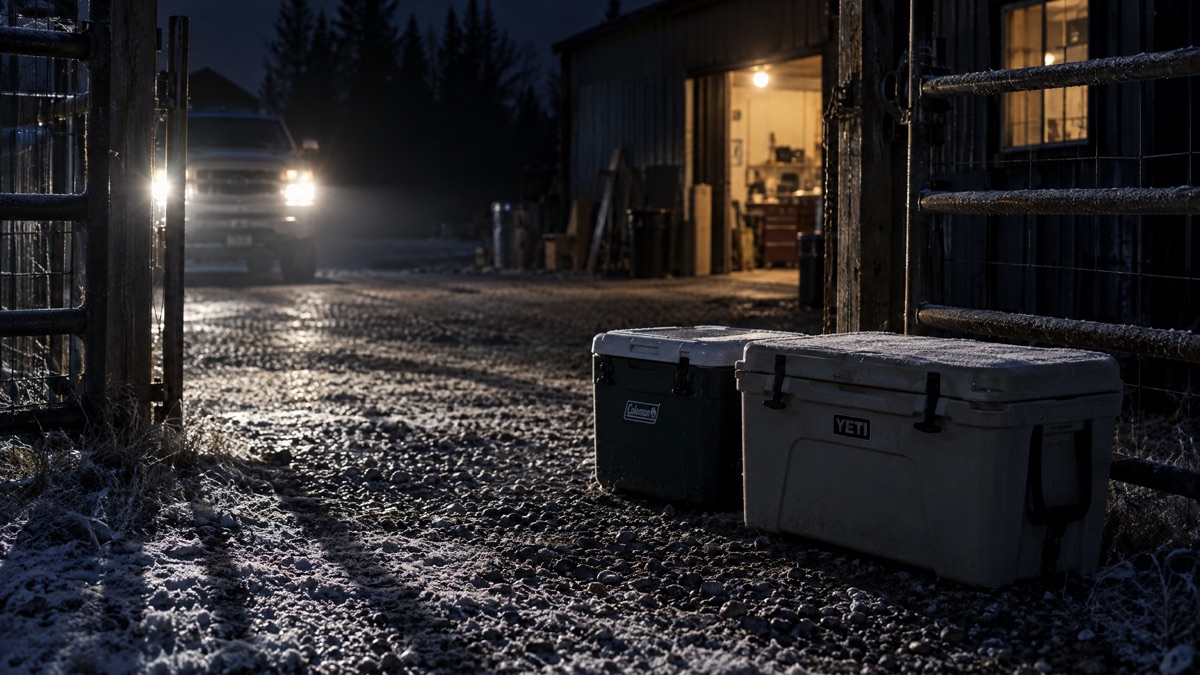
Tuesday, seven at night, and the alley is white with the first frost of the year. Headlights come down it slow and stop at the gate, and a truck door shuts, and then the gate clicks and the man from the roadhouse walks into Henry’s yard carrying a cooler in each hand like they weigh nothing at all. He does not knock. A man bringing six birds does not knock.
He sets them down by the workshop door. Goes back for two more. Then two more. Six birds, wet since Monday night, twelve to fourteen pounds apiece and every one of them soaked clean through to the bone. He has the same reading glasses pushed up on his forehead and he has brought his own mug, which is a thing a man only does when he has already decided he is staying.
A turkey is the one bird most people get into bed with once a year and disappoint once a year. It is not a hard cook. It is a cook that punishes a man for treating it like a brisket — low and slow and left alone all night — when what it wants is four hours, flat on its back, at 250, with the skin dried and waiting since the night before.
You can read this one for who stood in the door at the end. I read it for the backbone Henry took out of six birds, one at a time, while a man who had spent eleven years keeping his birds closed stood on the other side of the table and watched Henry open every one of them, and did not trust his own voice enough to say a word.
— Dutch
It is the first word he has said in Henry’s yard.
The manWhole. Eleven years.
HenryFlat. This year.
The man looks at the Ironbound, still cold, and at the workshop, and at the two folding chairs pulled up side by side under the bulb close enough to touch, and whatever he works out from that he decides not to say out loud in the dark.
The manShow me, then.
The birds come out of the brine onto the stainless table one at a time, cold and heavy and slick, and Henry takes the first one dry with a whole roll of paper towels, every fold of it, everywhere it is still wet, while the man stands there and watches him do it and does not offer to help. Then he lays it face down, picks up the poultry shears, and goes in along one side of the backbone from the tail all the way up to the neck, and the shears come through the rib bones one after another with a sound like a man walking slow on gravel.
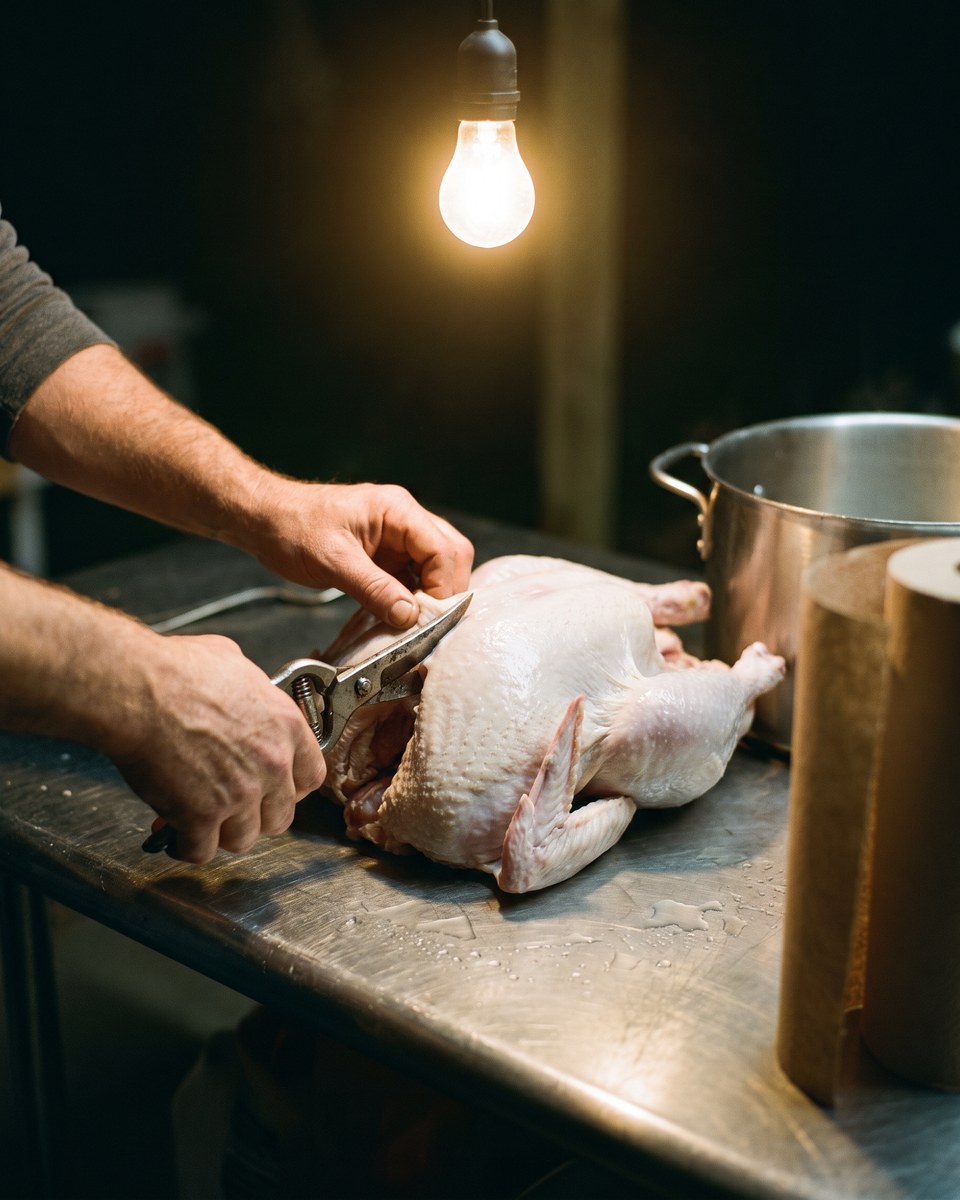
The man does not say anything. Henry goes up the other side just as slow. The backbone comes out in one long piece and goes straight in the stockpot, and neither of them pretends that was not something to watch.
He turns it over. Puts the heel of his hand square on the breastbone, and leans his whole weight down into it, and the bone gives with a crack you can hear across the yard, and the bird goes flat open on the steel with everything it has showing, like it has finally quit holding out on him.
Technique Spotlight: How to Spatchcock a Turkey
Spatchcocking is the single change that fixes a smoked turkey. It takes four minutes and a pair of poultry shears, and it gets the bird there in half the time, with the breast and thighs finishing together.
- Set the bird breast side down. Cut up one side of the backbone with heavy shears, from tail to neck, through the rib bones. Cut up the other side. Pull the backbone out and save it for stock.
- Flip the bird breast side up. Press hard on the breastbone with the heel of your hand until it cracks and the bird lies flat.
- Tuck the wing tips back behind the shoulders so nothing gets burned that did not ask for it.
- Flat, a 12- to 14-pound turkey cooks in about four hours at 250. Whole, the same bird takes six or seven, and the breast is dry before the thigh is safe.
Left Uncovered All Night
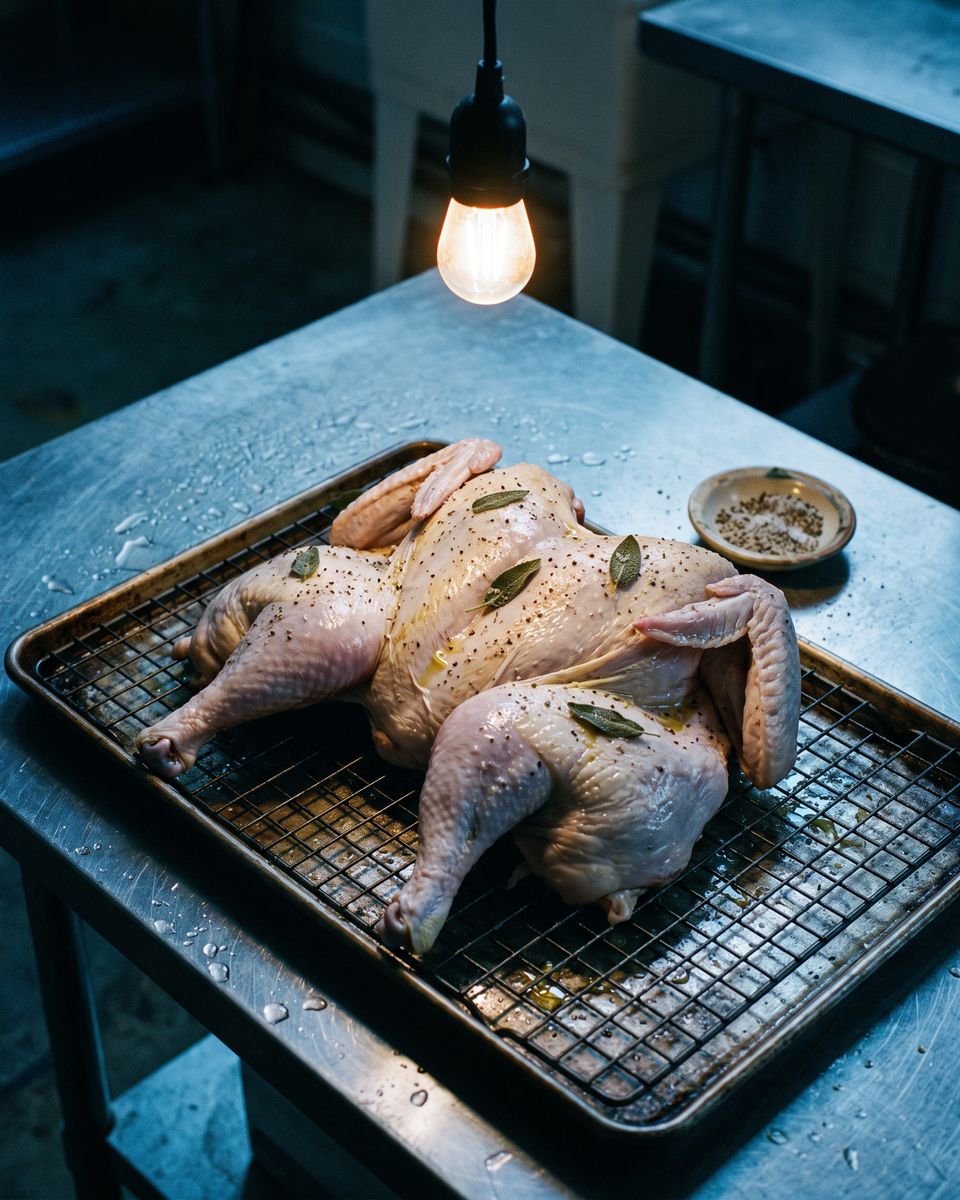
Wednesday, five in the morning, and the man is back at the gate before Henry has the fire lit. Six flat birds come out of the workshop fridge, and the skin on every one of them is dry to the touch, tight and drawn and gone a little see-through, because Henry did exactly what Lena told him to do: after the man left Tuesday night he laid every one of them out uncovered on a rack with nothing over them at all, and left them that way in the workshop fridge all night, cold and bare to the open air, and eight hours of that will take the last of the wet out of anything.
The manYou dried them.
He touches one with the back of a knuckle.
HenryOvernight.
The manI never dried them.
HenryHow was the skin?
The man does not answer that, which is an answer.
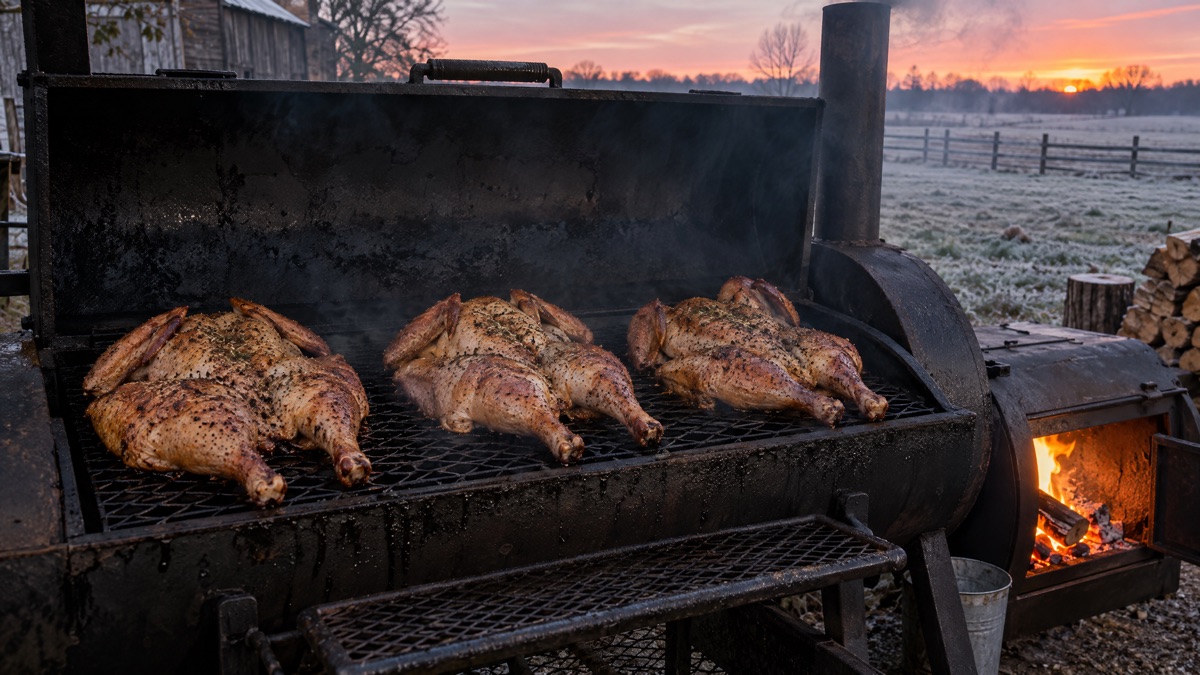
A thin coat of oil worked into the skin by hand, everywhere, until the whole thing shines under the bulb. Salt, pepper, a little granulated garlic and a little sage, nothing that will burn in four hours. The Ironbound is at 250 by 6:30, the water pan full, cherry on the fire. The birds go on skin side up, two to a row, legs open toward the firebox where the heat is worst and the breasts pointed at the stack. A probe into the thickest part of the biggest breast, another one into a thigh, neither of them touching bone. Lid down at 6:40, and after that the only thing left to do is leave them alone and let the fire have them.
The man is looking at the lid thermometer.
The manLow.
Henry“Low all the way. I’m not opening it up at the end.”
The man“The skin’ll be rubber.”
HenryNot if it’s dry going on. That’s what the night was for.
The man drinks from his mug and does not say he will believe it when he sees it, because he is not a man who says things like that out loud. He sits down in the good chair. Henry does not tell him whose it is, or what usually happens in it, or who has been sitting in it every Tuesday since August.
Technique Spotlight: The Brine, and the Bird You Should Not Brine
A brine is insurance against a dry breast. It is also the thing most people take too far.
- Wet brine: one cup of kosher salt and a half cup of brown sugar per gallon of cold water, bird fully under, 12 to 24 hours in a cooler with ice or in the fridge. Rinse, then dry.
- Dry brine, if you have no cooler to spare: a half teaspoon of kosher salt per pound rubbed over and under the skin, uncovered on a rack in the fridge for 24 to 48 hours. No rinse. The skin dries while it brines.
- Read the label. A bird sold as “enhanced” or “contains up to 8 percent solution” has already been brined at the plant. Brining it again makes ham. Dry it overnight and skip the salt bath.
- Either way, the last twelve hours before the cook are for drying, uncovered, in cold air. Dry skin is what crisps up. Wet skin just lies there and steams.
Mara Pulls Up a Third Chair
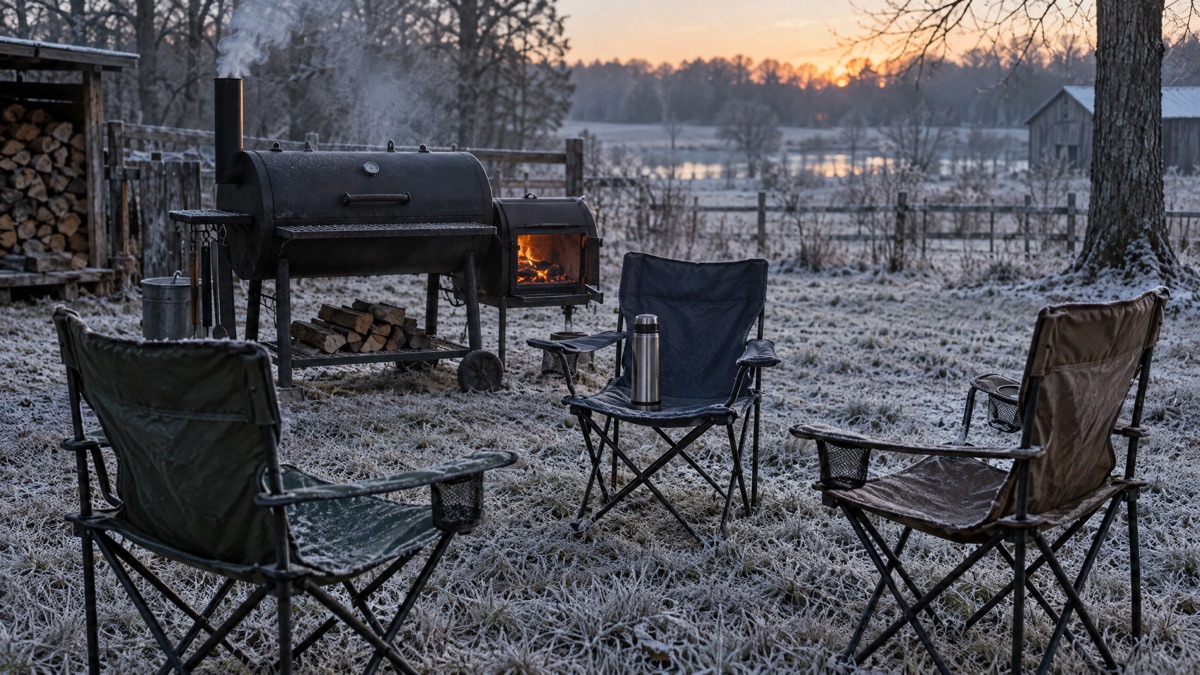
At nine the gate clicks and it is a chair first again, and then Mara behind it in jeans and a flannel shirt and a canvas jacket, covered up for the weather for once, with a thermos under her arm.
She stops dead when she sees the good chair is already taken, and taken by somebody who is not Henry and is not Lena. She looks at the man. The man looks back at her over the rim of his mug and does not get up.
MaraYou the roadhouse.
Not a question.
The manI’m the roadhouse.
MaraHuh.
She unfolds her chair and sets it down on the far side of the Ironbound from him, which puts Henry in the middle with a woman on either side of him and nowhere safe to look, and pours coffee into the cap of the thermos and puts it in his hand without looking at him once.
MaraSix birds?
HenrySix.
MaraFlat?
HenryFlat.
She looks at the stack, then at the man in the good chair, then at Henry.
Mara“So you’re going to spread it flat and keep it low all morning, and he’s just going to sit there and watch you do it.”
The man“That’s the arrangement.”
Mara considers him for a second longer.
MaraWell, somebody should.
And she sits.
Science Spotlight: Why Turkey Skin Goes Rubbery, and What Actually Fixes It
Every cook who has smoked a turkey low has served rubber skin at least once, and most of them blame the temperature. The temperature is only half of it. The other half happened the night before, or did not.
- Skin crisps when its water is gone and its fat has rendered. At 250, the fat renders fine; what does not happen is the drying, because a wet bird in a humid smoker spends the first two hours steaming its own skin.
- Drying the bird uncovered in the fridge for 12 to 24 hours removes most of that water before the cook starts. The skin goes on tight and translucent, and at 250 it turns bronze and bite-through instead of pale and chewy.
- A thin coat of oil, worked in by hand, helps it brown. Butter under the skin flavors the meat; it does not crisp the skin, and too much of it makes the skin slide.
- If you skipped the overnight dry and the skin is soft at 150, the fallback is heat: run the pit up to 325 for the last 15 to 20 minutes. It works. It is also the thing the night before was for.
160 in the Breast, 175 in the Thigh
A turkey does not stall. It does not make a man wait and it does not make him ask twice. At 250 the probe in the big breast climbs like a clock — 90 at eight, 118 at nine, 141 at ten — and there is no number to sit out. There is only the two of them running at each other, and flat, they run close: the thigh stays fifteen degrees out in front the whole way, which is exactly how a man wants it, because the thigh has fifteen more to give before it is ready and the breast does not have one.
The man watches the numbers the way Lena watches the stack. At ten he gets up, lifts the lid a hand’s width, takes one long look at the skin, and puts the lid straight back down like a man caught looking, and sits.
MaraBronze.
The manBronze.
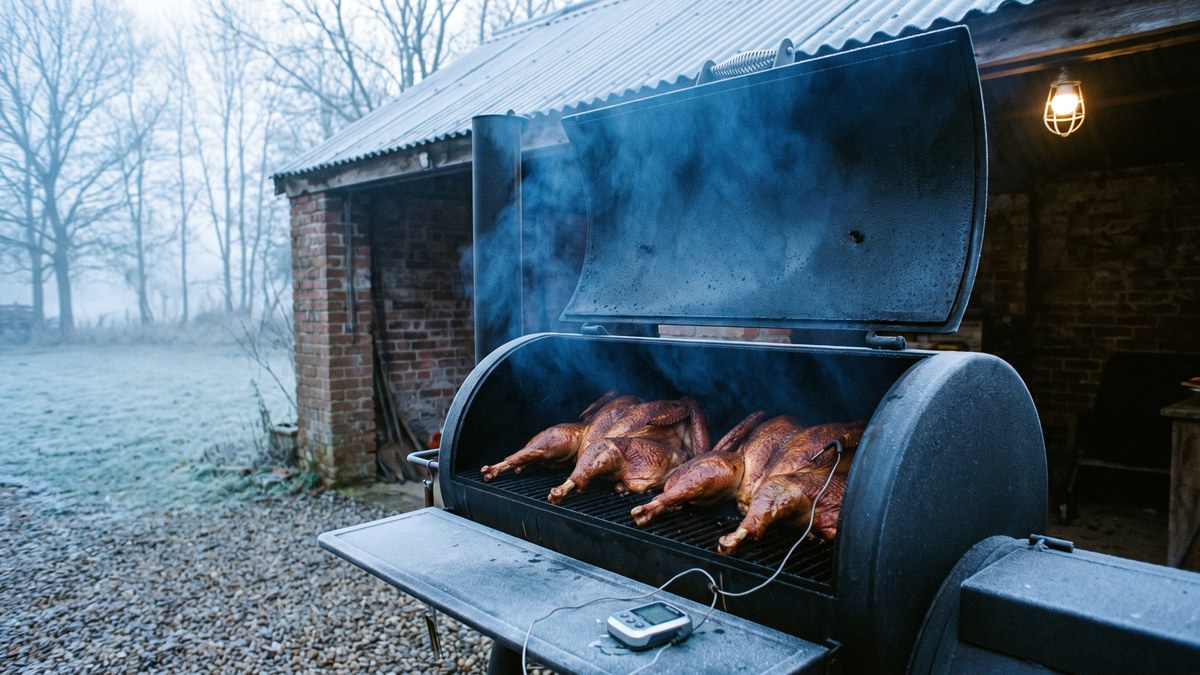
At 10:35 the breast reads 160 and the thigh 176, and Henry pulls on the ForgeGuard gloves and takes the lid all the way off. Six birds the color of an old penny, skin drawn tight and cracked open across every breast, legs spread flat and gone dark at the ends. He slides the probe out of the big one and into the next breast, and the next, and the next, and every one of them is inside four degrees of the last, because laid out flat like that they all took the same fire from the same height for the same four hours and not one of them got any less of it than the others.
The manFour hours.
HenryThree fifty-five.
The manEleven years I gave them seven.
The birds come off onto sheet pans and get tented loose in foil, and the breast keeps climbing under there on its own to 165 the way it is supposed to, and at 11:10 the gate clicks and Lena is standing in it with the truck still idling in the alley, and she looks at the three chairs, and the six birds laid out flat and spent, and the man, and says nothing at all, which from her is a speech.
History & Culture: The Bird That Fed the Highway
Smoked turkey is older in this country than the oven-roasted kind. Native cooks smoked wild birds over hardwood coals long before there was a holiday to put them on, and the East Texas smokehouses that still ship whole smoked turkeys by mail every November have been doing it since the Depression.
The roadhouse Thanksgiving is its own tradition, unwritten and everywhere: the diner on the two-lane that stays open for the drivers who cannot get home, the bar that closes its register and puts out a table. It is the same instinct as the church basement and the fire hall — feed whoever comes in the door. In After Dark BBQ, when a man who has cooked six turkeys a year for eleven years carries them into somebody else’s yard, he is not handing off a job. He is making sure the highway gets fed.
Laid Out on the Board
At 11:30 the man takes the first one himself, on Henry’s board, with Henry’s knife, without asking anybody. The breast comes away off the bone in one whole piece and he lays it out flat and opens it across the grain, and it is white and wet the whole way through with a quarter inch of pink up under the skin where the smoke got in and stayed, and the skin on top of every slice gives the second he puts a finger on it.
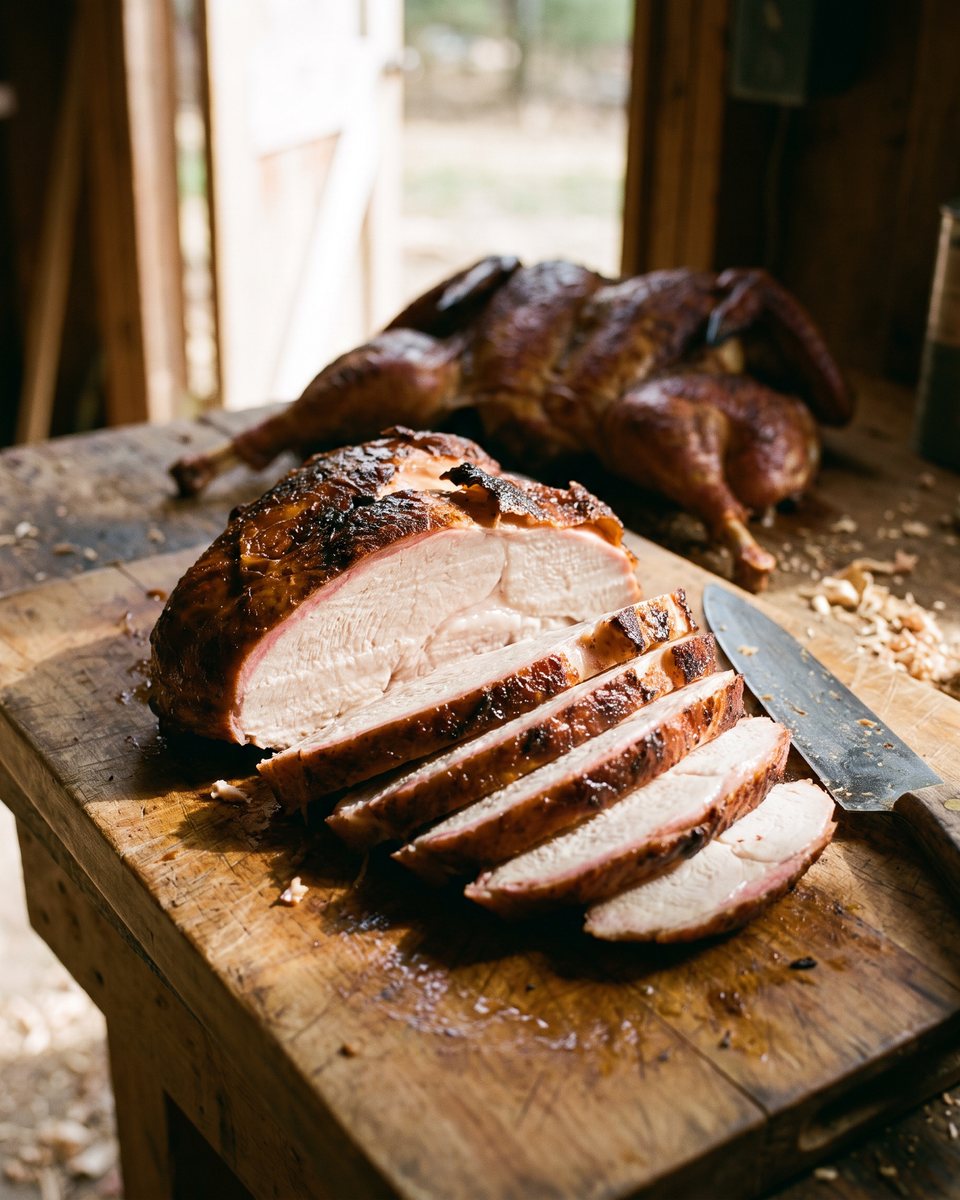
He eats a piece standing up. Chews slow. Then he looks at the Ironbound for a long time, the way a man looks at something that has just done to him what nobody ever told him it could.
The man“Flat, and low.”
Henry“And dried the night before.”
The manAnd that.
He wipes his mustache with the back of his hand.
The manTomorrow. Noon. You come in the front.
He carries the coolers out two at a time the way he carried them in. Lena drives. Mara stays right where she is with the thermos and looks at Henry until he gives up and sits down next to her.
Recipe: Henry’s Spatchcocked Smoked Turkey
The real method underneath the chapter. It works on an offset, a pellet grill, a kamado, or a kettle set up for indirect heat. The only thing it does not work on is a stuffed bird — never smoke a stuffed turkey.
Ingredients
- 1 whole turkey, 12 to 14 pounds, thawed, not labeled “enhanced” or “self-basting”
- Brine: 1 gallon cold water, 1 cup kosher salt, 1/2 cup brown sugar (double it for a cooler)
- 2 tbsp neutral oil
- 1 tbsp kosher salt, 1 tbsp coarse black pepper, 1 tsp granulated garlic, 1 tsp rubbed sage
- Cherry, apple or pecan splits or chunks
Method
- Two nights before: brine the bird, fully submerged, 12 to 24 hours in the fridge or an iced cooler. Skip the brine if the label says the bird already contains a solution.
- The night before: rinse, dry thoroughly, spatchcock (backbone out with shears, breastbone cracked flat), and set uncovered on a rack in the fridge overnight so the skin dries.
- Cook day: rub the skin with oil and the seasoning. Run the pit at 250. Bird skin side up, legs toward the heat. Probe the thickest breast and a thigh, away from bone.
- Lid down. Do not spritz, do not baste, and keep your hands off the lid for the first two hours. Poultry needs to pass 140 inside four hours; flat at 250, it does that easily.
- It is done when the breast reads 160 and the thigh 175, usually 3.5 to 4.5 hours. If the skin is still soft at 150, run the pit up to 325 for the last 15 minutes.
- Rest 20 to 30 minutes tented loosely in foil. The breast must climb to 165 while it rests; check it. Carve the breast off whole and slice it across the grain.
Time: about 15 to 20 minutes per pound at 250 spatchcocked — four hours for a 13-pound bird. Left whole, closer to 30 minutes per pound, and the breast will be done long before the thigh.
Come In the Front
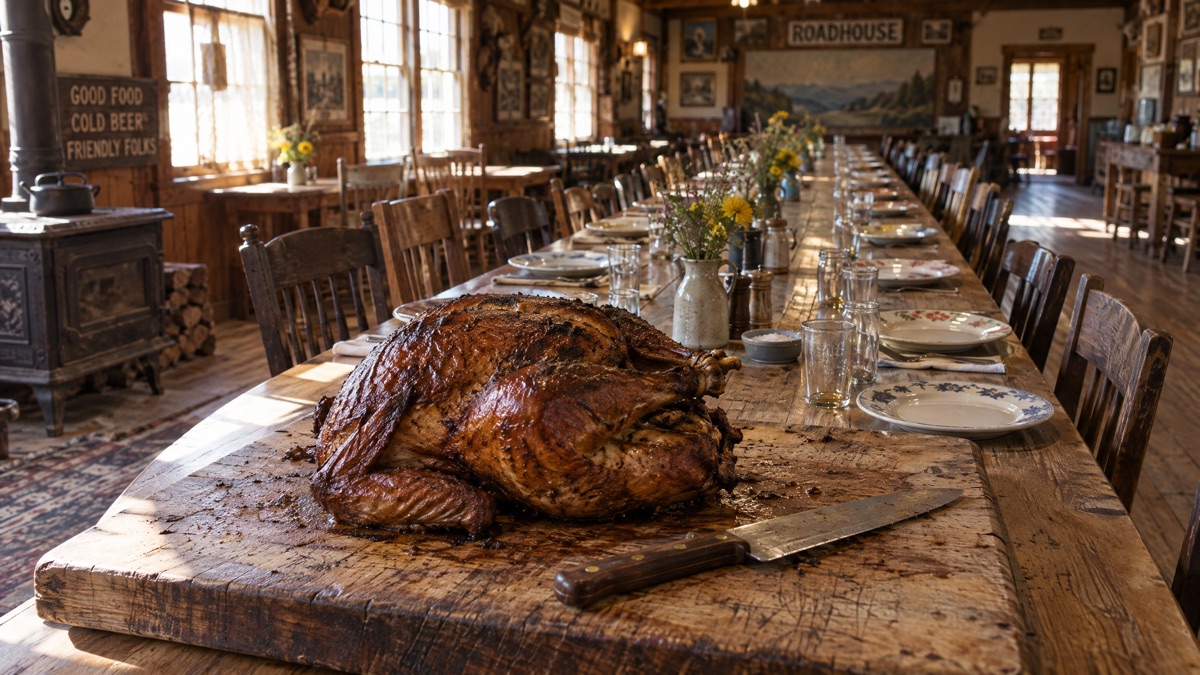
Thanksgiving, noon, eleven miles out on the state highway. The gravel lot is full of trucks with out-of-county plates and one with none at all. The sign that lost a letter has a hand-painted board hung under it that says CLOSED, and under that, smaller, EAT — which is the whole invitation, and every man in the lot understood it.
Henry comes in the front, because he was told to come in the front. It is one long room with the tables shoved end to end and every chair in the place taken — drivers, two women in reflective vests, one driver asleep on his folded coat, a man with a dog under his chair — and down at the far end, on a cutting board the size of a door, six bronze birds coming apart slow under a knife in front of everybody.
The man from the roadhouse looks up from the carving, sees him, and does not smile, because that is not what he does. He points the knife at the one empty chair at the end of the long table, which is between Lena and the woman who brings her own.
The manSit down. You’re the one with the clean smoke.
Nine pounds of beef that belongs to somebody else, and one pull he cannot take back.
Read the next chapterHow long does it take to smoke a turkey?
About four hours at 250 degrees for a 12- to 14-pound turkey that has been spatchcocked — 15 to 20 minutes per pound. Left whole, closer to 30 minutes per pound, six to seven hours. Brine it 12 to 24 hours, then dry it uncovered in the fridge overnight so the skin crisps. Cut out the backbone and press it flat, oil and season the skin, and run it skin side up at 250 with the lid down. There is no stall on a turkey; it climbs steadily. Pull it when the breast reads 160 and the thigh 175. If the skin is still soft at 150, run the pit up to 325 for the last 15 minutes. Rest 20 to 30 minutes tented; the breast climbs to 165 while it rests.
| Stage | Pit temperature | Internal | Time |
|---|---|---|---|
| Brine, fully under | — | — | 12–24 hours |
| Spatchcock, then dry uncovered in the fridge | — | — | overnight |
| Oil, season, on skin side up | 250°F | — | lid down, no spritz |
| Halfway check | 250°F | breast about 120°F | 2 hours in |
| Skin check | 250°F | breast 150°F | if soft, pit to 325°F for 15 min |
| Done | 250°F | breast 160°F, thigh 175°F | 3.5–4.5 hours total |
| Rest, tented loosely | — | breast climbs to 165°F | 20–30 min |
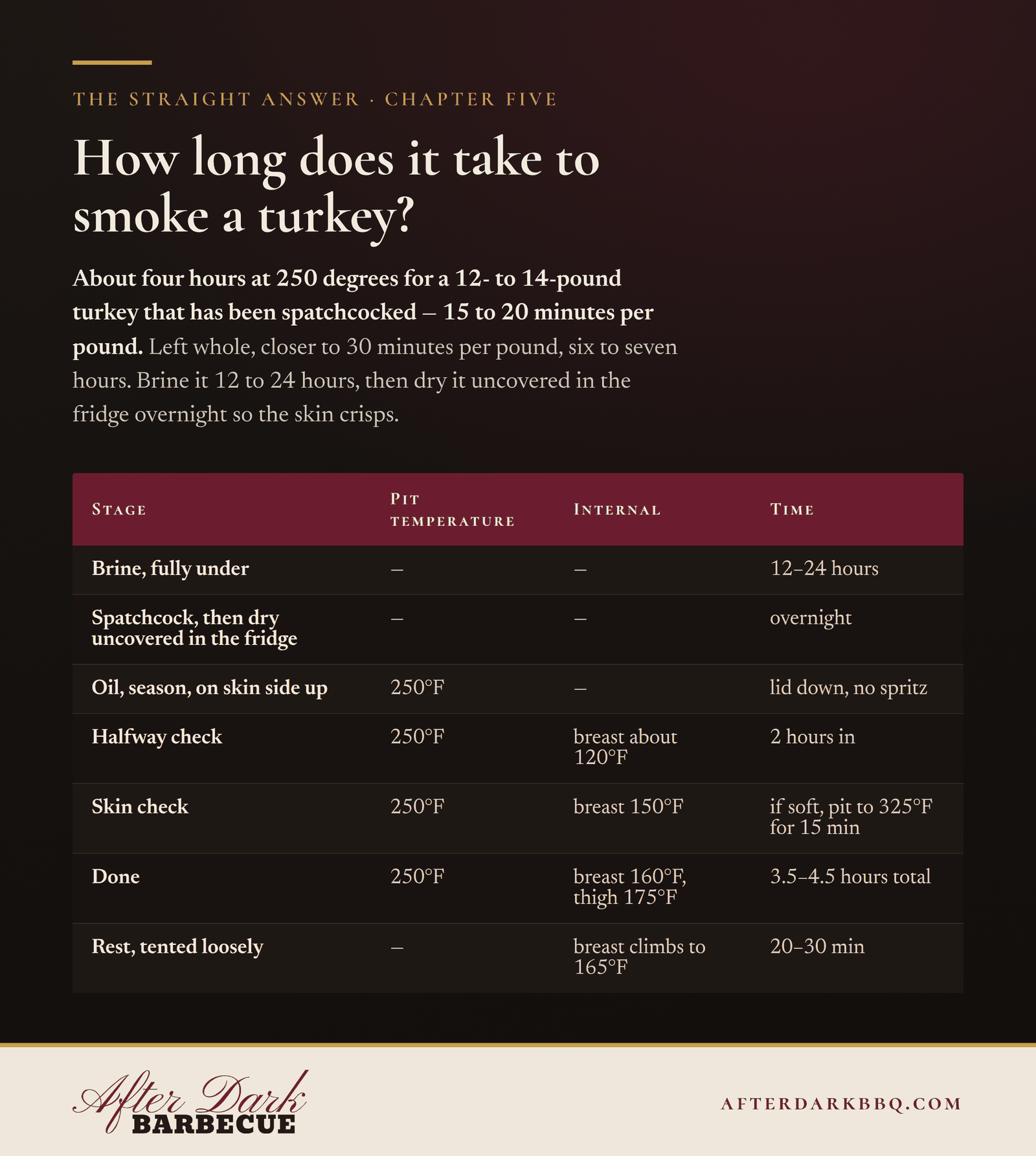
How to read this: Pit temperature is what the smoker holds; internal is what the meat reads on a probe in the thickest part of the breast and, separately, a thigh, neither touching bone. Poultry has to pass 140 inside four hours to be safe; flat at 250 it does that with room to spare, and a whole bird at 225 sometimes does not. Never smoke a stuffed turkey. Minutes per pound is a planning number — a 13-pound bird has finished in three and a half hours and taken four and a half.
The full method, straight: the smoking time and temperature chart, which wood to pair with which cut, and what to do about the stall.
This is the cook from the story above with nothing left on: just the numbers, ready for your own pit.
The Hard Numbers, Laid Out Bare
How long to smoke a turkey — the chart, the stage table and the questions people actually ask, with no story attached.
Sources
The 165°F safe minimum for poultry, measured in the thickest part of the breast, is from the USDA Food Safety and Inspection Service Safe Minimum Internal Temperature Chart. The brine, the overnight drying and the 250°F spatchcock schedule are After Dark BBQ’s own, measured at the grate and stated as ours rather than dressed up as research. Read October 2026.
Stay a While Longer
The chapters: Chapter One — Midnight Ribs · Chapter Two — Overnight Smoked Brisket · Chapter Three — Overnight Pork Butt · Chapter Four — Smoked Beef Ribs
Chapter Six — Smoked Prime Rib →
Letters to Dutch: How Long to Smoke St. Louis Ribs at 250 · The Night the Brisket Would Not Let Me Sleep
Everything at the After Dark BBQ hub · Technique · Who Dutch Cobb is · Write to Dutch
Volume One, complete. Volume Two, a new chapter every Friday.All the chapters · Write to Dutch