Chapter Sixteen · Chicken at 300° · Two hours
Chapter Sixteen
THE ARGUMENTSHE ATE OFF HIS HALFHE PROVED IT SLOWLY
Heat Somebody is going to get burned
Chapter sixteen of After Dark BBQ: the whole bird taken slowly at 300° for two hours, skin dried the night before and never rushed.
She said it was not worth the trouble. He took all night anyway.
The Argument About Skin
LenaNobody eats the skin off a smoked chicken.
HenryNobody eats your smoked chicken skin.
He had her there, and he knew he had her there, and he spent the next two hours proving it in a way that took considerably longer than the argument did.
Rubbery skin is not a smoking problem. It is a water problem and a temperature problem, in that order. Skin is collagen and fat with water trapped in between, and it cannot do one thing for a man until that water is gone.
Overnight, Uncovered, and Nothing on It
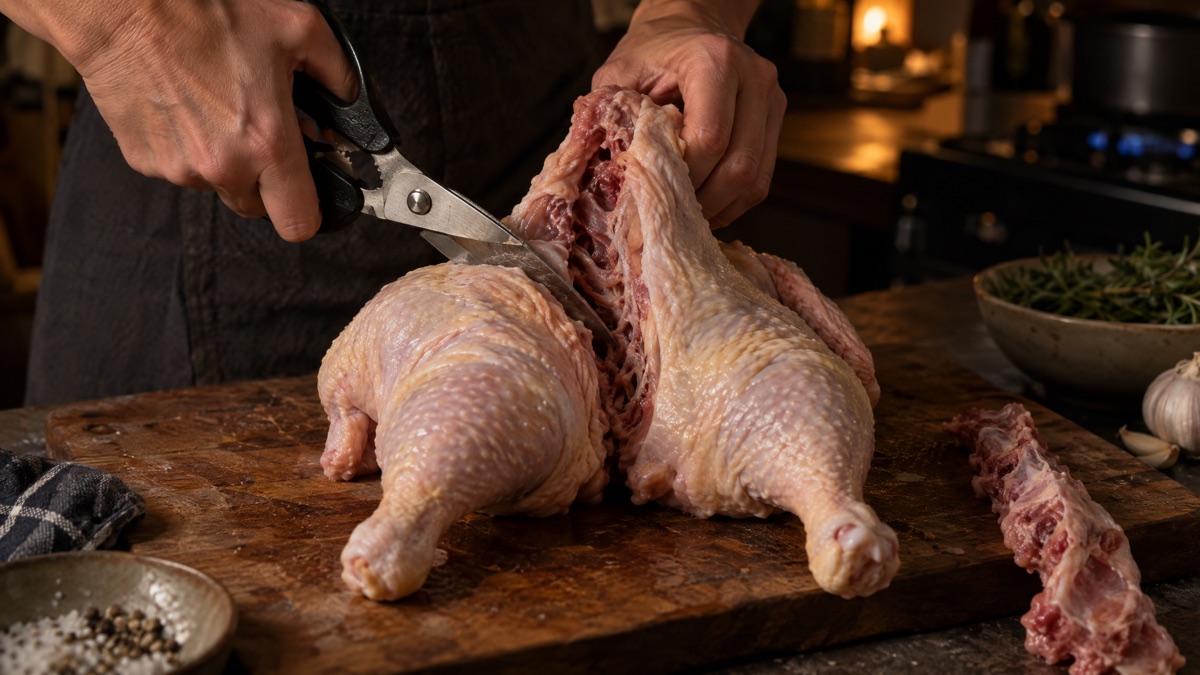
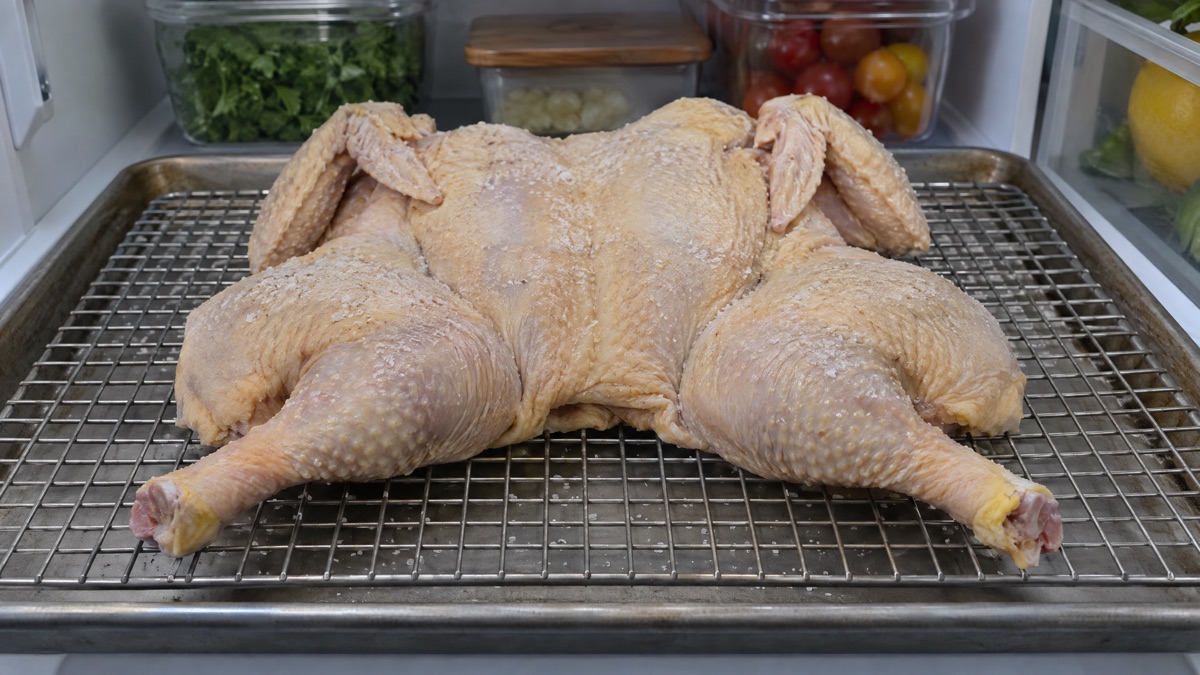
He spatchcocked it — backbone out with a pair of kitchen shears, breastbone cracked flat under the heel of his hand — and salted it, a tablespoon of kosher salt for four pounds, and put it on a rack in the refrigerator uncovered.
Overnight. No wrap, no plate over it, nothing on it at all, twelve hours of cold dry air pulling the moisture up out of the skin while the salt worked its way down into the meat.
In the morning the skin looked like it had been waiting up for him: tight, matte, faintly translucent. That is exactly right. That skin will crisp for him. A wet bird straight out of the package never will, no matter how hot he runs the fire.
A chicken is the cheapest cook in this story and the one that humbles the most men. It has two kinds of meat that finish fifteen degrees apart, and skin that will either be the best part of the plate or the thing everybody politely leaves behind.
You can read this one for the argument. I read it for the spatchcock, which is the single decision that settles the fifteen degrees.
DutchLenaIt looks terrible.
HenryGive it two hours.
A teaspoon of baking powder mixed into the rub is the other half of the trick, if you want it. It raises the pH of the skin, which speeds browning and blisters the surface. A quarter teaspoon per pound, and no more, or it tastes of it.
Technique Spotlight: Why Spatchcock
Breast comes off at 160°F and coasts to 165°F; thigh is not right until 175°F. On a whole upright bird the breast sits higher and hotter and gets there first, so you either dry the breast or serve raw thigh. Flatten the bird and both sides sit in the same plane, the thighs move to the outside edges where the heat is strongest, and the whole thing finishes within about ten minutes of itself.
Three Hundred Degrees, Skin Side Up, Lid Down
Three hundred degrees. Not two twenty-five. A chicken has no collagen worth breaking down and nothing to gain from six hours, and every hour under 275 is an hour the skin spends going soft on a man.
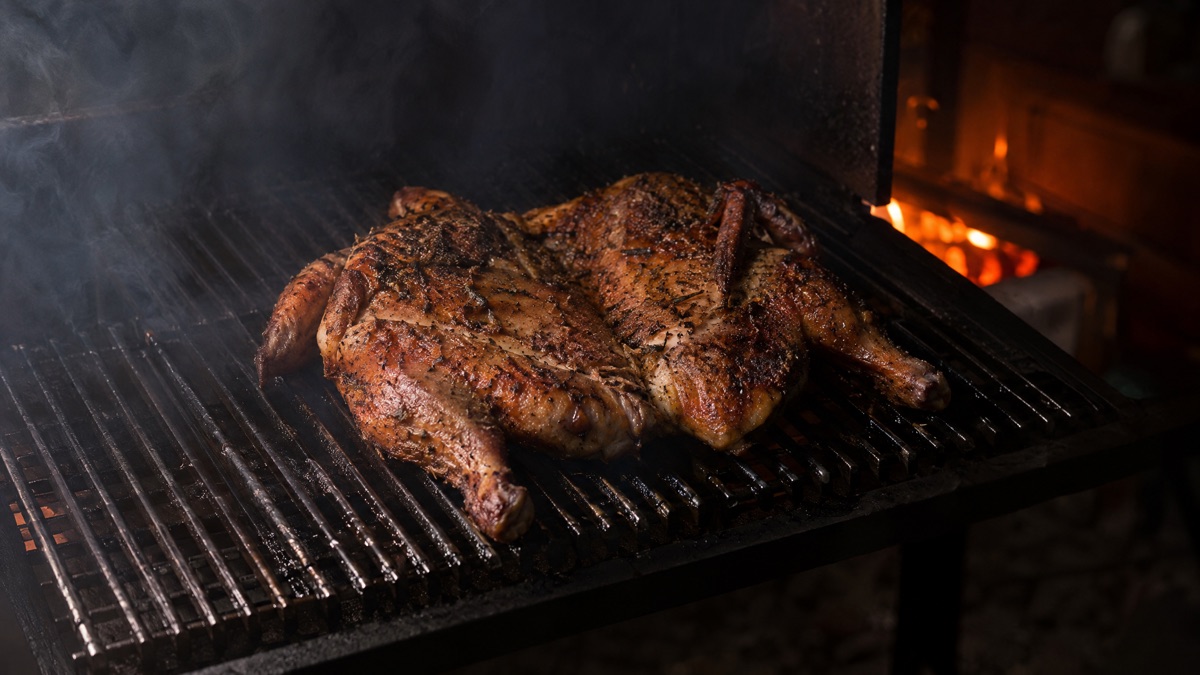
Cherry wood for color, and a little of it. Chicken takes on smoke fast and takes on color faster, and a bird that ran three hours in heavy hickory comes out mahogany and tasting of the inside of a chimney.
Skin side up the whole time. Do not flip it. Do not baste it. Do not keep opening it up to look. If a man wants sauce, it goes on in the last ten minutes and not one minute earlier.
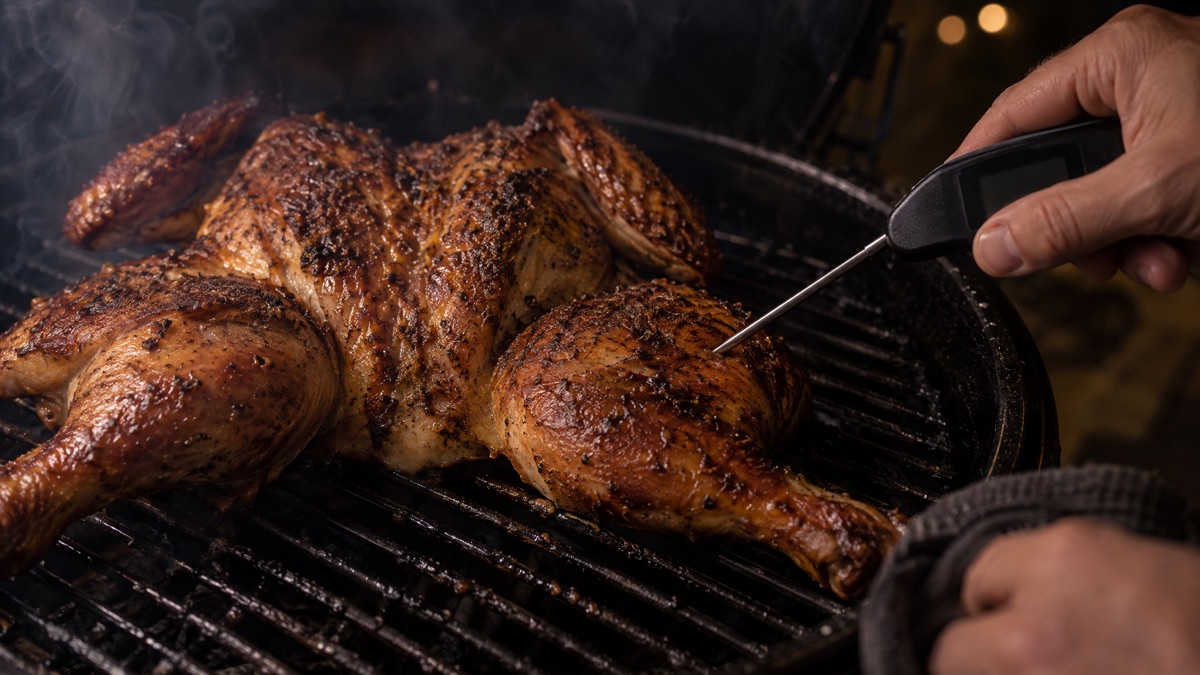
Two hours for a four-pound bird, maybe two and a quarter. He probed the thigh at the ninety-minute mark and it read one fifty-five, which told him everything about the last half hour.
The Part She Did Not Say Out Loud
Off at one sixty in the breast, which coasts to one sixty-five on the board, and one seventy-five in the thigh — both of them, checked separately, because one number never did describe a whole chicken.
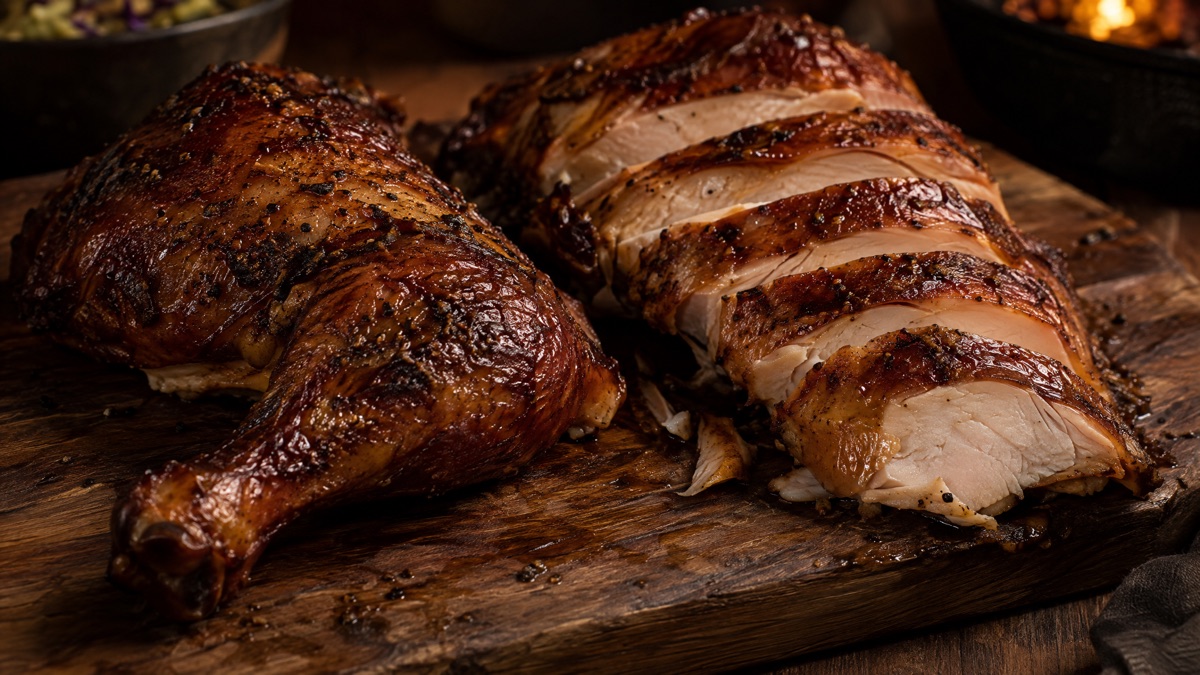
Fifteen minutes resting. He cut the leg quarters away first and she took one before it ever reached the board, and the skin came off in one piece and made a sound doing it.
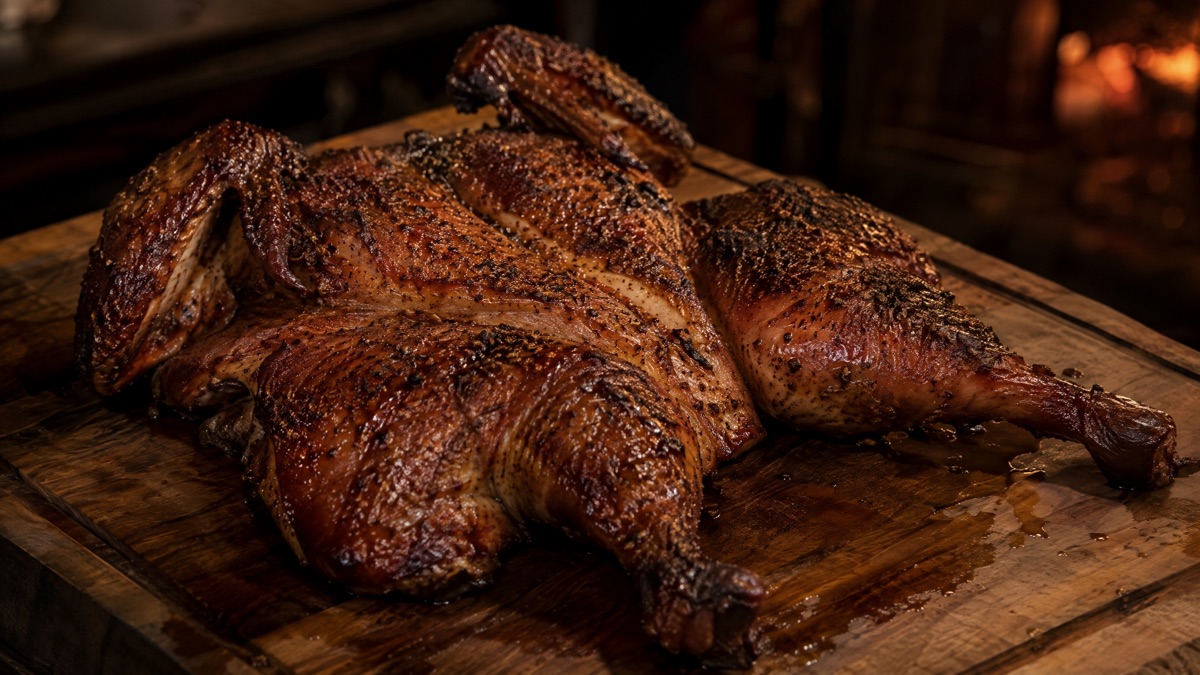
She did not concede the argument. She ate the skin off his half as well, which he counted as a verdict.
Lena“This does not mean you were right.”
Henry“It means something.”
The Bird You Buy
Four pounds is the number. Under three and a half and it dries before the skin is ready; over five and the thighs take so long that the breast pays for it, even spread flat.
Air-chilled, if the store has it and will admit which is which. Most supermarket chicken is water-chilled, which means it sat in a cold bath after processing and came out carrying up to eight percent of its weight in absorbed water. That water has to leave on the pit, and while it is leaving, the skin cannot brown. Air-chilled birds cost more and show up drier, which is half the seduction already done.
Read the label for a sodium solution. A bird injected to twelve percent is already brined, badly, with phosphates, and salting it again gives you something closer to a ham with wings.
LenaTurn the package over.
HenryIt says natural.
LenaNatural means nothing. Look for the percentage.
How to Spatchcock One Without Swearing
Breast side down on the board, tail toward you. Kitchen shears, not a knife.
Cut up one side of the backbone, close to it, through the ribs — they give in easier than people expect. Then up the other side. The backbone comes out in one piece and goes in the stock bag.
Open the bird like a book, flip it breast side up, and press down hard on the breastbone with the heel of your hand until you feel it give. It will give. If it does not, press harder; you are not going to hurt it.
Tuck the wing tips behind the shoulders so they do not burn. Two minutes, once you have done it twice.
The first one takes ten minutes and feels like surgery. Every one after that takes three, and you start to enjoy it. It is the highest-return knife skill in barbecue and it works on every bird a man will ever cook, the turkey in November included.
What Is Left on the Board
A four-pound bird feeds two people generously and leaves a frame.
The frame is not garbage. Backbone, wing tips, the carcass after you have picked it — into a pot with an onion and cold water, barely simmering for three hours, and what you get is a stock with smoke in it that no store sells. It makes the best pot of beans you will cook this year.
The picked meat goes cold into anything. Chicken salad with too much black pepper. Folded into eggs. On a tortilla with the leftover sauce from the burnt ends.
And the skin, if by some accident there is any left, goes back on a rack at four hundred degrees for five minutes and comes out as something worth standing at the counter for.
Henry“There was never going to be any skin left.”
Lena“No. There was not.”
Why Two Numbers and Not One
Every chart in every kitchen says one hundred and sixty-five degrees for chicken, and that number is doing a job that has nothing to do with how it tastes.
One sixty-five is the temperature at which salmonella is killed instantly. It is a food safety threshold, not a doneness target, and it is the same number whether you are cooking a breast or a drumstick. Time matters too — poultry held at one hundred and fifty-five degrees for about a minute is just as safe — which is why a breast pulled at one sixty and rested is not a risk.
Thigh is a different problem entirely. Dark meat is full of connective tissue and it is still tough and rubbery at one sixty-five. It needs one hundred and seventy-five to one hundred and eighty-five before the collagen gives in and the texture goes from chewy to silky. And unlike breast, it does not dry out getting there, because it has the fat to survive it.
So: two numbers, two probes, one bird. Breast at one sixty, thigh at one seventy-five. Anyone who takes the whole bird to a single number is leaving one half of her unsatisfied.
Sauce, Rubs, and the Last Ten Minutes
A rub with sugar in it will burn at three hundred degrees over two hours. Most commercial barbecue rubs are sugar-forward, because sugar sells. Read the ingredient list — if sugar is first or second, use it on ribs and use something else here.
What a chicken wants is salt, coarse black pepper, granulated garlic, a little paprika for color, and that is the whole list. The skin does the rest of the work.
If you want sauce, it goes on in the last ten minutes, thin, with a brush, and you accept that you are trading some crispness for it. There is no version of this where sauce goes on early and the skin survives. Sugar and two hours do not share a pit.
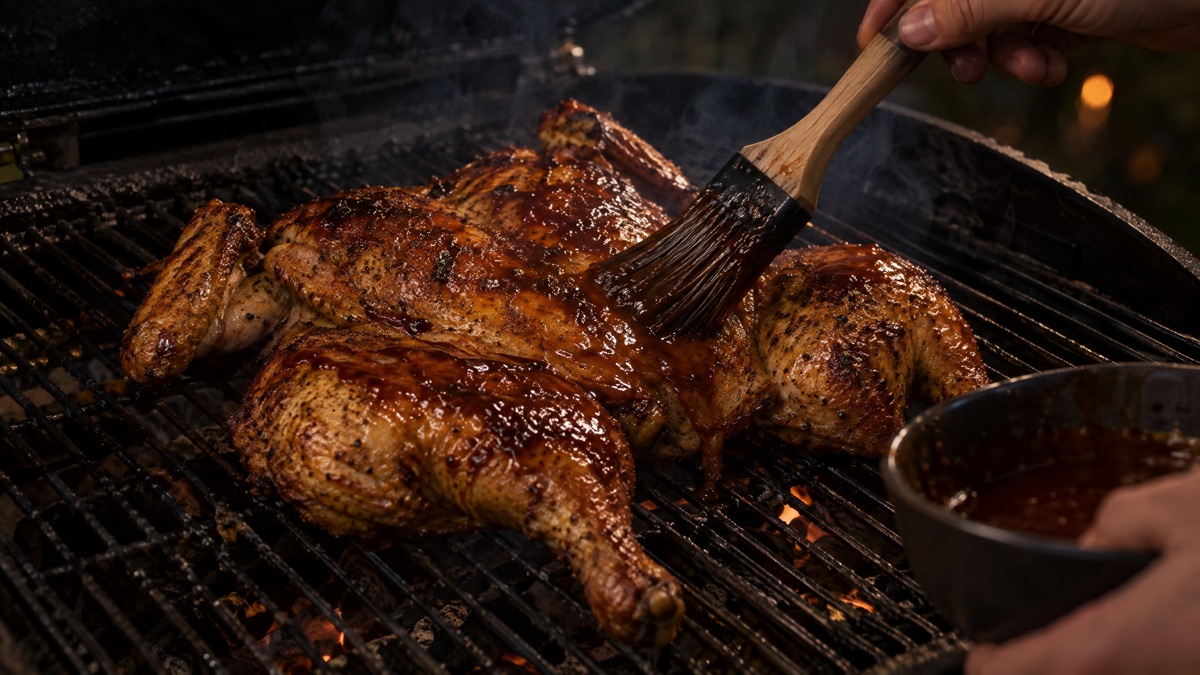
The alternative, and the better one, is a bowl of warm sauce on the table and a bird that shows up bare. Let people ruin their own portion.
Lena“Nobody sauced it.”
Henry“I noticed that too.”
Three cars in the drive and nothing ready.
Read the next chapterHow long does it take to smoke a whole chicken?
About two hours at 300°F for a four-pound spatchcocked bird — breast off at 160°F, thigh at 175°F. A whole upright bird at 275°F runs closer to three hours and finishes unevenly.
| Stage | Pit | Internal | Time |
|---|---|---|---|
| Spatchcock and salt | — | — | 15 min |
| Uncovered on a rack, refrigerated | refrigerated | — | 12–24 hr |
| On, skin side up, flat | 300°F | — | — |
| Skin tightens and colors | 300°F | about 120°F | 1 hr |
| Check the thigh | 300°F | about 155°F | 1.5 hr |
| Sauce, if using | 300°F | — | last 10 min |
| Off — breast 160°F, thigh 175°F | 300°F | 160 / 175°F | about 2 hr |
| Rest | — | — | 15 min |
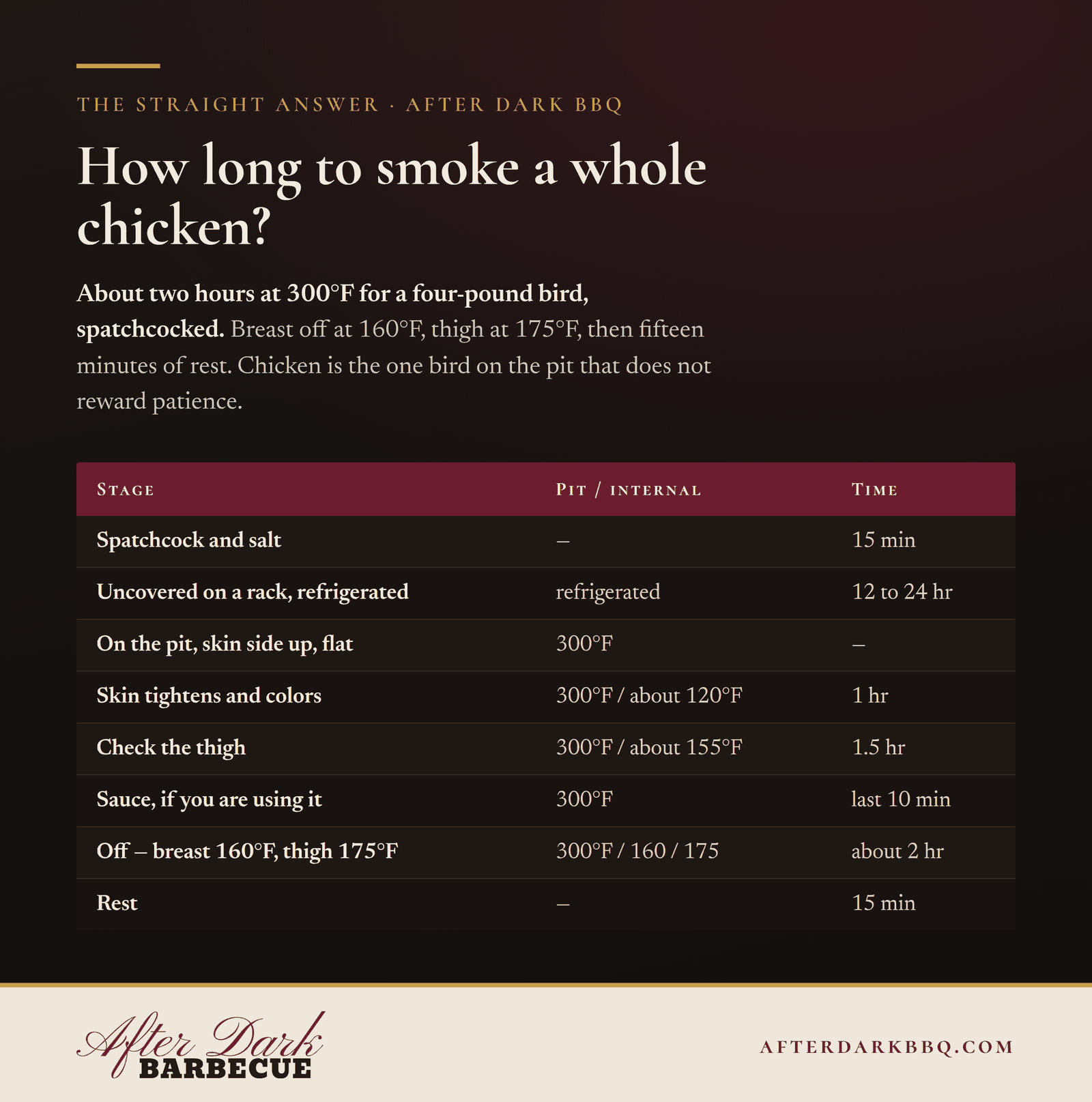
If the skin is still soft at the two hour mark, open the vents and push the pit to 350°F for ten minutes. That is a rescue, not a plan — the overnight dry is what actually crisps it.
Recipe: The Short Version
Prep: spatchcock the bird, backbone out, breastbone cracked flat.
Dry brine: 1 tbsp kosher salt per 4 lb, uncovered on a rack, 12 to 24 hours.
Optional: ¼ tsp baking powder per pound mixed into the rub for blistered skin.
Smoke: 300°F, cherry wood, skin side up, no flipping, no basting.
Time: about 2 hours for 4 lb.
Pull: breast 160°F (it coasts to 165°F resting) and thigh 175°F, checked separately.
Rest: 15 minutes.
Next: a block of cream cheese, two hours, and the shortest cook that ever emptied a plate.
The Hard Numbers, Laid Out Bare
How long to smoke a whole chicken — the chart, the stage table and the questions people actually ask, with no story attached.
Sources
The 165°F safe minimum internal temperature for poultry is from the USDA Food Safety and Inspection Service Safe Minimum Internal Temperature Chart. The 40 to 140°F range and the two hour limit out of refrigeration are from the FSIS Danger Zone (40°F to 140°F) fact sheet. The 175°F thigh target, which is well past safe and is about texture, the 300°F pit and the overnight uncovered rest are After Dark BBQ’s own, measured at the grate and stated as ours rather than dressed up as research. Read September 2026.
Volume One, complete. Volume Two, a new chapter every Friday.All the chapters · Write to Dutch

Leave a Reply