Chapter One · St. Louis ribs at 228° · Six hours
Chapter One
SLOW BURNA STRANGER AT THE FENCEHE FED HER FIRST
Heat Lid down
Chapter one of After Dark BBQ, a late-night ribs story for cooks who take their rub seriously and their evenings much less so.
Three hours is a long time to stand next to somebody and not touch anything.
A rack of St. Louis ribs is the shortest cook in this story and the easiest one to talk yourself out of. Six hours at 228, and the only hard part is leaving the lid alone for the first three. Henry cooks two most nights and tells nobody. Somebody found him anyway. That is how these things go.
You can read it for the woman in the alley. I read it for the fire. He never once let it drop under 225, and that is the whole story if you ask me.
— Dutch
Why It Is Always Better After Midnight
Most ribs never get the long night they deserve. Some get rushed through dinner service. Some get boiled, baked, or smothered and forgotten. Midnight ribs are different. They’re cooked when the city is quiet, when phones stop buzzing, and when a pitmaster can listen to the fire instead of the clock. In After Dark BBQ, midnight ribs are both meal and signal — comfort for the right people, curiosity for the wrong ones.
This chapter introduces Henry, a shy Midwestern cook whose hickory–cherry ribs are about to draw attention from the wrong side of the smoke. It also hands you his method, low and slow, so you can stay up all night with your own.
Smoke in a Quiet Man’s Breath
Smoke comes first. It always does.
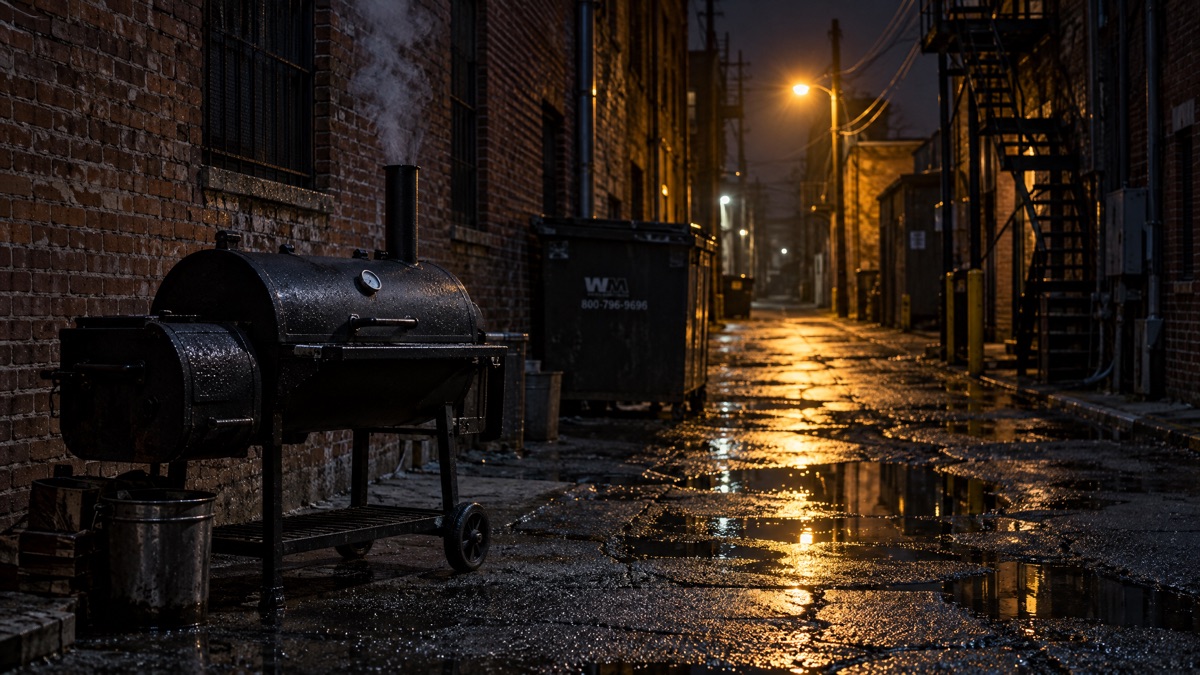
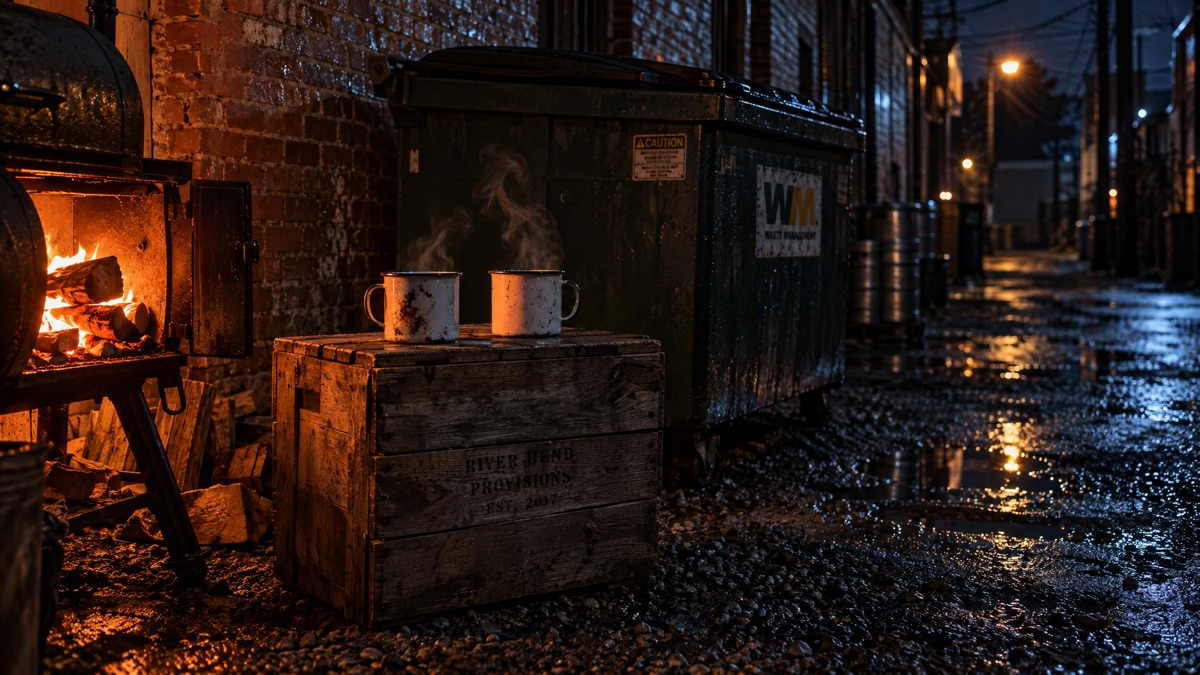
A thin ribbon of it lifts out of the alley behind the old brick building, pale and unhurried, curling past a streetlamp that has never once committed to anything. The night rain has left every surface slick and gleaming — the pavement, the dumpster, the iron grate over the storm drain, all of it wet and waiting. The puddles catch that low yellow light and break it into small trembling shapes, the way a thing trembles when it knows what is coming.
Blocks away the traffic drags itself across concrete. A train horn moans at the edge of town, low and unashamed. But out here the only sound that matters is the long, steady exhale of a smoker settling into its rhythm — a deep and confident draw that says the fire inside is not asking anyone’s permission tonight.
And beside it, sleeves pushed up and hands not quite steady, stands a man named Henry.
At a glance he is nothing much: early forties, unattached, quiet, the sort of polite Midwesterner who apologizes when you walk into him. He is kind in a way that can look like absence and clumsy in a way that suggests his hands and his intentions have not yet been properly introduced. No wife. No dog. Only a rented workshop down in the river district, a tired pickup, and a smoker that knows exactly what he is and has never told anybody.
That smoker is the Nightfire “Ironbound” Offset, and it is a great deal of machine. Matte black. Heavy-gauge. Built to outlast every man who has ever put his hands on it. The firebox runs deep. The vents are generous and tonight they are wide open. The chamber is shaped to roll thin blue smoke instead of belching out thick white regret. It is the kind of pit a serious man spots from clear across a crowded yard and then finds himself thinking about again at two in the morning.
Inside the firebox a split of Ashfell Fuelworks Midnight Hickory is burning with real discipline — dense, kiln-dried, built to go all night long without once complaining about it. Low ash. Clean exhaust. Deep, relentless, unhurried heat that does not let up and does not need to be asked. And every bit of it tonight is pointed straight at two racks of ribs that have no earthly idea what is about to be done to them.
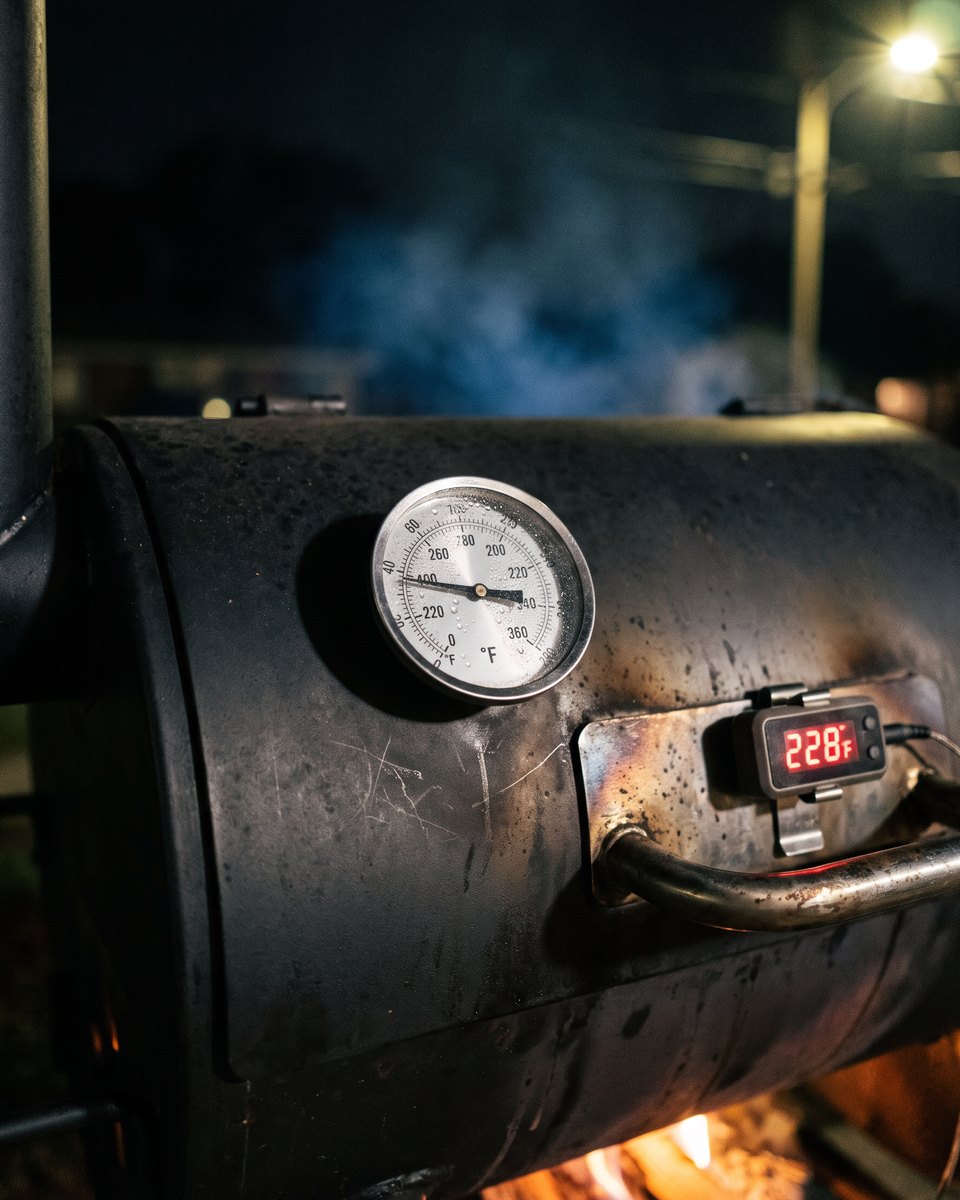
He wipes his fingers slowly down the front of his apron and checks the analog dial set into the lid. Then the compact digital unit clipped along the handle — the Nightfire × Emberline Digital Probe — which flickers between 227°F and 228°F as though it cannot quite decide how much to give him.
Henry smiles at that, almost to himself.
HenryTwo-twenty-eight. Perfect.
Featured Pit: Nightfire “Ironbound” Offset Smoker
In the After Dark BBQ universe, Henry’s midnight ribs ride on the shoulders of the Nightfire Ironbound Offset. It’s built for cooks who know a real pit doesn’t just get hot — it stays hot all night and never quits early.
- Heavy-gauge steel construction for stable, overnight heat.
- Deep firebox designed for clean combustion with splits or lump charcoal.
- Oversized vents for precise control of airflow and smoke quality.
- Cook chamber geometry tuned for thin blue smoke and even heat distribution.
Why Hickory and Cherry Do It Better in the Dark
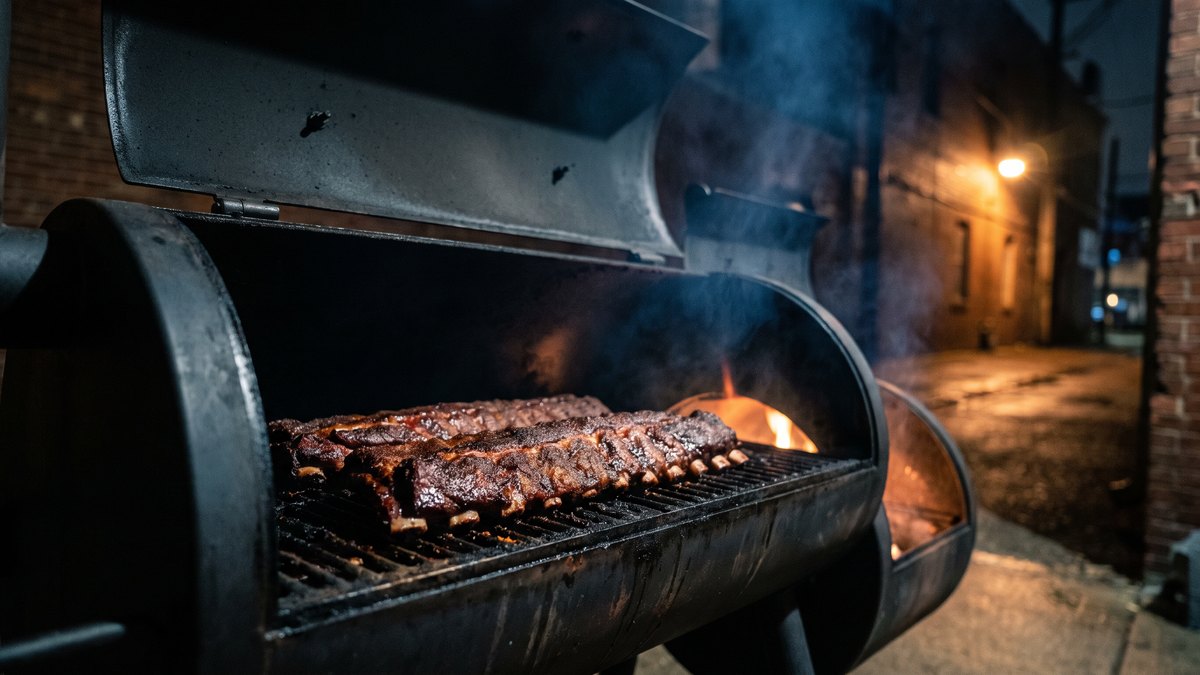
He lifts the lid slow. Nobody who respects meat has ever rushed this part. Inside, two racks of hickory–cherry ribs lie bone side down exactly where he left them, hot and slick and shining, and they have spent the last hour taking everything he gave them without one word of complaint. They are not going anywhere. They could not if they wanted to. That batch of eight for the Saturday market is inside on sheet pans, cold and covered and spoken for by other men, and Henry does not spare them a thought. These two are his. The midnight ribs. The ones he keeps back for the regulars who text him at eleven at night with the same six words — “Rough week. Any chance you’re cooking?” — and who have never once had to ask him twice.
Hickory gives him the backbone. Cherry gives him the color, and that soft fruit note underneath that makes bark come up deep mahogany under a workshop bulb. One does the work and the other makes it blush. There is a reason people keep going back to this pairing and there is a reason they do not talk about it much.
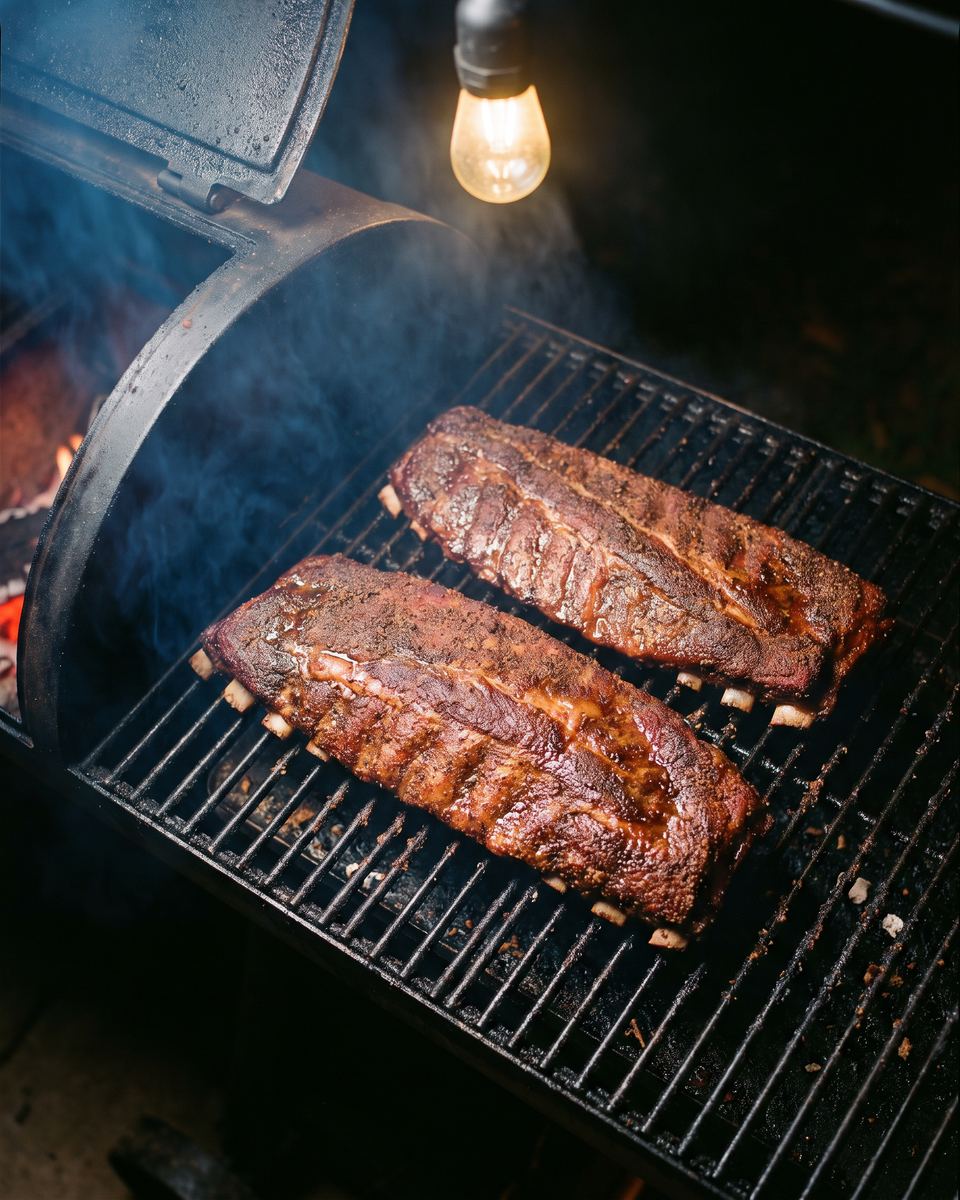
He works a final pass of Emberline Ironwood Rub over the surface — the flat of his hand first, then the heel of it, then his fingers, going with the grain and then against it, slow, until the whole thing stops resisting him and takes every last bit of what he is giving it. Enough sugar to lacquer down hard. Enough salt and spice to keep all that sweetness from going naive on him. The surface turns tacky, then slick, then willing. Henry keeps his hand flat on it a long while after the job is finished, and he does not apologize to anybody, because it is his pit and it is nearly midnight and nobody out here is watching.
The fire pops in the box. Henry steps back, breathes it all the way in, and lets his shoulders come down. This is the part he loves most — the moment it stops being something he is doing to it and becomes something it is doing all by itself, in the dark, with the lid down and six hours ahead of it and no way out. Hickory gives direction. Cherry gives nuance. Patience does the rest, and patience is the one thing Henry has ever been any good at.
Technique Spotlight: The Midnight Ribs Fire Profile
Good midnight ribs aren’t an accident. The fire profile matters as much as the rub. Henry’s approach is minimalist, but not casual:
- Clean combustion first. He lets the Ashfell Fuelworks Midnight Hickory split catch fully before closing the firebox, waiting for thick white smoke to fade to a faint blue stream.
- Steady 225–228°F chamber temperature. This narrow band lets collagen break down slowly while keeping surface sugars from burning.
- Thin blue smoke. Thick, billowing smoke means incomplete combustion and can lead to bitter or acrid flavors. Thin smoke means the fire has found the right balance of oxygen and fuel and settled in for the long haul.
- Minimal door openings. Every peek costs heat and clean airflow, so he keeps his hands off the lid and watches the vents and thermometers instead of giving in to nervous habit.
If you want to dig deeper into smoke science, sites like AmazingRibs offer detailed breakdowns of combustion, wood chemistry, and smoke quality — but Henry’s guiding principle is simple: if the smoke looks gentle and smells pleasant, the fire is speaking the right language.
She Smelled It From the Alley
That is when he feels it. A shift in the air that has nothing to do with pressure or wind. Not a sound. Not a footstep. Just the unmistakable certainty that somewhere at the mouth of the alley, someone has been watching him work.
Henry clears his throat, because he is the kind of man who stays polite even when he believes he is alone.
HenryUh… hello?
A voice answers. Female. Low. Unhurried. Carrying a roughness that has nothing to do with age and everything to do with mileage — the kind of voice that has spent equal time in cold air and hot kitchens and has never once had to be raised.
LenaYou always talk to your smoker, or am I getting special treatment?
Henry turns far too quickly and very nearly loses his footing on the wet concrete. His boot skids. One hand flies out. He catches himself hard on a crate by the dumpster, fingers scraping damp wood, and he is aware, immediately and completely, of exactly how that looked.
HenrySorry. Didn’t see you there.
She steps forward into the half-light and takes her time about it. Dark hair loosely tied, one piece of it escaped. A jacket worn just enough to suggest experience rather than neglect. And her eyes — sharp, unhurried, not unkind, and entirely unsparing. She has the look of a woman who knows alleys like this one from more angles than most, who has seen both the deliveries and the departures and never once flinched at either.
LenaI noticed.
She goes to the smoker first. Not to Henry. She leans into the thin blue smoke with her eyes shut and her chin lifted and takes it all the way in, slow, holding it — not for show, but the way a woman does when she intends to find out exactly what a man has been up to out here on his own.
LenaHickory and cherry?
HenryYes, ma’am — uh, yes.
She opens her eyes. One corner of her mouth lifts. It is not quite a smile, but it is close enough that Henry feels it land somewhere under his ribs and decide to stay there.
LenaGood pairing. Cherry hides behind hickory if you push the fire too hard. Your smoke’s clean. Your bark’s setting. Your ribs aren’t panicking.
Henry’s face goes warm, which is deeply unfair, because the fire is behind her.
HenryI try to keep things steady.
LenaSteady’s rare. Especially in this part of town.
HenryYou from the neighborhood?
He tries to sound casual and manages instead to sound precisely like a man trying very hard to sound casual.
She takes longer over the question than it needs. Not stalling. Weighing whether he has earned an answer.
LenaPassing through. But I listen to the right corners. Word is there’s a quiet guy back here cooking midnight ribs with smoke clean enough to make professionals nervous.
Henry blinks.
HenryProfessionals?
LenaNot the kind that smile on TV. The kind who cook where the city doesn’t bother looking. Places where smoke settles into the walls and names get traded like currency.
A small gust pulls the alley darker. The streetlamp hums, flickers, and gives up. Somewhere down the block a bottle rolls across asphalt and comes to rest against a curb. She glances at the metal door that leads back into Henry’s workshop, and lets the glance sit there a moment longer than she needs to.
LenaYou headed inside?
Henry startles, because he was. He needs a fresh tray and another bag of cherry splits. He nods, a little too stiffly, like a man agreeing to something considerably larger than the question asked.
HenryYeah. Just… grabbing supplies.
LenaThen let’s talk where the walls don’t leak.
She tips her head toward the workshop door, and Henry — who could not explain to a jury why he is obeying — walks toward it. She follows. Her step makes no sound at all.
History & Culture: The Quiet Tradition of Midnight BBQ
In the real world, midnight ribs sit in a long tradition of late-shift cooks. Railroad crews, factory workers, bar staff, and overnight freight teams have been sharing food in off-hours for generations. The smoke from those long nights rarely makes it into glossy cookbooks, but it lingers in alleys, back rooms, and loading docks, anywhere somebody needed it hot and late.
In After Dark BBQ, Henry stands in that lineage — even if he doesn’t know it yet. He’s cooking in the liminal hours when the people who need comfort most tend to appear. His ribs aren’t just dinner; they’re a quiet kind of hospitality for anyone carrying something heavy enough to keep them outside past midnight.
That’s part of why his smoke is starting to draw attention. In some corners of the barbecue world, a man who goes slow and stays steady is rarer than a show-off. The people who notice the difference first never come around just once.
Stepping Inside with a Stranger
Henry reaches for the door, and the keys are heavier in his fingers than they have ever been. He works the lock with the careful, practiced motion of a man who has dropped things at the worst possible moment more than once in his life.
The old hinges complain softly as the door gives inward, and the smell comes out to meet them — sawdust, cold metal, and the ghost of every fire he has ever built in there. It wraps around him, and around the woman who still has not told him her last name.
LenaAfter you.
Her voice does not waver. Henry hesitates, but only for a second, and then he goes through ahead of her.
Inside, Where It Was Warmer
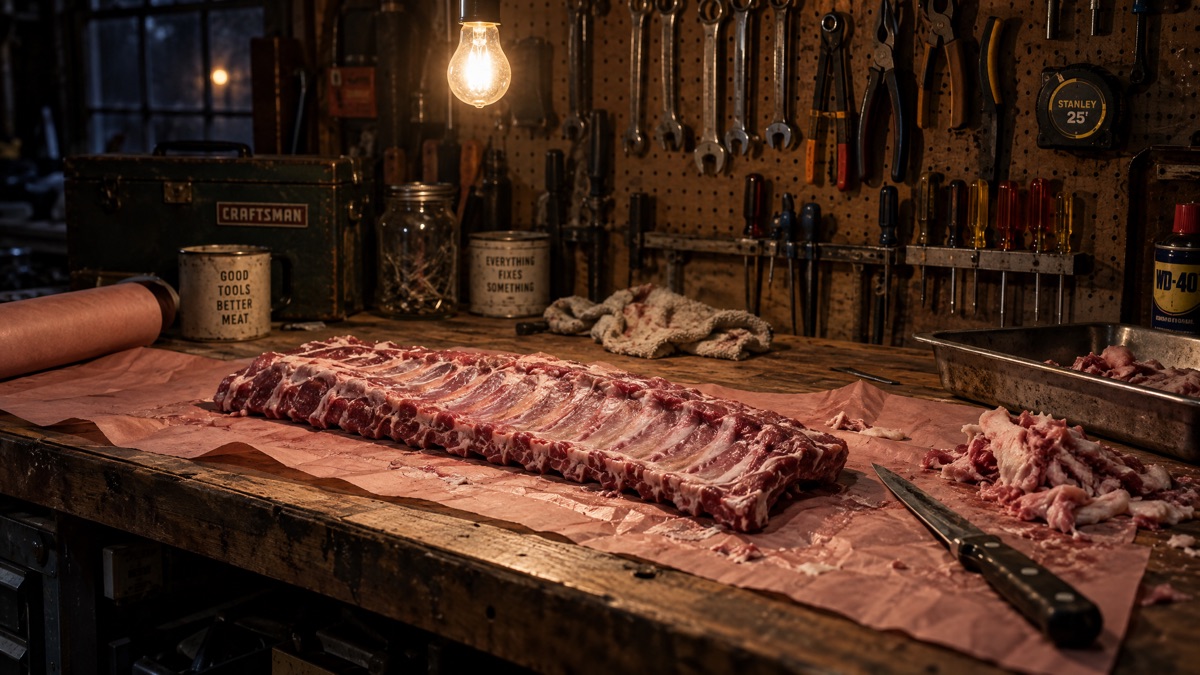
The workshop is warmer than the alley, though not by much. He keeps it cool for food safety and because heat makes him clumsy, which is a liability he already wrestles with daily. A single overhead bulb throws a soft yellow cone across the stainless prep table. Sheet pans wait there in the low light — eight racks of ribs resting under loose foil, spoken for, going to the Saturday market.
Two racks is plenty for tonight. Midnight ribs were never meant for a crowd. They are meant for the ones who turn up at the wrong hour for the right reasons, and Henry has never once asked any of them a question.
She comes in behind him and lets the door fall closed with a soft click. She does not look around the room the way curious people do. She scans it. Evaluates it. Takes the whole of it in at once, the way someone does who was raised in places where knowing the exits mattered. Then she drifts closer to the prep table.
LenaYou work alone?
HenryAlways have. Keeps things predictable.
LenaPredictable is a luxury. Especially when your ribs are drawing eyes.
He swallows. She glances toward the alley-facing wall.
HenryI didn’t know anyone was… watching.
LenaMost people wouldn’t notice. But I follow smoke. Clean smoke, especially.
LenaYours cuts through noise.
Technique Spotlight: Why Henry’s Surface Prep Works
Before they hit the smoker, Henry’s ribs go through a quiet transformation. Surface prep determines bark texture, smoke adherence, and seasoning penetration — the foundation of midnight ribs.
- Membrane removed. A clean bite runs all the way to the bone. Leave the membrane on and the rub never gets in, and nobody wants it chewy.
- Binder optional. Henry uses just enough mustard to help the Emberline Ironwood Rub cling without creating a distinct flavor.
- Rub balance matters. His ratio — salt, pepper, sugar, paprika, garlic, onion, cumin — builds umami and color without letting sweetness overpower smoke.
- 20–30 minutes to sweat. Let the rub settle in. The salt draws moisture up to the surface until the spices bloom and cling.
If you’ve ever wondered why your bark won’t set up firm the way competition ribs do, what your hands did before the lid came down is often the silent culprit. Give that rub time to cling. Patience earns bark, and bark never comes to a man in a hurry.
The Question That Changes Everything
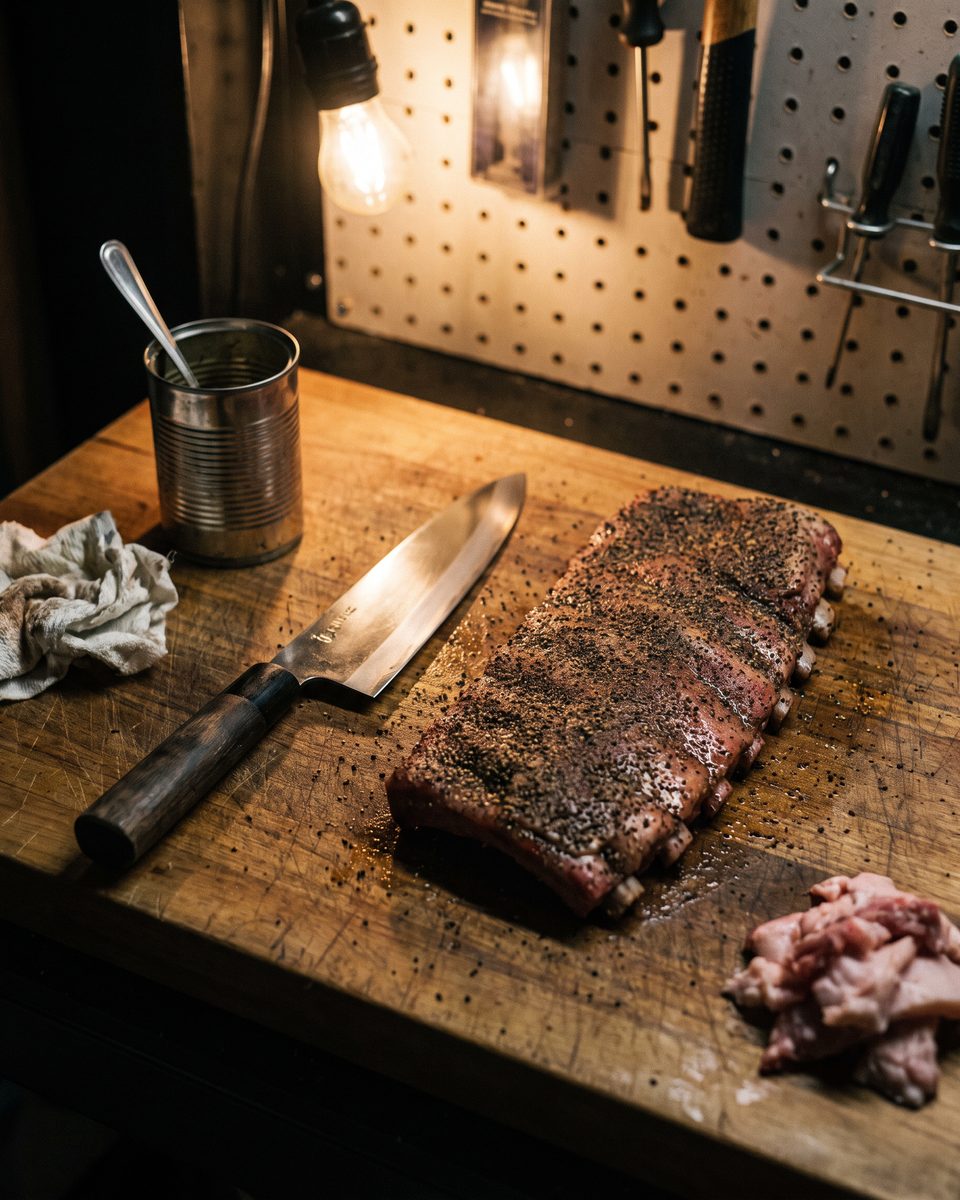
She drifts along the pegboard where he keeps his tools — knives, tongs, gloves, thermometers — and lays one finger on the Emberline 8″ Chef’s Knife, whose edge catches even this poor light.
LenaYou sharpen these yourself?
HenryHelps me focus. Some people meditate. I keep steel honest.
Immediately after saying it, he regrets how dramatic it sounds.
She turns and studies him in a way that manages to be respectful and invasive at the same time.
LenaHenry… do you know who else cooks at midnight around here?
Henry“Just me.”
Lena“No. Not anymore.”
And something in the way she says it goes straight up his spine.
Tools of the Midnight Pit
Henry’s workshop uses a kit built for precision and calm under pressure.
- Emberline 8″ Chef’s Knife — exceptional edge retention for trimming ribs.
- ForgeGuard Heat Gloves — safe handling of hot grates and pans.
- Nightfire × Emberline Digital Probe — accurate chamber and meat readings in low light.
Recipe: Henry’s Midnight Hickory–Cherry Ribs
Below is the real-world rib method from this chapter, the one that keeps going all night. It works on home smokers, offsets, pellet grills, and kettle setups, whatever you like to get your hands on.
Recipe: Henry’s Midnight Hickory–Cherry Ribs
Ingredients
- 2 racks pork spare ribs or St. Louis–cut ribs
- 2–3 tbsp mustard (binder optional)
- 1/4 cup kosher salt
- 1/4 cup coarse black pepper
- 1/4 cup light brown sugar
- 1 tbsp smoked paprika
- 2 tsp garlic powder
- 2 tsp onion powder
- 1 tsp cumin
- 1 tsp chili powder
- Apple juice + apple cider vinegar (50/50 spritz)
- Ashfell Fuelworks Midnight Hickory & Cherry Splits
- Optional: your preferred BBQ sauce
Instructions
- Trim the ribs. Remove the membrane. Square edges. Remove hard fat.
- Apply binder and rub. Mix dry ingredients. Coat ribs evenly. Let rest 20–30 minutes.
- Preheat smoker to 225–228°F. Use hickory for backbone, cherry for color.
- Set ribs bone side down. Smoke for 2–3 hours until color deepens.
- Spritz lightly. Once bark looks dry, spritz every 45–60 minutes.
- Finish unwrapped or lightly wrapped. Cook to tenderness at 195–203°F.
- Rest 15–20 minutes. Slice and serve as midnight ribs — best enjoyed after hours.
Science Spotlight: Why 228°F is a Sweet Spot
Many pitmasters hover around 225°F as a default. Henry’s choice — 228°F — is deliberate:
- It accelerates collagen conversion slightly without risking dry meat.
- It helps sugar caramelization without pushing bark into bitterness.
- It recovers faster every time the lid comes up.
- It complements mixed hardwoods like hickory–cherry.
Small temperature decisions like this are what separate midnight ribs from a quick afternoon fling. They’re built for a man with patience — and they reward him for every hour of it.
One Knock, and Nobody Breathed
Henry reaches for the handle of a storage cabinet and stops, because he feels her attention shift. She is not looking at his tools any more, or at his setup. She is listening to something outside.
LenaDid you hear that?
HenryNo.
LenaExactly. Too quiet. Your fire’s steady. Your vents aren’t hissing. The alley’s holding its breath.
LenaThat only happens when someone else is out there.
She looks at him. Henry’s pulse stumbles. Her expression says plainly that no such luck is coming.
Henry“Like… another customer?”
Lena“No. Not tonight.”
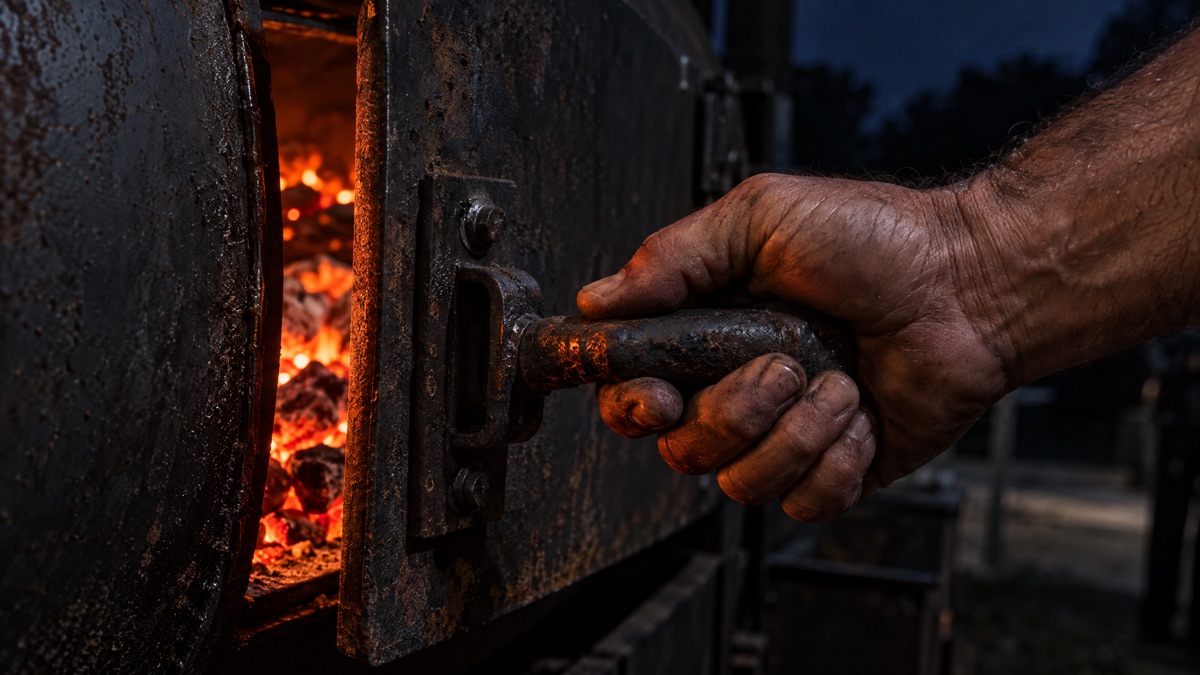
She moves toward the door that leads back into the alley — the same one he came through — and stops an inch from it, turning her head slightly, as though to catch a whisper.
LenaDon’t open it. Not yet.
Henry swallows. His fingers itch toward the latch anyway.
HenryI… uh… I can check?
It comes out more nervous than heroic.
She turns sharply.
LenaNo. Whatever happens next, let me look first.
For the first time since she arrived, her voice has edges — the kind you don’t argue with.
Henry nods and backs away from the door. She lowers her stance a little, shoulders angled, ready for whatever is about to break the quiet.
And then — a soft knock.
One knuckle. Slow. Deliberate.
Henry’s breath catches. The woman’s eyes sharpen in a way that makes him question every quiet assumption he has ever made about his own uneventful life.
LenaStay behind me.
Then she reaches for the handle.
She lets herself in with a twelve-pack and does not wait to be asked.
Read the next chapterHow long to smoke St. Louis ribs at 225?
Five to six hours at 225 to 228 degrees. Smoke them bare for the first two to three hours, until the color deepens and the surface stops looking wet. Once the bark is dry to the touch, spritz every 45 to 60 minutes. Start checking for tenderness at 195 degrees internal. They are done between 195 and 203, when a probe slides between the bones without resistance. Wrapping is optional; at this temperature they finish without it. Rest 20 to 30 minutes before cutting.
| Stage | Pit temperature | Internal | Time |
|---|---|---|---|
| Preheat | 225–228°F | — | — |
| Smoke uncovered | 225–228°F | — | 2–3 hours |
| Spritz on a cycle | 225–228°F | — | every 45–60 min |
| Start probing | 225–228°F | 195°F | — |
| Done | 225–228°F | 195–203°F | probe slides free |
| Rest before cutting | — | — | 20–30 min |
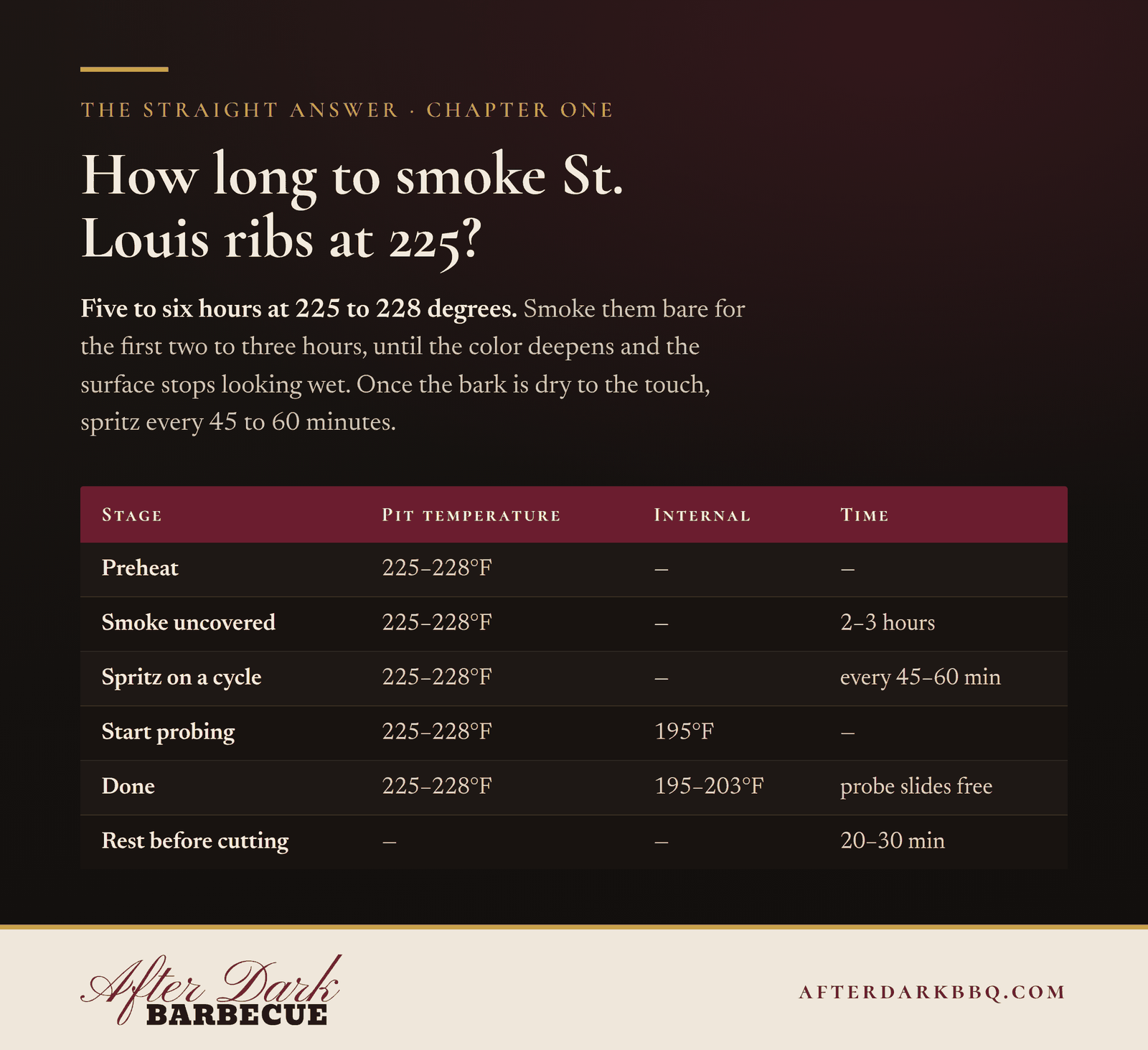
How to read this: The left column is the order you do things in. Pit temperature is what the smoker holds; internal is what the meat reads on a probe. Where a cell says a range, anywhere in that range is fine. The last two stages are decided by feel rather than by the clock — if the probe still drags at 203, give it longer.
The full method, straight: smoked rib technique, which wood to pair with which cut, and the smoking time and temperature chart.
This is the cook from the story above with nothing left on: just the numbers, ready for your own pit.
Sources
The 145°F safe minimum with a three-minute rest for whole cuts of pork is from the USDA Food Safety and Inspection Service Safe Minimum Internal Temperature Chart. The pit temperature, the hours bare before the first spritz and the 195°F tenderness check are After Dark BBQ’s own, measured at the grate and stated as ours rather than dressed up as research. Read October 2026.
Stay a While Longer
The chapters: Chapter Two — Overnight Smoked Brisket · Chapter Three — Overnight Pork Butt · Chapter Four — Smoked Beef Ribs · Chapter Five — Smoked Whole Turkey
Letters to Dutch: How Long to Smoke St. Louis Ribs at 250 · The Night the Brisket Would Not Let Me Sleep · What Temp Are Ribs Done?
The technique pages: How Long to Smoke Ribs · How Much Meat Per Person · the whole technique library
Everything at the After Dark BBQ hub · Who Dutch Cobb is · Write to Dutch
Volume One, complete. Volume Two, a new chapter every Friday.All the chapters · Write to Dutch

Leave a Reply